Picture a hypercar at full speed on a rough road. The wheels are hammering up and down over every bump, yet the body stays almost perfectly level, as if the road had been ironed flat. The driver feels the steering stay calm and the tyres stay glued to the tarmac. Nothing about that is luck. Under each corner of the car sits a suspension system that reads the road a hundred times a second and changes its own stiffness before the bump has finished happening.
That is active suspension, and in a hypercar it is one of the most complicated systems on the whole machine. Sensors watch the wheels, the body, and the steering, a computer decides what each corner should do, and hydraulic or electric actuators push back against the road in real time. Building it means machining parts that survive enormous forces, sealing hydraulics that work at hundreds of bar, and testing the whole system on rigs that shake it harder than any road ever will. Here is how hypercar active suspension is made, step by step.

How Hypercar Active Suspension Is Made
Step 1: Designing the system around the car’s weight
Every active suspension starts with the numbers of one specific car. Engineers map how much weight sits on each wheel, how far the body is allowed to roll in a corner, and how much the nose may dive under braking. The team chooses the layout, usually a double wishbone at each corner. The computer model is then driven around a virtual track thousands of times, tuning how stiff each corner should be in every situation. The braking hardware it works beside is its own feat of engineering, as described in how carbon ceramic brakes are made, where heat and force are managed at the same extreme level.
Step 2: Forging the wishbones and uprights
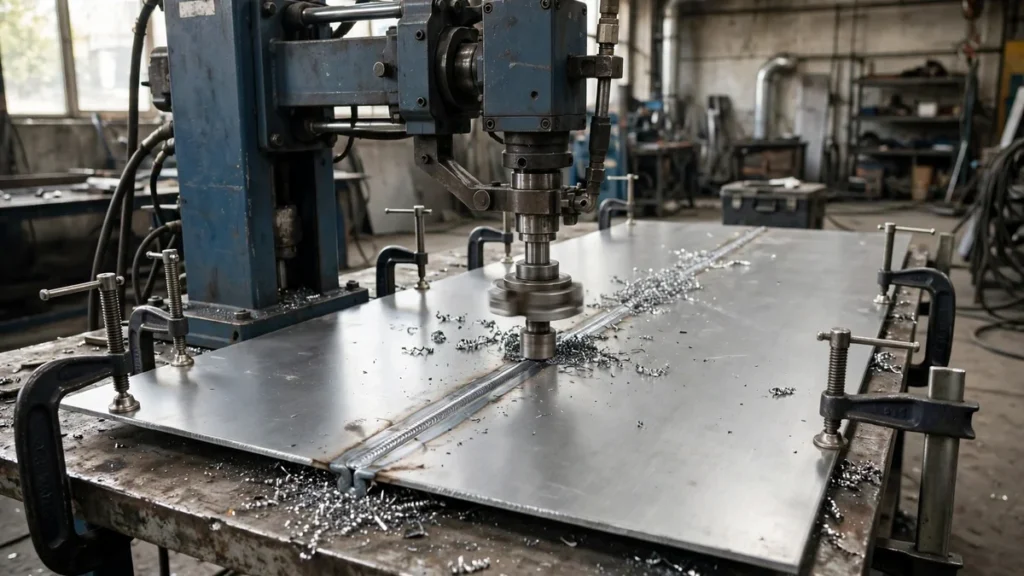
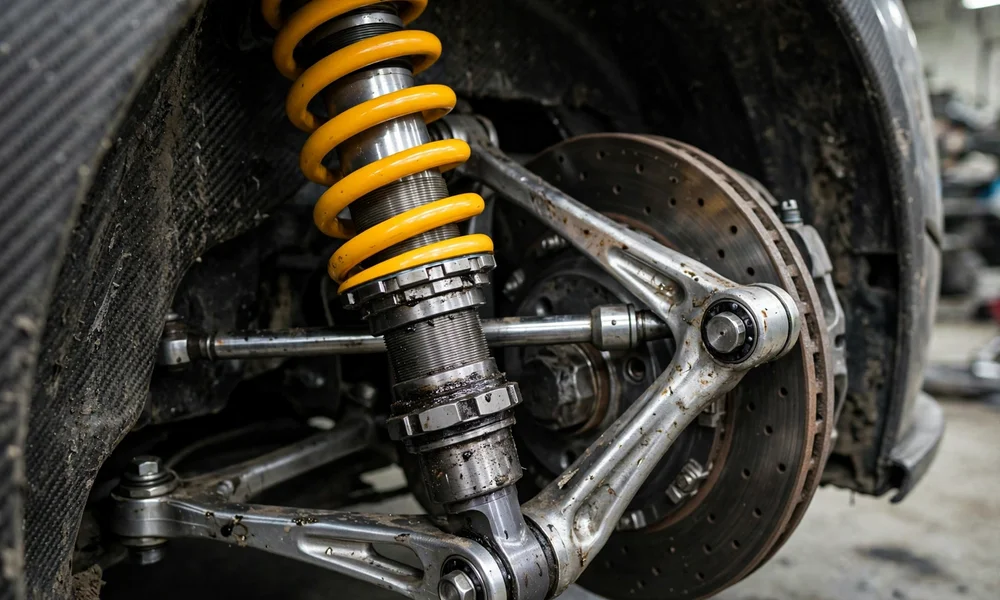
The arms that connect the wheel to the body are forged from aluminium or titanium, then machined to their final shape. Forging lines up the metal’s grain so the arm can take huge loads without bending, and machining cuts the bearing seats and mounting points to a fraction of a millimetre. Each upright, the part the wheel bolts to, is made the same way, and every piece is checked for cracks with dye or ultrasound before it is allowed near a car. Weight is the enemy here, so engineers hollow out anything that does not carry load, and each finished arm is weighed against the design target.
Step 3: Building the dampers and actuators
The damper is the heart of the system. Inside a precision-bored steel or aluminium tube sits a piston with tiny valves, filled with oil. In an active system the valves are controlled by the computer, opening and closing in milliseconds to make the damper soft over a bump and firm in a corner. The parts are machined to tolerances of a few microns, because a damper that leaks oil past its piston cannot hold its settings. The actuator, the part that can actually push the wheel, is either a hydraulic ram fed by a high-pressure pump or an electric motor driving a screw. Both are assembled in clean rooms, filled with oil, and sealed with rings that must survive heat and vibration without weeping a drop.
Step 4: Making the sensors and the control unit
An active system is blind without sensors. Each wheel gets a position sensor that reports how far the suspension has moved, and accelerometers on the body report how the car is pitching and rolling. The steering angle, the brake pressure, and the wheel speed are all read too, and everything feeds into a control unit, a rugged computer that lives in the car and runs the suspension software. The control unit is built with a sealed case, vibration-proof connectors, and chips rated to survive engine-bay heat and winter cold. The gearbox it shares data with is another precision assembly, covered in how a dual clutch gearbox is made, and the two systems must agree on what the car is doing at every instant.
Step 5: Assembling each corner on the bench
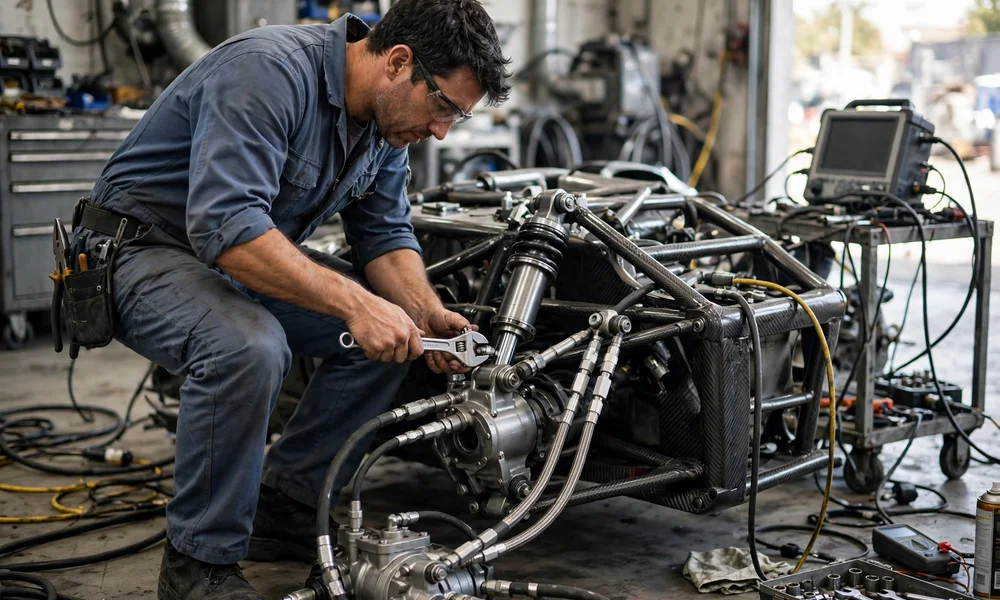
Each corner of the suspension is assembled as a complete unit before it meets the car. The wishbones are fitted with ball joints and bushings, the damper and actuator are bolted to the upright, and the springs are compressed onto their seats with a special press. Hydraulic lines are connected and bled of air, because a single bubble in a line makes the actuator spongy and slow. The sensor wires are routed and clipped so they can flex with the suspension without chafing. The finished corner is then mounted on a test rig that moves the wheel up and down while the computer commands different damper settings, and the force at each setting is measured.
Step 6: Fitting the system and testing the car
The four corners are bolted to the chassis, the hydraulic pump and reservoir are fitted, and the control unit is wired in. The car is then put through its paces, first on a four-post rig that shakes each wheel independently while engineers watch the body stay level, then on a track. Test drivers push the car through fast corners, heavy braking, and rough surfaces, while engineers compare what the sensors recorded with what the car actually did. The software is tuned until the car feels calm at speed and comfortable on the road. The engine that powers all of this is itself a masterpiece, as explained in how a Bugatti W16 engine is made.
Hypercar Active Suspension Specs
| Specification | Typical figure |
|---|---|
| System type | Hydraulic or electric active dampers |
| Sensor updates | Around 100 times per second |
| Hydraulic pressure | Up to around 200 bar |
| Damper response | Within a few milliseconds |
| Materials | Forged aluminium, titanium, steel |
| Control unit | Dedicated suspension computer |
What Hypercar Active Suspension Costs
A complete active suspension system for a hypercar is estimated to cost the maker roughly 20,000 to 50,000 dollars, though the exact figure is an estimate and varies with the actuator type, the materials, and the production volume. That is more than many whole cars cost, and it is one reason the system stays mostly in hypercars and top racing machines. Owners rarely see the bill separately, since it is buried in the price of a car that can cost several million dollars.
A Rare Fact About Hypercar Active Suspension
Here is a detail most people never hear: a hypercar’s active suspension can lift a wheel clean off the ground on purpose. When the computer senses the car is about to bottom out over a crest, or when it needs to keep the body level through a fast corner, it can push one corner down so hard that the opposite wheel unloads completely. The system can also lower the whole car at speed to cut drag, then raise it again for a speed bump, all without the driver touching a button. The suspension is not just reacting to the road, it is deciding what the road should feel like.