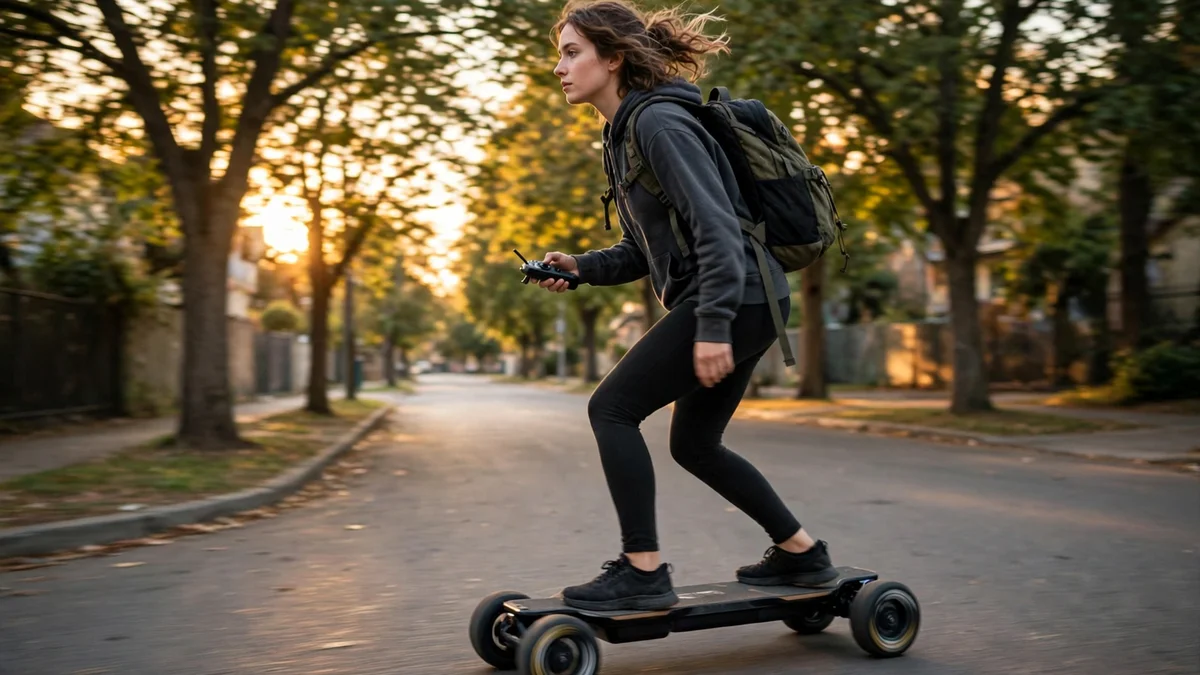
The rider stepped onto the board at the top of the hill, tapped the remote in his hand, and rolled away without pushing once. There was no kick, no wobble, no engine noise, just a smooth, silent glide that picked up speed as the road fell away. An electric skateboard looks like a toy, a plank with four wheels and a battery, but it is a serious piece of engineering. It has to carry a person at speed, over cracks and kerbs, with nothing to hold onto but a wireless remote.
The trick is packing a whole electric vehicle into something thin enough to stand on. The deck hides the battery, the motors live inside the wheels, and a small computer decides how much power to send and when to brake. This is how an electric skateboard is made, from a sheet of maple or carbon to a machine that can climb a hill without a single push.
How an Electric Skateboard Is Made
Making an electric skateboard takes six stages: the deck is pressed, the motors are built into the wheels, the battery is packed into the deck, the controller is wired in, the trucks and wheels are fitted, and the finished board is ridden and tested. Each stage is done by a small team, and the board is checked at every step, because a fault in a machine with no brakes you can grab is not a small problem.
Step 1: Pressing the deck
The deck begins as thin sheets of Canadian maple, bamboo, or carbon fibre, stacked with glue and pressed into shape in a mould. The mould gives the deck its curve, a gentle concave across its width that locks the rider’s feet in place, and a slight kick at each end for turning. The press squeezes the layers together under heat for hours, and when the deck comes out it is already strong enough to carry a rider. It is then cut to shape, sanded smooth, and sealed with a clear coat or a sheet of grip tape on top.
Step 2: Building the motors into the wheels
Most electric skateboards use hub motors, motors built directly inside the rear wheels. Each motor is a ring of copper coils around a set of permanent magnets, sealed inside a wheel made of soft polyurethane. When current flows through the coils, the magnets turn, and the wheel turns with them, with no gears, no chain, and no belt to wear out. An electric scooter motor works on the same brushless principle, but the skateboard version is smaller, flatter, and built to survive being slammed into a kerb.
Step 3: Packing the battery into the deck
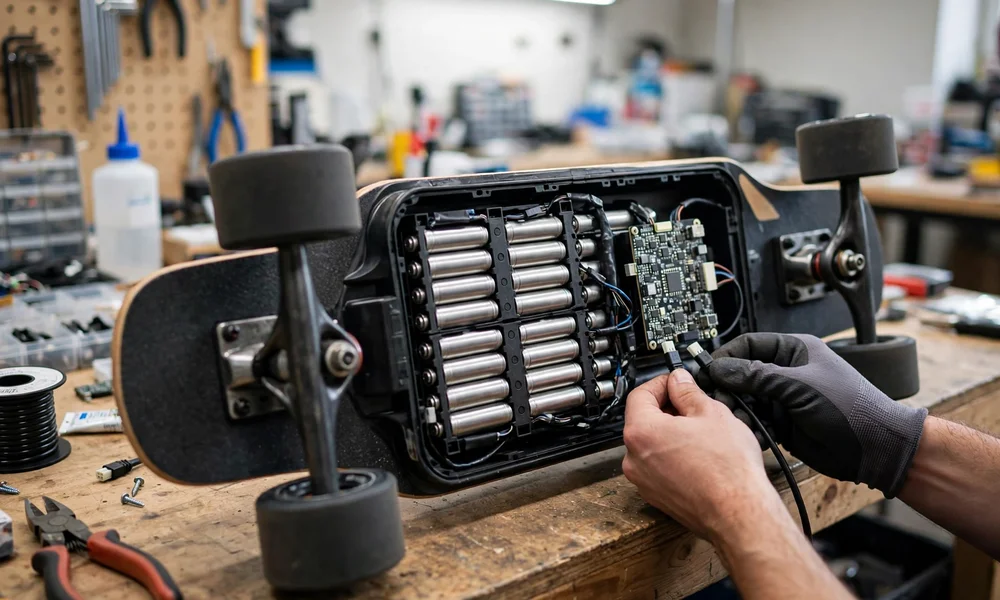
The battery is a pack of lithium-ion cells, usually the same kind used in power tools, welded together and wrapped in a slim case that bolts to the underside of the deck. The cells are arranged flat, so the pack is only a couple of centimetres thick, and a battery management system watches every cell for heat, voltage, and charge. The pack is sealed against rain and fitted with a charging port on the side, and the whole assembly is tested before it is bolted on, because a battery buried under a deck is hard to reach once the board is finished. An electric scooter battery is built to the same rules, but the skateboard pack is thinner and flatter, shaped to disappear under the rider’s feet.
Step 4: Wiring the controller and the remote
The controller is a small box of electronics, usually hidden in the same enclosure as the battery, that turns battery power into motor power. It switches the current thousands of times a second, sending pulses to the motor coils in a timed sequence that makes the wheels turn smoothly. It also talks to the remote in the rider’s hand, a small device with a thumb wheel for speed and a button for braking, connected by a wireless link that is paired to one board only. The controller reads the remote, limits the current so the motors do not overheat on a long hill, and cuts power if the link is lost.
Step 5: Fitting the trucks, wheels, and brakes
The trucks, the metal T-shaped parts that hold the wheels and let the board turn, are cast from aluminium and machined to fit the deck. The front truck carries ordinary wheels, while the rear truck carries the motor wheels, and both are fitted with soft bushings that decide how easily the board leans into a turn. Braking is done by the motors themselves, which reverse into generators when the rider pulls back on the remote, slowing the board and feeding a little power back into the battery.
Step 6: Riding, testing, and the final check
The finished board is ridden before it is boxed. A tester rides it up a hill, down a hill, and over rough ground, checking that the remote responds instantly, the brakes bite smoothly, and nothing rattles loose. The board is then checked on a bench: the wheels are spun to look for wobble, the battery is charged and discharged once, and every bolt is tightened to its setting. An electric scooter frame is tested the same way, and for the same reason: a machine that carries a person at speed has no room for a loose bolt. Only a board that passes every test is cleaned, boxed with its remote and charger, and sent out.
Electric Skateboard Specifications
| Specification | Typical figure |
|---|---|
| Deck material | Maple, bamboo, or carbon fibre |
| Motor type | Dual brushless hub motors |
| Motor power | 500 to 1,500 watts combined |
| Battery | 150 to 400 watt-hours, lithium-ion |
| Top speed | 20 to 30 miles per hour |
| Range | 10 to 25 miles per charge |
| Weight | 7 to 12 kilograms |
What an Electric Skateboard Costs
A good electric skateboard typically sells for an estimated $500 to $1,500, with premium carbon models reaching an estimated $2,000 or more. The battery and motors are the expensive parts, together accounting for more than half of the cost, while the deck and trucks are comparatively cheap. A replacement battery typically costs an estimated $150 to $400, and a set of replacement wheels an estimated $40 to $100, so running costs are low. The cheapest boards cut corners on the battery and the controller, which is why they feel jerky and fade on hills, while the best boards spend the money where the rider feels it: smooth power, strong brakes, and a deck that does not flex in the wrong place.
A Rare Fact About Electric Skateboards
The first electric skateboards were built in garages in the 1970s, with motors bolted to ordinary boards and car batteries strapped underneath, and they were so heavy and so unreliable that almost nobody rode them. The modern board only became possible when small, powerful lithium batteries and brushless motors arrived from the drone and power-tool industries.
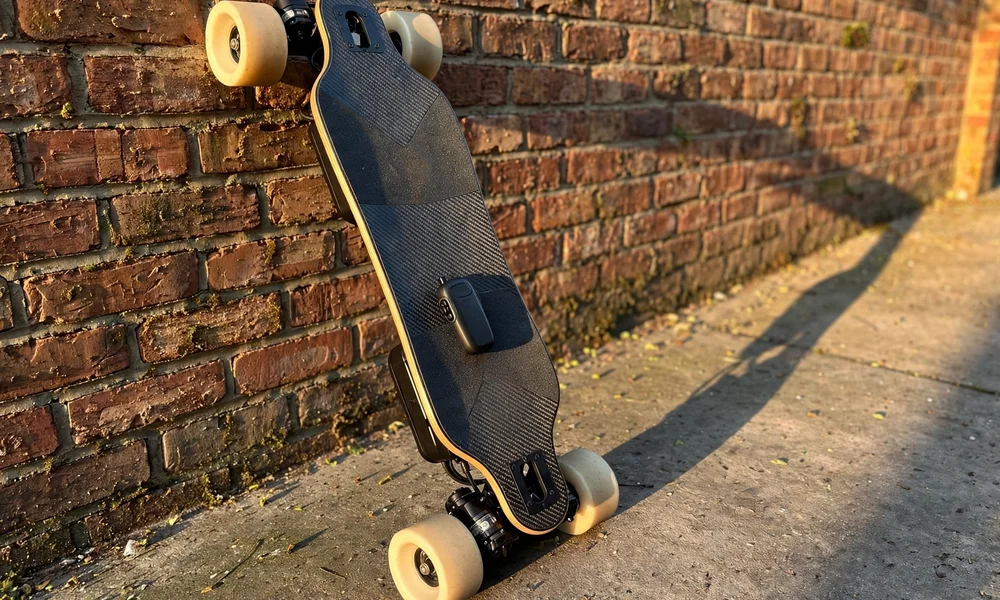
An electric skateboard is a reminder that a vehicle does not need a seat, a steering wheel, or even a handlebar to be a vehicle. It needs a deck that holds together, motors that push smoothly, a battery that lasts the ride home, and brakes that work every time. When those four things are made well, a plank with wheels becomes a way to cross a city, climb a hill, and arrive smiling, without ever pushing once.