An electric supercar does something no ordinary electric car is asked to do. It delivers its full power, not in a brief burst for overtaking, but again and again: full throttle out of a corner, hard braking into the next one, lap after lap, and then a fast charge at hundreds of kilowatts before going out again. The battery is the part that makes that possible, and it is also the part that suffers most. Every amp of current flowing through a cell generates heat, and a battery delivering nearly two thousand horsepower generates a great deal of it.
Cooling an electric supercar battery is therefore not a supporting detail. It is one of the core engineering problems of the car, as important as the motors or the aerodynamics. The solution is a system of cold plates, pumps, radiators, and software that keeps thousands of individual cells inside a narrow temperature window, from a cold morning start to a fast charge on a hot afternoon.
This guide explains how electric supercar battery cooling works, from the heat inside a single cell to the cooling circuits of the whole car.

How Electric Supercar Battery Cooling Works
Electric supercar battery cooling works by moving heat from the cells to the outside air as fast as the cells make it. Heat is generated inside every cell by electrical resistance whenever current flows, and it grows with the square of the current, so doubling the power quadruples the heat. The cooling system gives that heat a short path out: from the cell into a thermally conductive material, into a metal plate carrying coolant, through a pump and a radiator, and finally into the air rushing past the car. Sensors watch cell temperatures continuously, and the car’s software adjusts pump speed and coolant flow to keep the pack in its ideal window, usually around 20 to 35 degrees Celsius.
Step 1: The cells make the heat
A supercar battery holds thousands of cells. The Rimac Nevera, the benchmark for the class, carries 6,960 cylindrical 21700 cells in a 120 kilowatt-hour pack, delivering up to 1,914 horsepower through four motors. Each cell has a small internal resistance, and when the car draws hundreds of amps, that resistance turns a fraction of the energy into heat inside the cell itself. Discharging makes heat, fast charging makes more, and the cells in the middle of the pack make the most, because they are furthest from any cooling surface. The cooling system exists to stop that temperature spread from ever forming.
Step 2: Cold plates carry the heat away
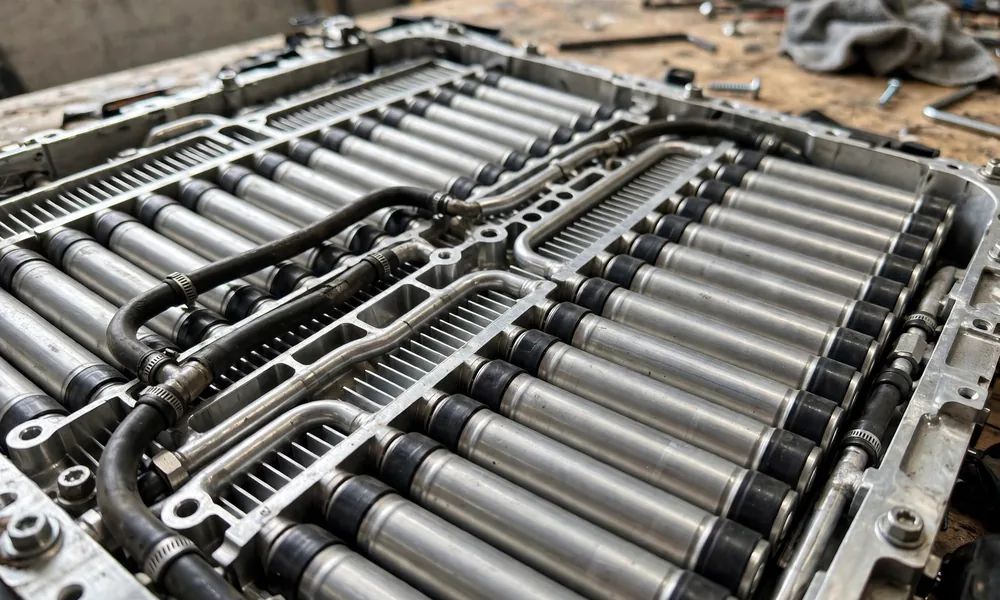
The workhorse of supercar battery cooling is the liquid cold plate, a metal plate with internal channels through which a water-glycol coolant circulates. In most electric cars a single cold plate sits under the modules, drawing heat from the bottom of the cells. The Nevera goes further: its cooling plates sandwich the cells, contacting them from both the top and the bottom, which is why its cells are unusually elongated. Cooling from both ends halves the distance heat must travel inside the cell and keeps the temperature far more even across the pack.
Step 3: Pumps and radiators move the heat out
Coolant leaving the pack carries the heat to radiators at the front of the car, where airflow dumps it into the atmosphere. The Nevera circulates coolant through the battery at around 60 litres a minute, driven by electric pumps whose speed the car adjusts constantly. At low speed, when there is little airflow, the pumps and fans work hardest; at high speed, the ram air does much of the work for free. The car carries five cooling systems and two refrigerant circuits in total, because the battery, the motors, the power electronics, and the cabin all want different temperatures at different times. Separating them lets the battery stay cool while the motors run hotter.
Step 4: Immersion cooling takes the direct route
There is a more radical alternative to cold plates: immersion cooling, where the cells sit in direct contact with a dielectric fluid that does not conduct electricity. Heat passes straight from the cell surface into the fluid, with no plate and no interface material in the way, which gives very even temperatures and very high heat transfer. Rimac used immersion cooling in earlier battery packs, including the one it built for the Koenigsegg Regera, but chose water-glycol cold plates for the Nevera, citing weight and packaging. Immersion fluid is heavy, it needs seals that survive years of vibration and temperature cycling, and servicing a pack full of fluid is far harder than servicing a dry one.
Step 5: Software decides when to cool
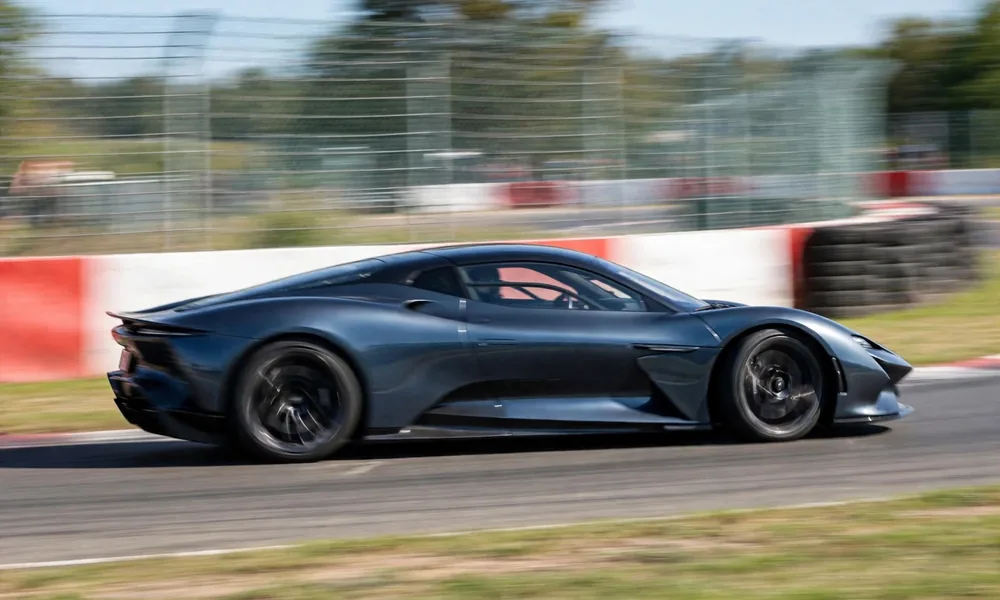
The hardware is only half the system. The car’s thermal management software predicts heat before it arrives: it knows the route, the driving mode, and the state of charge, and it pre-cools the pack before a fast charge or a track session, so the cells start at the bottom of their window with maximum headroom. During driving it balances the cooling between the battery, the motors, and the brakes. A cold battery cannot deliver full power or accept a fast charge, so on a cold morning the car warms the pack with a heater in the coolant loop before it allows full performance. The driver feels none of this directly. They feel a car that delivers the same acceleration on the tenth lap as on the first,
Step 6: Fast charging is a cooling problem too
The hardest thermal test a supercar battery faces is not a lap but a charge. The Nevera can accept up to 500 kilowatts of DC charging, which pours energy into the pack far faster than any driving does, and every kilowatt that becomes heat has to be removed while the car is standing still with no airflow. The cooling system runs at full capacity during a fast charge, and the car throttles the charge rate as the cells warm, trading a few minutes of charging time for the long-term health of the pack. That is why the charging curve falls away from its peak so quickly: the limit is not the charger, it is the temperature of the cells.
Why Cooling Decides Performance
Two electric supercars can have the same battery capacity and the same headline power, and the one with the better cooling will be faster in the real world. Peak power is easy; sustained power is hard, and it is the cooling system that decides how long the peak lasts. A car that can only deliver full power for one lap before derating is a demonstration, not a supercar. The best systems are invisible to the driver and obsessive about the details: cooling both ends of every cell, keeping the temperature spread across the pack to a few degrees, and using software to stay ahead of the heat.
That is the lesson of electric supercar cooling in one sentence: the battery is not limited by how much energy it holds, but by how fast it can shed the heat that energy makes. Solve the heat, and the power follows.
For the wider picture, see how EV battery cooling works in ordinary electric cars, how the Rimac Nevera battery works as a complete pack, and how a hypercar cooling system works across the whole car. The battery is where the power lives; the cooling system is what lets the car use it.


