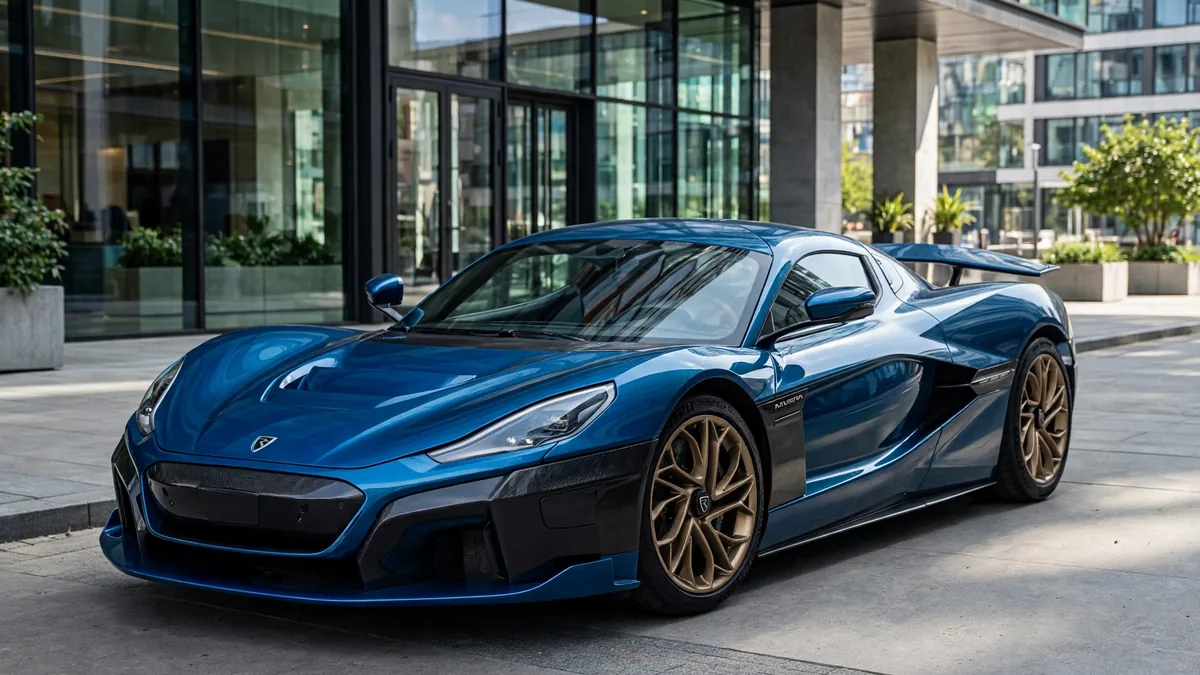
The Rimac Nevera does not have an engine. When it launched, it reset what people thought an electric car could do: 0 to 100 kilometres per hour in under two seconds and a top speed over 400. The secret is not just the size of the battery. It is the way the battery was designed, cooled, and woven into the structure of the car itself.
Rimac started as a one-man garage project in Croatia, built by Mate Rimac after he blew up the engine of his old BMW and decided to replace it with an electric motor. Two decades later, that stubborn idea had become a company that supplies electric technology to Porsche, Hyundai, and Bugatti. The Nevera is its proof: a car with no petrol at all, yet with more power than almost any combustion hypercar ever made. The battery is the heart of it, and it is unlike any battery in any other road car.
Most electric cars treat the battery as a heavy box bolted underneath the floor. The Nevera treats it as part of the car’s skeleton, shaped like a letter H and built into the carbon-fibre monocoque. That choice changes everything about how the car drives, charges, and survives a crash. Here is how it works.
How It Works
Step 1: Packing 120 kilowatt-hours into an H shape
The Nevera’s battery holds 120 kilowatt-hours of energy, stored in 6,960 individual cylindrical cells arranged in a distinctive H-shaped pack. The long spine of the H runs down the centre of the car, between the seats, while the crossbar sits behind the cabin, where a petrol engine would normally live. This shape keeps the heaviest part of the car low and centred, which is exactly where a hypercar wants its weight. The cells are grouped into modules, and each module is sealed against water and damage, so a failure in one cell cannot easily spread to its neighbours.
Step 2: Making the battery part of the structure
Unusually, the battery pack is a structural part of the Nevera. It is bonded into the carbon-fibre monocoque and helps carry the loads of the chassis, which means the car is stiffer and lighter than it would be if the battery were simply bolted underneath. The battery casing is designed to protect the cells in a crash while also stiffening the spine of the car. That integration is one reason the Nevera can be both a 2,300-kilogram car and one of the stiffest chassis in production.
Step 3: Cooling every cell with liquid
A battery this powerful generates enormous heat when it is working hard, so the Nevera circulates liquid coolant through channels woven between the cell modules. The system can pull heat away during flat-out acceleration and also warm the battery before a fast-charging session. The cooling loops are connected to radiators at the front of the car, and the software constantly adjusts flow to keep every module within a narrow temperature window. Without this cooling, the car could not deliver its full 1,914 horsepower more than once or twice before the battery had to protect itself.
Step 4: Feeding four motors independently
The battery sends its energy to four separate electric motors, one for each wheel, and each motor can be controlled independently many times per second. This is the Nevera’s greatest trick: because there is no mechanical connection between the wheels, the car can send power to one wheel and take it away from another, steering the car with torque as much as with the steering wheel. The system reads the road, the steering angle, and the driver’s inputs hundreds of times per second and adjusts each wheel’s power accordingly. The same principles of independent electric drive appear in smaller form in how an EV battery pack works, where one pack feeds everything the car needs.
Step 5: Charging at up to 500 kilowatts
When the battery runs low, the Nevera can accept direct-current fast charging at up to 500 kilowatts, far faster than most electric cars on the road. At that rate the pack can go from empty to about 80 percent in roughly 20 minutes on a suitable charger. The charging system is managed by the same battery software that handles cooling and power delivery, and it slows the charge rate as the pack fills to protect the cells. Rimac designed the battery to handle repeated fast charging without rapid degradation, which matters because a hypercar battery that wears out quickly would be ruinously expensive to replace.
Step 6: Protecting the pack with software that never sleeps
Finally, a battery management system watches every one of the 6,960 cells, measuring voltage and temperature and balancing charge between them so that no cell is overworked. If a single cell starts to behave strangely, the system can isolate its module and keep the car running on the rest of the pack. The software also learns how the car is being driven and adjusts its limits accordingly, giving full power on a circuit and saving energy on a motorway. It is this constant, invisible supervision that lets the Nevera be both the fastest accelerating production car in the world and a car that can be driven every day. The scale of the engineering is comparable to the systems described in EV battery pack specs explained, and the cooling challenge is the same one explored in how EV battery cooling works.

Rimac Nevera Battery Specs
| Specification | Typical range |
|---|---|
| Battery capacity | 120 kilowatt-hours, lithium-ion |
| Number of cells | 6,960 cylindrical cells |
| Pack layout | H-shaped, structural, inside the carbon monocoque |
| Total power | About 1,914 horsepower from four motors |
| Maximum torque | About 2,360 newton-metres |
| Fast charging | Up to 500 kilowatts, 0 to 80 percent in about 20 minutes |
| Driving range | About 490 kilometres on the WLTP cycle |
| 0 to 100 km/h | About 1.8 seconds |
| Top speed | About 412 kilometres per hour |
What Does a Nevera Cost?
The Rimac Nevera was estimated to cost around €2 million, roughly $2.2 million, before options and taxes, with only 150 cars planned. Prices are estimates only, and the car’s rarity and record-breaking performance have kept values high. It is an extraordinary amount of money for a car from a company that barely existed twenty years ago, but it buys the fastest accelerating production car ever made, and a battery that no other manufacturer has matched.
A Rare Fact
In 2023 the Nevera set 23 performance records in a single day at a test track in Germany, including the fastest 0 to 400 kilometres per hour and back to zero, and the quickest quarter-mile time for a production car. What makes that remarkable is that all 23 records were set by the same car, on the same day, with no mechanical changes between runs — the battery and its cooling system simply kept delivering full power again and again. Most record cars need rest between attempts; the Nevera just kept going.

The Nevera’s battery is not just a fuel tank. It is the chassis, the cooling system, and the brain of the car all at once, and it is the reason a small Croatian company now builds the fastest accelerating car on the planet. When the history of the electric hypercar is written, it will start with this battery.


