A hypercar engine can make more than a thousand horsepower, and most of that power never reaches the wheels. It turns into heat, a furnace burning inside a body shaped like a teardrop, with almost no room for the radiators and pipes that must carry that heat away.
So a hypercar cooling system is not one radiator and a fan. It is a whole network of radiators, oil coolers, intercoolers, pumps, and ducts, each one fed by air that the bodywork has been sculpted to catch, and each one sized for a different job. The air that enters the nose is split, guided, and spat out again, and every litre of it is spent twice, first cooling one thing and then another. Here is how a hypercar cooling system works, step by step.

How a Hypercar Cooling System Works
Step 1: The nose catches the air
Everything starts at the front of the car, where the nose is shaped to swallow air rather than push it aside. Large intakes in the bumper and bonnet feed separate ducts, and each duct has one job: one for the engine radiators, one for the brakes, one for the oil coolers. The shape of the openings matters as much as their size, because air arriving at 200 miles per hour is a battering ram, and a badly shaped intake turns it into turbulence that cools nothing. The engine that makes all this heat in the first place is a marvel of its own, described in how a hypercar V12 engine works.
Step 2: The radiators trade heat for air
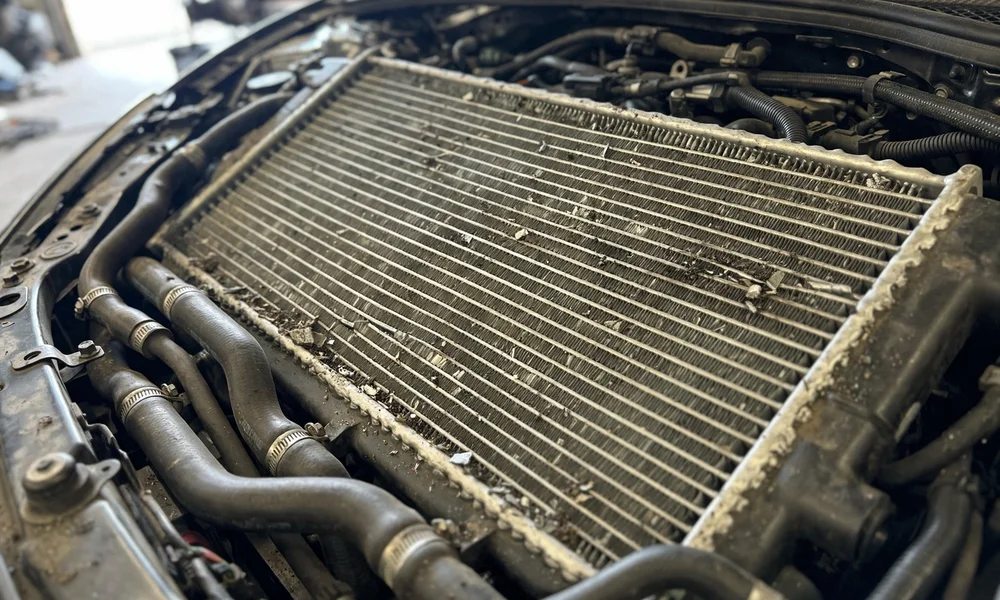
Behind the intakes sit the radiators, thin aluminium panels packed with fine fins, and hot coolant from the engine flows through them in narrow tubes. As air rushes through the fins, it picks up the heat and carries it away, and the cooled liquid returns to the engine to do it all again. A hypercar usually carries two or three main radiators rather than one big one, placed low and wide so the nose can stay low and the weight can sit close to the ground.
Step 3: The intercoolers chill the intake air
Turbocharged hypercars have a second cooling job that matters just as much. A turbo squeezes the air going into the engine, and squeezing air makes it hot, and hot air holds less oxygen, so the engine makes less power. Intercoolers sit between the turbos and the engine, chilling that compressed air back down before it is burned. Many hypercars use air-to-water intercoolers, small and dense, fed by their own low-temperature radiators, because they cool faster than air-to-air units when the car accelerates hard.
Step 4: The oil and gearbox get their own coolers
The engine is not the only thing that gets hot. Engine oil thins as it heats, and thin oil cannot protect bearings spinning at eight thousand revolutions a minute, so a dedicated oil cooler keeps it in a narrow band of temperature. The gearbox has its own cooler too, because a dual-clutch gearbox shifting in milliseconds generates serious heat in its clutches, and the differential that splits power between the wheels needs cooling as well. Each of these circuits has its own small radiator, its own pump, and its own thermostat, and they all share the same air that the nose caught. The gearbox itself is covered in how a hypercar gearbox works, where those clutches and their cooling needs are explained in full.
Step 5: The pumps and thermostats direct the flow
Coolant does not move by itself. Electric water pumps, some spinning at speeds a normal car pump never reaches, push litres of coolant through the engine block every minute, and thermostats act as traffic police, deciding how much coolant goes to the radiators and how much loops back to the engine. When the engine is cold, the thermostat keeps the coolant circulating inside the block so it warms up fast. When it is hot, everything goes to the radiators.
Step 6: The hybrid battery needs cooling too
Most modern hypercars carry a hybrid battery, and batteries hate heat even more than engines do. A battery that gets too hot loses power, ages fast, and in the worst case becomes a safety risk, so it gets its own liquid cooling circuit, often chilled by the air conditioning system. Cold plates sit against the battery cells, drawing heat away cell by cell, and the coolant in that loop is kept far cooler than the engine’s coolant. The same thermal thinking applies to electric cars, where the battery is the whole powertrain, as explained in how EV thermal management works. Balancing the battery’s temperature against the engine’s is one of the hardest jobs the car’s computer has to do.
Step 7: The hot air is spat out cleanly
Cooling is only half the job, because the hot air has to leave the car without ruining the aerodynamics. Bonnet vents, side exits, and rear outlets let the heated air escape, and designers place them where the escaping air helps rather than hurts, sometimes even adding downforce as it leaves. At low speed, electric fans pull air through the radiators when the car is crawling in traffic or sitting on a starting grid. At high speed, the fans switch off and the rush of air does the work. If an outlet is blocked by debris or a badly fitted panel, temperatures climb within seconds, which is why pit crews check every vent before a car goes out.
Hypercar Cooling System Specs
| Specification | Typical figure |
|---|---|
| Main radiators | Two or three, aluminium, finned |
| Coolant capacity | Roughly 20 to 30 litres across all circuits |
| Engine coolant temperature | Around 90 to 110 degrees Celsius |
| Oil temperature | Around 100 to 130 degrees Celsius |
| Intercooler type | Usually air-to-water on turbocharged cars |
| Battery cooling | Liquid cold plates, often air-con chilled |
| Cooling fans | Electric, used mainly at low speed |
What a Hypercar Cooling System Costs
The cooling system on a hypercar is estimated to cost the maker roughly 30,000 to 80,000 dollars in parts alone, though the exact figure is an estimate and varies with the number of circuits, the materials, and how much of the ducting is carbon fibre. That sounds enormous next to a normal car’s cooling system, but a hypercar’s radiators are bespoke, its pumps are racing parts, and its ducting is shaped by hundreds of hours in a wind tunnel. Replacing a single damaged radiator after a stone strike can cost several thousand dollars on its own.
A Rare Fact About the Hypercar Cooling System
Here is a detail most drivers never hear: at full speed, a hypercar can push more air through its radiators every second than the engine breathes in to burn fuel, and some of that cooling air is deliberately sent through the rear diffuser. The hot air leaving the engine bay is fed under the car, where it speeds up the airflow beneath the floor and helps suck the car onto the road. In other words, the waste heat of the engine is recycled into downforce, and the cooling system becomes part of the aerodynamics. It is one of the neatest tricks in hypercar design, and it only works because the cooling and the bodywork were designed together from the very first sketch.