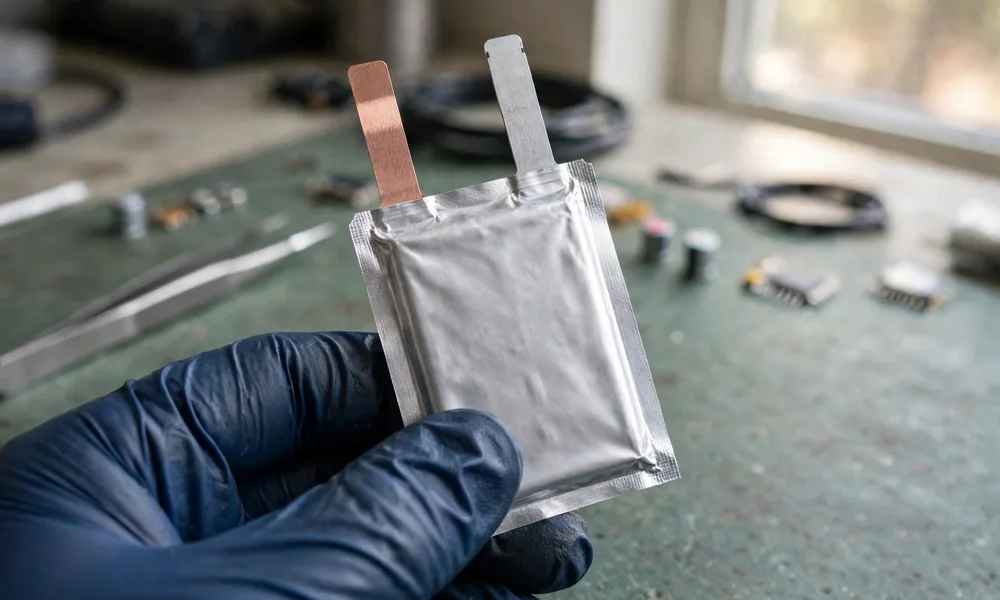
Hold a single electric car battery cell in your hand and it feels like nothing much: a metal can about the size of a chunky marker pen, or a flat silver pouch no thicker than a paperback book. It weighs less than a bag of sugar. Yet this quiet little object is where every kilometre of an electric car begins. It stores energy, releases it on demand, and does so thousands of times over a decade of driving.
Open one up, and the modesty disappears. Inside that plain casing is a stack of impossibly thin layers, each one doing a precise chemical job. A mistake measured in microns can ruin a cell. The cell is the smallest unit of the electric car, and its most demanding piece of engineering.

How an EV Battery Cell Works
A lithium-ion cell works by shuttling tiny charged particles, lithium ions, back and forth between two electrodes through a liquid or gel called the electrolyte. When the car charges, the ions are pushed to one side and stored there; when the car drives, they drift back, and the electrons forced to travel the long way around the outside circuit become the current that turns the motor. Nothing burns, nothing spins. The whole trick is keeping that shuttle running cleanly, thousands of times, inside a sealed can.
Step 1: The cathode stores the lithium
The cathode is the positive electrode, a thin sheet of aluminium foil coated with a metal oxide, usually a mix of nickel, manganese and cobalt, or iron phosphate in cheaper cells. Its crystal structure is full of tiny gaps where lithium ions can sit, like books on shelves. When the cell is charged, the ions are pulled out of these gaps; when it discharges, they slide back in. The chemistry of this coating sets the cell’s voltage and much of its cost. The specifications of an EV battery cell start here, with a cathode that must hold lithium, release it cleanly, and survive the cycle for years.
Step 2: The anode takes the ions in
The anode is the negative electrode, a sheet of copper foil coated with graphite, a soft form of carbon made of stacked layers. Lithium ions slip between those graphite layers during charging and wait there, packed in like pages in a book. Graphite is chosen because it accepts ions without swelling much or falling apart, and it does so cheaply. Some newer cells mix in silicon to hold more lithium, but silicon swells as it fills, so the blend must be tuned carefully or the anode cracks.
Step 3: The separator keeps the electrodes apart
Between the cathode and the anode sits the separator, a plastic film only about twenty microns thick, thinner than a human hair, full of microscopic pores. It lets lithium ions pass but blocks electrons, and it stops the two electrodes touching, which would short the cell and set it on fire. If the cell overheats, the separator’s pores melt shut and the flow of ions stops, shutting the cell down before it can run away.
Step 4: The electrolyte carries the ions
The electrolyte is the liquid the ions swim in, a mix of solvents and a lithium salt, soaked into the separator and the pores of both electrodes. It must conduct ions well, resist breaking down at high voltage, and stay stable from freezing mornings to hot summer charging. It also ages: over time it reacts slowly with the electrodes, forming thin films that consume a little lithium on every cycle, which is one reason a battery gradually holds less charge.

Step 5: Charging pushes the ions across
When the car plugs in, the charger pushes current into the cell, and the ions are forced out of the cathode, through the separator, and into the graphite anode. The cell’s voltage rises as it fills, from about three volts empty to about four and a fifth volts full. The battery management system watches that voltage closely, because pushing past it damages the cathode and the electrolyte. Fast charging pushes the ions harder, which is why a cold or nearly full cell is charged more gently: the ions cannot move fast enough, and forcing them leaves lithium metal plating on the anode instead.
Step 6: Discharging hands the power to the motor
Driving reverses the flow. The ions drift back from the anode to the cathode, and the electrons, which cannot pass through the separator, are forced around the outside circuit and into the motor. That stream of electrons is the current. One cell alone makes only about four volts, far too little for a car, so hundreds or thousands of cells are wired together into modules and then into a pack. The EV battery pack is where those cells are grouped, cooled and managed as one big battery.
Step 7: The casing seals and protects it all
The whole stack is sealed inside a steel or aluminium can, or a laminated foil pouch, closed against air and moisture, which would poison the chemistry. A vent lets gas escape safely if a cell ever fails, and a small device breaks the circuit if the pressure rises. The finished cell is tested and graded: only cells that match each other closely go into the same pack, because a pack is only as good as its weakest cell. The cooling system of an EV battery then keeps those matched cells at the temperature where they work best.
| Specification | Typical value |
|---|---|
| Cell voltage | About 3.0 to 4.2 volts, 3.7 volts nominal |
| Cell capacity | About 2 to 6 amp-hours for a cylindrical cell |
| Energy density | About 250 to 300 watt-hours per kilogram |
| Cell weight | About 45 to 70 grams for a 2170 cylindrical cell |
| Charge cycles | About 1,000 to 2,000 full cycles before noticeable fade |
| Operating temperature | Roughly minus 20 to 45 degrees Celsius |
Price is hard to pin to a single cell, because cells are sold by the kilowatt-hour. Industry estimates put lithium-ion cells at roughly 70 to 100 US dollars per kilowatt-hour at the time of writing, so the cells inside a 75 kilowatt-hour car hold about 5,250 to 7,500 dollars of value before the pack and cooling are added. A single replacement cell costs only a few dollars on its own, but it is never sold alone: it must match its pack-mates exactly. Those are estimates (estimate), not shop prices, and the figure has fallen by more than ninety percent since the first modern electric cars.
A rare fact: a battery cell is assembled in a room drier than a desert. The factories that build cells hold their dry rooms at a dew point of minus 40 degrees Celsius or lower, because even a trace of moisture reacts with the electrolyte to form acid, which eats the cell from the inside. Workers enter through airlocks. The cell that powers a car through rain and snow is born in air with almost no water in it at all.
The EV battery cell works because four humble layers, a cathode, an anode, a separator and a liquid, pass lithium back and forth without complaint, thousands of times, in a space smaller than your hand. It is chemistry doing the work of an engine, silently and without moving parts. When it works well, the driver never thinks about it, which is exactly the point.


