Three people sit shoulder to shoulder inside a metal ball barely wider than a small car, and outside the thick round window there is nothing but black water. No engine roar, no wind, no sky — only the slow drift downward and the soft hum of the life-support fans. That ball is the research submersible sphere, and it is the reason scientists can visit places no diver can reach.
How a Research Submersible Sphere Works
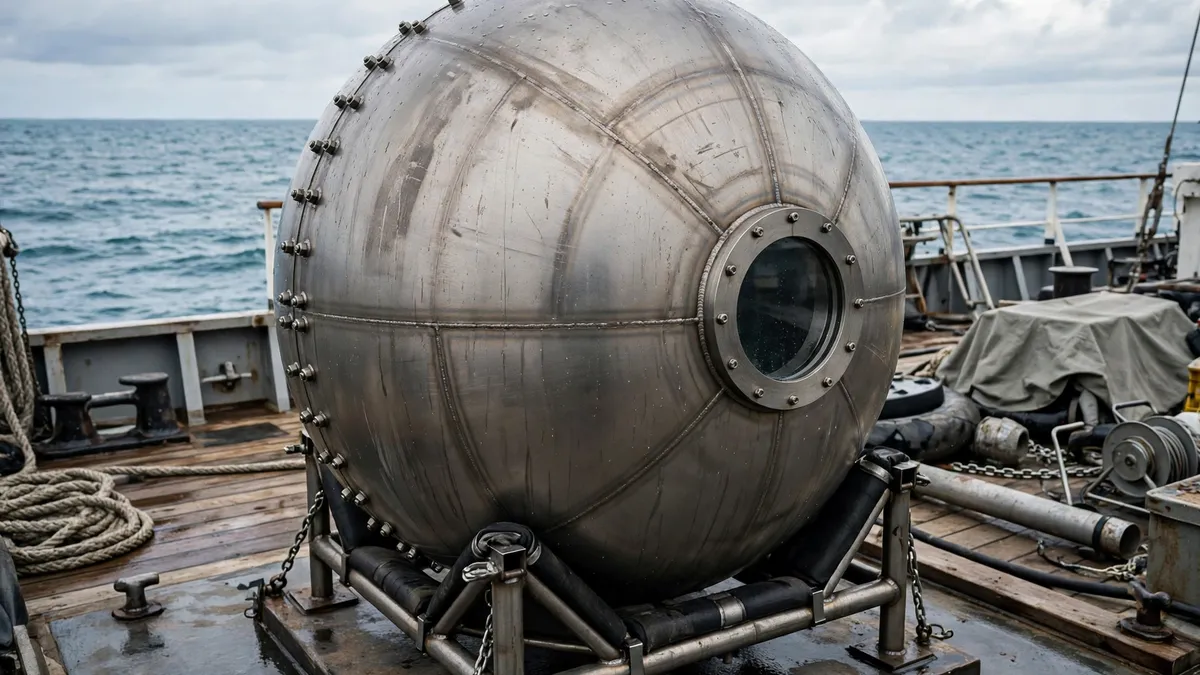
A research submersible sphere works because a sphere is the strongest possible shape for a pressure vessel. Water presses on it from every direction at once, and the round shape spreads that force evenly across the whole shell, so no single point carries more than its share. There are no corners to concentrate stress and no flat panels to bend. Inside, the sphere holds three people, their instruments and their air at normal surface pressure, while outside the water may press in with hundreds of times that force.
Step 1: Two halves are forged and machined
The sphere begins as two hollow hemispheres, usually forged from titanium or a high-strength steel alloy and then machined on giant lathes until the wall thickness is even to within a fraction of a millimetre. Evenness matters more than thickness alone: a thin spot in the shell becomes the place where the sphere starts to fail, so machinists measure the wall again and again as they cut. The two halves must match perfectly, because any gap at the joint would concentrate stress where the sphere is most vulnerable.
Step 2: The halves are joined around the equator
The two hemispheres are welded or bolted together around the equator, the widest circle of the ball. Welding is done slowly, in a controlled atmosphere, and the joint is then inspected with ultrasound and X-rays from every angle. Some spheres are bolted instead, with a ring of heavy bolts clamping the halves against a precision-machined seal, which has the advantage that the sphere can be opened for maintenance. Either way, the joint must be as strong as the shell around it. The deep-sea submersible that carries this sphere depends on the joint completely:

Step 3: Viewports and penetrations are fitted
Next come the holes: the round viewports, the hatch, and the small penetrations for cables, lights and sensors. The viewports are the most delicate part of the whole sphere. Each one is a thick disc of acrylic or glass, shaped like a cone so that water pressure pushes it tighter into its seat the deeper the sphere goes. The hatch is a heavy round door that seals from the inside, so the pressure outside helps to hold it shut. Every penetration is fitted with a metal collar and a seal rated for the full diving depth
Step 4: The sphere is pressure-tested empty
Before anyone climbs inside, the finished sphere is lowered into a pressure chamber or a deep test tank and taken down in stages to pressures beyond its rated diving depth. Sensors glued to the shell listen for the tiny sounds of metal yielding, and strain gauges measure how much the sphere shrinks under load. A sphere under pressure does shrink — by millimetres — and then springs back when the pressure is released. That flexing is normal, and the test proves the sphere can do it again and again without cracking. The pressure hull of a submarine is tested in much the same way
Step 5: Life support and instruments move in
With the shell proven, the inside is fitted out. The sphere carries oxygen tanks, carbon dioxide scrubbers that clean the air the crew breathes out, and a small battery pack for the instruments and lights. The pilot’s controls are simple: a joystick for the thrusters, switches for the lights and cameras, and a manipulator arm for picking up samples from the seabed. Everything is packed tight, because the sphere is small, and every kilogram must be balanced by buoyancy foam or weights outside.

Step 6: The sphere is mounted in its frame
The sphere does not dive alone. It sits in an open frame with thrusters, batteries, lights, cameras and big blocks of syntactic foam — tiny glass bubbles set in resin — that make the whole vehicle almost neutrally buoyant. The frame carries everything the sphere cannot: the propulsion, the power, the sample baskets and the lights that turn black water into a work site. The sphere is bolted into the middle of the frame on shock mounts, so a bump on the seabed or a knock during launch does not reach the crew. The ballast tanks of a submarine do a similar job on a larger scale
Step 7: The dive, the work, and the return
On a dive day the submersible is lifted over the side by a crane and lowered into the water, and the crew seal the hatch from inside. The pilot drops weights and the vehicle sinks, while the support ship follows from above with sonar. At the bottom the pilot switches on the lights and gets to work — filming, sampling, measuring — while the sphere’s air is scrubbed and the oxygen topped up. When the work is done, weights are released and the submersible floats back up, to be recovered by the crane and lifted onto the deck.
| Specification | Typical value |
|---|---|
| Shape | Sphere, two hemispheres joined at the equator |
| Material | Titanium or high-strength steel alloy |
| Diameter | About 2 metres for a three-person sphere |
| Crew | Usually 2 to 3 people |
| Viewports | Conical acrylic discs, pressure-seated |
| Depth rating | From 1,000 metres to full ocean depth, by design |
| Life support | Oxygen tanks and carbon dioxide scrubbers |
A research submersible sphere is not sold off the shelf, so its price is always an estimate. Estimates put a complete small research submersible, sphere included, at roughly 2 to 10 million US dollars, depending on depth rating, instruments and the support ship it needs. The sphere itself is a large share of that cost, because the forging, machining and testing are so specialised. Those are estimates, not list prices. The money is justified by access: the sphere takes scientists to places no other vehicle can reach.
A rare fact: the deepest-diving research spheres are rated for the full depth of the ocean — nearly 11,000 metres — where the pressure is more than a thousand times the air pressure at sea level. At that depth the sphere shrinks measurably under the load and then springs back on the way up, and the crew can hear the hull ticking as it flexes. The shape has barely changed since the first full-depth dives, because the sphere was right the first time.
The research submersible sphere works because it is the most honest piece of engineering in the ocean: a round shell, evenly loaded, with nothing to hide and nowhere to hide it. It carries people into black water and brings them home again, dive after dive, and it does so with a shape that a child could draw. The simplicity is the point. In the deep, the simplest shape is the strongest one.


