An electric car has no gearbox in the old sense, no driveshaft running down the middle, and no exhaust. What it has, tucked between the rear wheels, is a single compact unit that does the work of three separate systems at once: the motor that makes the power, the gearbox that tames it, and the axle that delivers it to the wheels. Making one means building a high-speed electric motor, precision gears and power electronics into a package that must be quiet, efficient and strong enough to survive a decade of potholes.
An EV electric axle combines an electric motor, a reduction gearbox and a differential in one housing, mounted directly on the axle line. The motor spins at very high speed, the gears reduce that speed and multiply the torque, and the differential lets the two wheels turn at different speeds in a corner. The whole unit is sealed, oil-cooled and controlled by software. This is how an EV electric axle is made.
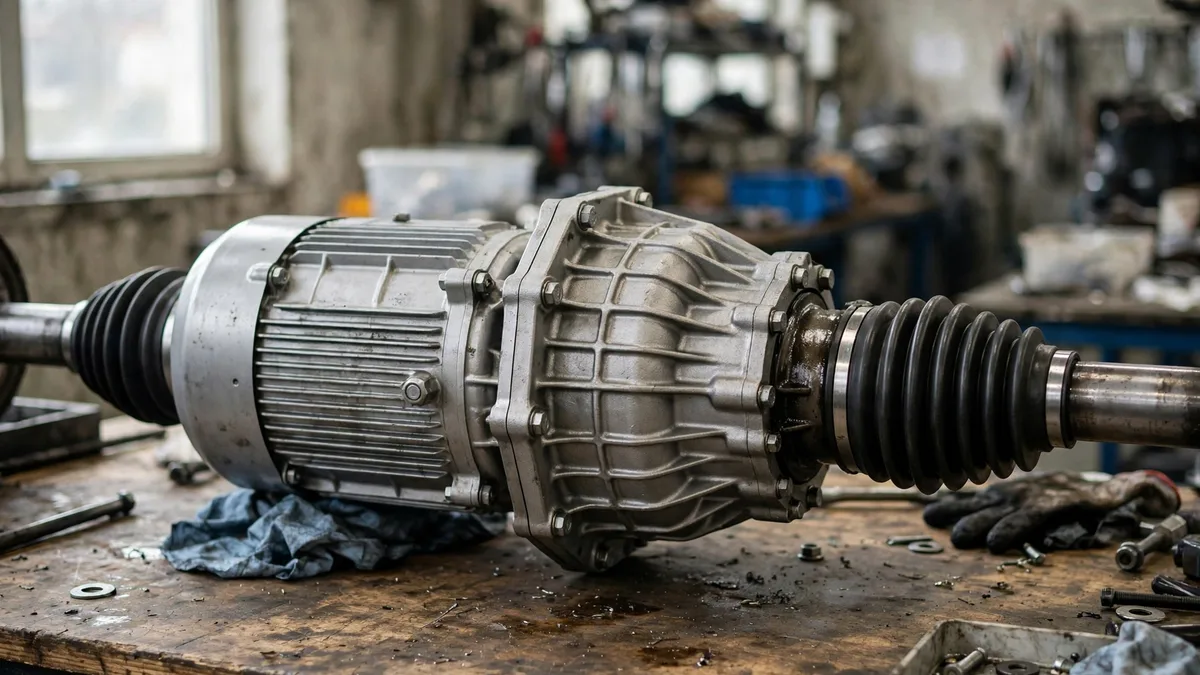
How It’s Made
Step 1: Casting the housing
The housing is the skeleton of the e-axle, and it starts as molten aluminium poured into a mould. Aluminium is chosen because it is light, strong, and good at shedding heat, and the housing must do all three jobs at once: hold the motor and gears in exact alignment, carry the loads from the wheels and the suspension, and act as a heat sink for the electronics. The casting is made by high-pressure die casting, which forces the metal into the mould fast enough to fill thin walls and complex shapes. After casting, the housing is machined on computer-controlled mills that cut the bearing seats and mounting faces to tolerances of a few hundredths of a millimetre.
Step 2: Winding the electric motor
The motor is the most valuable part of the axle. Its stator, the stationary part, is built from stacks of thin steel laminations, each coated to stop electrical losses, with copper wire wound through slots in the stack. The winding is done by machines that place the copper with robotic precision, because the pattern of the winding decides how efficiently the motor turns electricity into motion. The rotor, the spinning part, carries powerful permanent magnets, usually made from neodymium, fitted into slots and secured against the enormous centrifugal forces of a motor that can spin past 15,000 revolutions per minute. The engineering of the motor’s materials is detailed in EV electric axle materials engineering, which covers the magnets, copper and steels involved.
Step 3: Cutting the gears
The motor spins far too fast to drive a wheel directly, so the e-axle uses a reduction gearbox, usually a single-stage or two-stage set of gears, to trade speed for torque. The gears are cut from hardened steel on machines that shape each tooth to a profile accurate to microns, then ground and polished to a mirror finish. The gears are heat-treated to harden their surfaces while keeping their cores tough, then measured on a gear-checking machine that maps every tooth. The differential, which splits the torque between the two wheels, is built into the same housing, with its own set of bevel gears that must mesh just as precisely.
Step 4: Building the power electronics
Next to the motor sits the inverter, the device that turns the battery’s direct current into the alternating current the motor needs, switching thousands of times a second. The inverter is built from silicon carbide semiconductors, which handle high voltages and high temperatures better than ordinary silicon, mounted on a cooling plate that carries the heat away. The control board, the inverter’s brain, is populated with components by pick-and-place machines and soldered in a reflow oven. The inverter’s own build is a story in itself, as how an EV inverter is made explains, but on the e-axle it must live in the same housing as the motor it drives.
Step 5: Assembling the unit
Assembly happens on a line where the motor, gears and electronics come together inside the housing. The stator is pressed into the housing, the rotor is fitted on its bearings, and the gear set is installed with shims that set the exact spacing between the teeth. The differential is fitted, the drive shafts are attached, and the inverter is bolted to its cooling plate. Seals are fitted at every joint, because the inside of the axle is filled with oil that lubricates the gears and cools the motor, and that oil must never leak out or let water in. The production line where this happens is shown in inside EV electric axle production, where each unit is assembled and tested in sequence.

Step 6: Testing the finished axle
Every e-axle is tested before it leaves the factory, on a rig that spins it up to full speed under load while sensors measure noise, vibration, temperature and efficiency. The test simulates driving: accelerating, cruising, regenerative braking, and reversing, checking that the axle delivers the right torque at every point and that it recovers energy cleanly when the car slows down. This end-of-line test is the reason an electric car feels so smooth: the axle has already driven thousands of simulated kilometres before it ever meets a road.
Step 7: Fitting the axle to the car
The final step happens on the car assembly line. The e-axle is lifted into the car’s subframe and bolted in place, the drive shafts are connected to the wheels, the cooling hoses are attached, and the high-voltage cables are plugged into the battery. The car’s software then calibrates the axle, learning the exact characteristics of that particular motor and gearbox, so the throttle response is smooth and the regenerative braking feels natural. From casting to calibration, the axle has passed through dozens of hands and machines, and it will spend its life hidden under the car, doing the work of three systems at once.

Specs
| Specification | Typical figure |
|---|---|
| Housing | High-pressure die-cast aluminium, machined |
| Motor type | Permanent magnet synchronous motor |
| Motor speed | Up to 15,000 revolutions per minute or more |
| Magnets | Neodymium permanent magnets in the rotor |
| Gearbox | Single or two-stage reduction gearing, hardened steel |
| Inverter | Silicon carbide semiconductors, oil or liquid cooled |
| Differential | Integrated bevel-gear differential |
| Cooling | Oil lubrication and cooling, shared with the motor |
| Efficiency | Typically around 90 percent or better, motor to wheels |
Price
An electric axle is a component inside an electric car, not a product sold on its own, so there is no retail price for one. As an estimate, a complete e-axle generally costs the manufacturer in the region of $1,000 to $3,000, depending on its power output and whether the inverter is integrated — these are estimates, and the true figures are commercial secrets. The electric cars that carry them typically sell for roughly $30,000 to $80,000, also an estimate.
A Rare Fact
The electric axle is a return to an idea more than a century old. In 1900, Ferdinand Porsche built the Lohner-Porsche, an electric car with a motor in each front wheel hub, doing away with the gearbox and driveshaft entirely.
From molten aluminium to a motor spinning at 15,000 revolutions per minute, the EV electric axle is made by packing three machines into one.


