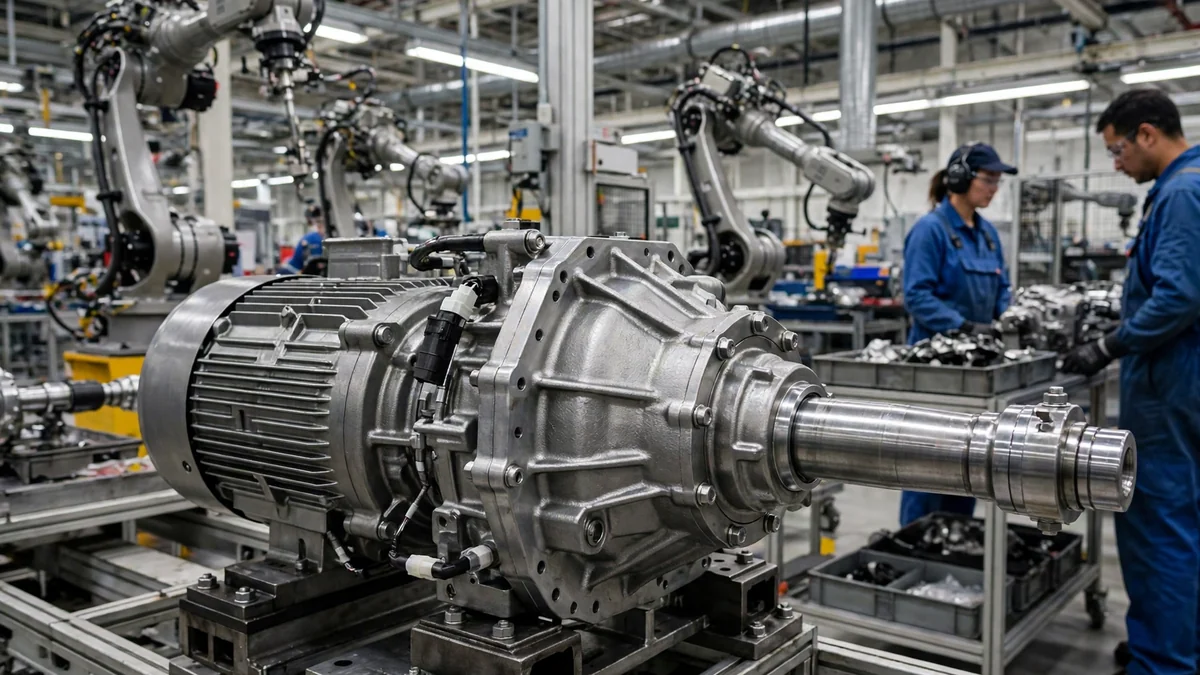
An electric car has no engine, no gearbox in the old sense, and no exhaust. What it has, in most cases, is an electric axle, a single compact unit that holds the motor, the reduction gear, and the differential, all bolted together and fitted between the driven wheels. It is the heart of the car, the part that turns battery power into motion, and it is built on a production line that looks more like a watch factory than a car plant.
The electric axle, often called an e-axle, replaces a whole chain of parts. In a petrol car, power travels from the engine through a clutch, a gearbox, a driveshaft, and a differential before it reaches the wheels. In an electric car, the motor spins fast, the gears slow it down and multiply its torque, and the differential lets the two wheels turn at different speeds around a corner. All of that happens inside one housing, sealed against water and dust, and cooled by oil or water so it can run hard for hours.
Building one means winding copper, cutting gears, and assembling parts to tolerances a human hair would dwarf. Here is how an EV electric axle is made.
How an EV Electric Axle Is Made
Step 1: Casting and machining the housing
The axle begins as a housing, usually cast in aluminium alloy for lightness, in two or more pieces that will bolt together around the motor and gears. The castings are made in high-pressure die-casting machines, then machined on computer-controlled centres that bore the bearing seats, mill the mating faces flat, and drill the oil and coolant passages. The tolerances are tight, measured in hundredths of a millimetre, because the motor shaft, the gear shafts, and the differential all have to line up perfectly inside the housing.
Step 2: Winding the motor stator
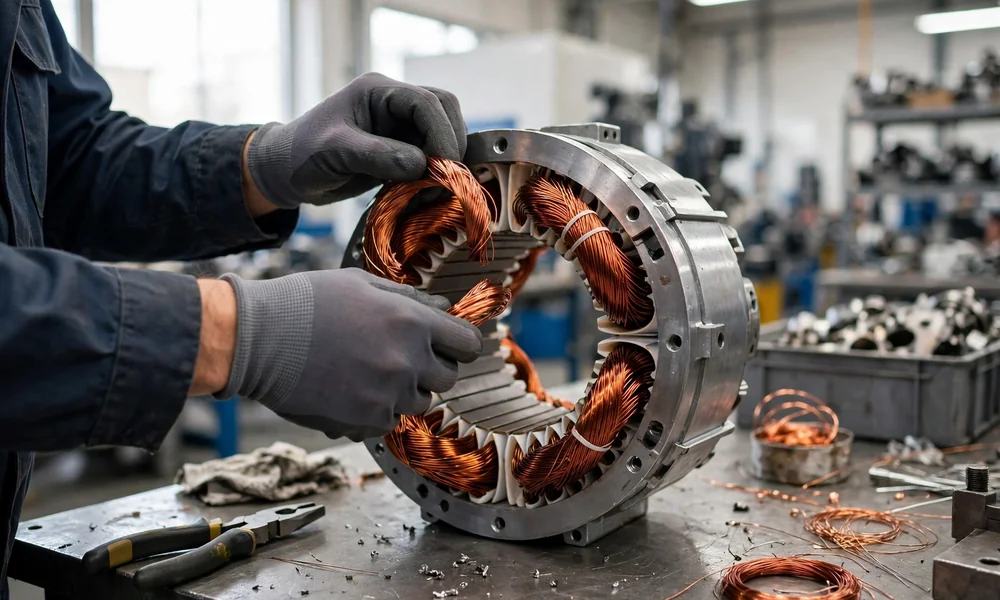
The motor’s stator, the stationary part with the copper windings, is built next. Thin sheets of electrical steel are stacked into a laminated core, and copper wire or copper bars are wound through its slots, either by machine or, for the newest hairpin designs, by bending pre-formed copper pins into place and welding their ends. The windings are then insulated, impregnated with resin, and cured, so they can survive heat, vibration, and years of use without shorting.
Step 3: Building the rotor
Inside the stator spins the rotor, the part that actually turns. In most modern e-axles it is a permanent-magnet rotor, with powerful magnets set into a laminated steel core, or an induction rotor with copper or aluminium bars. The magnets are glued and banded in place, the rotor is balanced on a machine that spins it fast and measures vibration, and any imbalance is corrected by removing or adding tiny amounts of material. A rotor that is out of balance will shake the whole axle at speed, so balancing is done to a fine tolerance, and every rotor is checked again after it is fitted with its shaft and bearings.
Step 4: Cutting and fitting the gears
The reduction gears slow the motor down and multiply its torque, and they are cut from forged steel blanks on gear-cutting machines, then hardened, ground, and polished to a mirror finish. The gears are fitted into the housing with their shafts and bearings, and the backlash, the tiny play between meshing teeth, is measured and adjusted with shims. The differential, the set of gears that lets the wheels turn at different speeds, is assembled at the same time, with its own bearings and seals, and checked by hand for smooth, even rotation.
Step 5: Assembling the complete axle
With the motor, gears, and differential ready, the axle is assembled. The rotor is lowered into the stator, the gear set is fitted, the differential is installed, and the housing halves are bolted together with a sealant that keeps oil in and water out. Sensors are fitted, including the resolver that tells the car’s computer exactly where the rotor is, and the temperature sensors that guard against overheating. Oil is added, the cooling connections are made, and the whole unit is turned by hand to check that it spins freely and quietly. This is the moment the separate parts become a single machine.
Step 6: Testing on the dynamometer
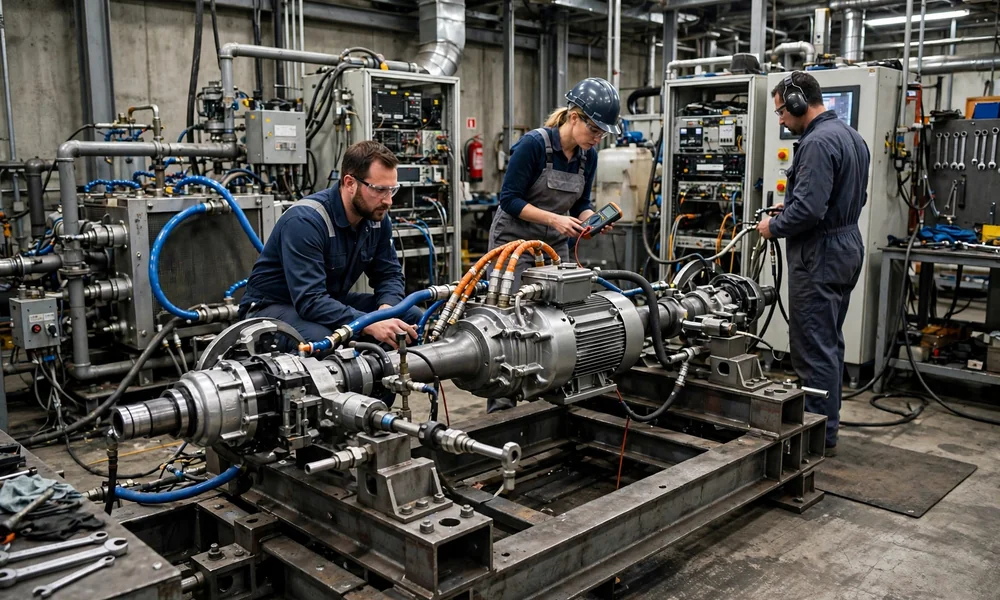
Every e-axle is tested before it leaves the factory, on a dynamometer that spins it through its full range of speeds and loads while engineers watch power, torque, temperature, vibration, and noise. The axle must deliver its rated torque smoothly, run quietly, and stay cool under sustained load, and any unit that whines, vibrates, or overheats is pulled off the line and investigated. The test also checks the seals, because a leak would let oil out and water in, and the sensors, because the car’s computer depends on them. Only an axle that passes every test is packed and shipped to the car factory. The motor at its heart is covered in EV electric axle materials engineering, the battery that feeds it is covered in EV battery pack materials engineering, and the gearbox it replaced is covered in dual-clutch gearbox materials engineering.
EV Electric Axle Specs
| Specification | Typical range |
|---|---|
| Layout | Motor, reduction gear, and differential in one housing |
| Motor type | Permanent-magnet synchronous, or induction |
| Power output | About 100 to 400 kW per axle, depending on model |
| Motor speed | Up to about 16,000 to 20,000 rpm |
| Gear reduction | About 8:1 to 12:1, single speed |
| Torque | About 2,000 to 4,000 Nm at the wheels |
| Housing material | Cast aluminium alloy |
| Cooling | Oil or water cooling, depending on design |
What Does an EV Electric Axle Cost?
An e-axle is one of the most expensive parts of an electric car after the battery. A complete unit for a mass-market car is estimated at roughly $1,500 to $3,000, while a high-performance axle for a fast electric car is estimated at $4,000 to $8,000 or more. The motor’s magnets are a large part of the cost, because they use rare-earth materials, and the precision gears and machining add the rest. All prices are estimates only and vary widely by power, specification, and order volume.
A Rare Fact
The electric axle is not a new idea, even if the name is. In the early 1900s, Ferdinand Porsche built the Lohner-Porsche, a car with an electric motor in each wheel hub, decades before the modern electric car. The idea was abandoned because batteries were heavy and weak, and petrol took over. A century later, the same idea returned, refined into the e-axle: the motor moved inboard, the gears added to multiply its torque, and the battery finally good enough to make it work. The electric axle is, in a sense, a very old idea that had to wait a hundred years for its moment.
The e-axle is easy to miss, tucked under the floor of an electric car, silent and sealed, with no moving parts visible from outside. Yet it is the part that makes the car go, turning the silent power of the battery into the push that moves two tonnes of metal down the road. It is a motor, a gearbox, and a differential in one box, built to a precision that would have astonished the engineers who built the first electric cars, and it is only getting better.


