Picture a hypercar launching from a standstill. More than a thousand horsepower flows to the rear wheels, the tyres grip, slip, and grip again, and the car rockets forward without a hint of drama. Now picture the same car at full lean through a fast corner, the inside wheel unloaded and desperate to spin, the outside wheel carrying almost all the weight. The car stays planted through both moments, and the reason is a component most drivers will never see: the differential.
A differential is the referee of the drivetrain. It takes the engine’s power from a single driveshaft and splits it between two wheels that almost never want to turn at the same speed. In a corner, the outside wheel travels further than the inside one, so it must turn faster. The differential sorts all of this out, hundreds of times a second, without the driver ever touching a control.
In a hypercar, that referee has to work at a level no ordinary car demands. This is how a hypercar differential works, from the power arriving at the ring gear to the two wheels turning at exactly the speeds they need.

How It Works
Step 1: Power arrives at the ring gear
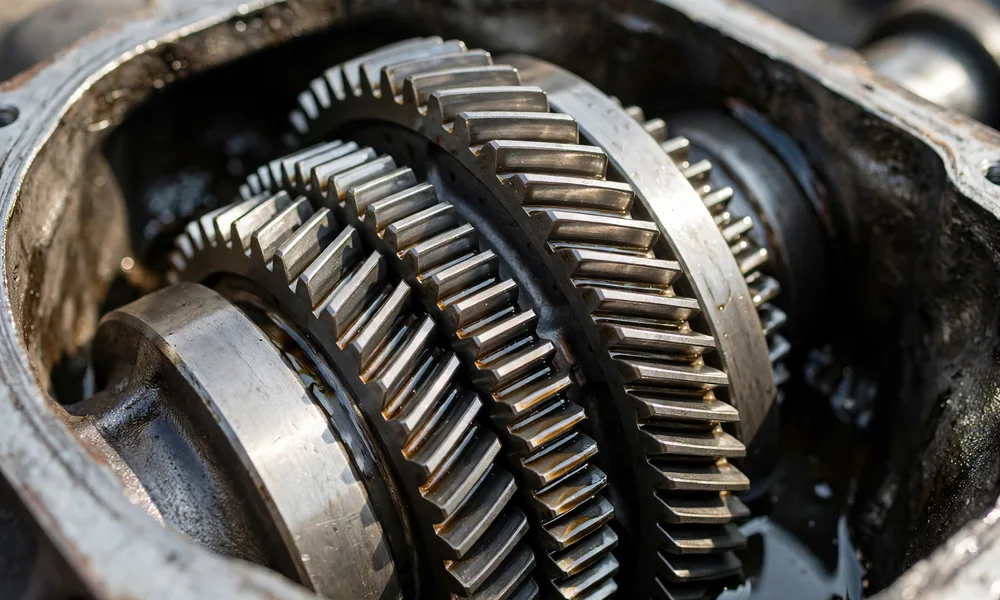
Everything starts with the driveshaft, which carries the engine’s power to the back of the car. At the end of the driveshaft sits a small bevel gear called the pinion, and it meshes with a much larger gear called the ring gear, or crown wheel. The ring gear is bolted to the differential carrier, so when it turns, the whole carrier turns with it. This gear pair does two jobs at once: it turns the power through ninety degrees, from the length of the car to across it, and it multiplies the torque, because the ring gear is several times larger than the pinion.
Step 2: The planet gears let the wheels disagree
Inside the carrier sits the clever heart of the device: a set of small planet gears, also called spider gears, mounted on a cross-shaped pin. These little gears mesh with two larger side gears, one connected to each wheel’s driveshaft. When the car drives straight ahead, the planet gears barely turn on their own pins; they simply carry both side gears around together at the same speed. But in a corner, the planet gears start to spin, and that spin is what lets the two wheels turn at different speeds while still receiving power. The gearbox that feeds this whole system is just as specialised, as the dual-clutch gearbox shows.
Step 3: The clutch packs decide how much slip is allowed
An open differential has one famous weakness: if one wheel loses grip entirely, on ice or in the air over a crest, it will spin freely and the car will go nowhere. A hypercar cannot accept that, so its differential adds clutch packs — stacks of alternating steel and friction plates sitting between the side gears and the carrier. When the plates are squeezed together, they resist any speed difference between the wheels, forcing power towards the wheel that still has grip. The squeeze is controlled by hydraulic pressure, and the car’s computer adjusts it constantly, tightening the packs when it senses slip and loosening them when the car is turning cleanly.
Step 4: Electronics think faster than any driver
The clutch packs are only as good as the brain controlling them, and in a hypercar that brain is fast. Wheel-speed sensors, steering angle, throttle position, and yaw sensors feed the car’s computer many times a second, and it calculates how much lock the differential needs right now. Some systems go further, using torque vectoring: they deliberately send more power to the outside wheel to help rotate the car, effectively steering with the drivetrain. That same electronic integration shapes the chassis around it, as hypercar suspension demonstrates.
Step 5: Oil cools, cushions, and protects
All of this happens inside a bath of special synthetic oil, and the oil is doing far more than preventing rust. It carries heat away from the gears and clutch packs, which can get extremely hot under hard track use. It cushions the teeth as they mesh, damping the shock of each engagement. And it keeps the friction plates working consistently, because a clutch pack with the wrong oil will either grab too harshly or slip when it should hold. The housing is designed with fins and oil galleries to shed heat, and some hypercars add a dedicated oil cooler and pump, treating the differential like a small engine of its own.
Step 6: The power reaches the road
The final step is the simplest: the side gears drive the half-shafts, the half-shafts drive the wheels, and the wheels drive the car. But the differential’s work is visible in how the car behaves. A good one lets the car launch hard without wheelspin, turn in sharply without pushing wide, and power out of corners with both tyres working. That is why hypercar makers spend so much time tuning the differential’s software for each model: the same hardware can feel completely different depending on how the clutch packs are told to behave. The engines feeding all this power are just as demanding, as hypercar turbochargers demonstrate.
| Main material | Forged alloy steel gears in a machined aluminium or magnesium housing |
| Key gears | Pinion and ring gear, planet gears, and two side gears |
| Lock-up control | Electronically controlled clutch packs, adjusted many times a second |
| Torque capacity | More than 1,000 newton-metres in the most powerful cars |
| Typical weight | About 25 to 45 kilograms, depending on type and size |
| Lubrication | Special synthetic oil, sometimes with a dedicated cooler and pump |
| Extra functions | Torque vectoring can steer the car by sending power to one wheel |
| Service interval | Oil changes on a strict schedule, more often after track use |
What Does a Hypercar Differential Cost?
A hypercar differential is a bespoke part, built for one model in small numbers, so there is no standard price. A mechanical limited-slip unit is estimated at roughly $8,000 to $20,000, while an electronically controlled differential with clutch packs, hydraulics, and its own control software is estimated at $25,000 to $50,000 or more. Those are estimates only, and they exclude the engineering and testing behind the design. For owners, the ongoing cost is maintenance: the special oil must be changed regularly, and clutch packs wear with hard track use.
A Rare Fact
The differential is one of the oldest ideas in the car — it was patented in the 1820s for steam carriages, long before the petrol engine existed — yet it took more than a century to become smart. Early differentials were purely mechanical and could do nothing about a spinning wheel. It was only in the 1930s that limited-slip designs appeared, and only in the last few decades that electronics let a differential think.

The differential will never be the part a hypercar owner brags about. It has no badge, no sound, and no visible drama. But every clean exit from a corner, every launch without wheelspin, and every moment the car feels planted rather than nervous comes down to this box of gears doing its sums in silence.


