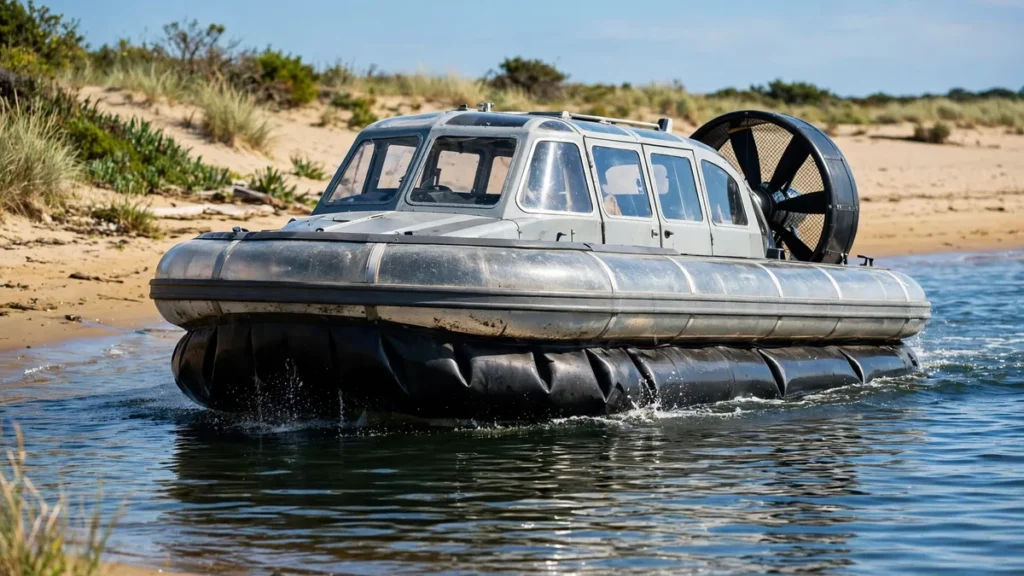
A hovercraft is a machine that refuses to decide what it is. It is not a boat, because it never touches the water. It is not an aircraft, because it never really leaves the ground. It rides on a cushion of air, floating a hand’s breadth above the sea, the sand or the marsh, and it can cross from water to land without slowing down. The part that makes this trick possible is not the engine or the fan, impressive as they are. It is a floppy curtain of rubberised fabric that hangs below the hull, trapping the air beneath it like a skirt. Without the skirt, there is no cushion, and without the cushion, there is no hovercraft.
The skirt is one of the humblest-looking parts on any machine, and one of the hardest to make well. It must be flexible enough to drag over rocks and waves without tearing, tough enough to survive years of salt water and sun, and light enough not to weigh the craft down. This is how that skirt is made.

How It’s Made
Step 1: Designing the skirt for the cushion
The design begins with the cushion itself. Engineers calculate how much air the fans must push under the hull, how high the craft must lift, and how the skirt must flex when the craft crosses a wave or climbs a beach. The most common design is the bag-and-finger skirt: a big inflatable bag around the edge of the hull, with hundreds of separate rubber fingers hanging below it. The bag holds the air in, and the fingers brush the surface, sealing the cushion while flexing over bumps.
Step 2: Choosing and cutting the fabric
The skirt is made from a heavy woven fabric — usually nylon or polyester — coated on both sides with rubber, often neoprene, which keeps the water out and the air in. The fabric arrives in huge rolls, and it is unrolled onto long cutting tables, where workers mark out the patterns for the bag sections and the fingers. The cutting is done with long knives or powered cutters, following the patterns exactly, because a finger cut too short will not seal the cushion. The cut pieces are numbered and stacked in order, ready for the sewing room. The work is closer to sailmaking than to shipbuilding, where cloth and thread must survive the sea.

Step 3: Sewing and bonding the sections
The cut pieces are joined into the bag and the fingers. Heavy industrial sewing machines stitch the seams with thick thread, and then the seams are sealed with rubber cement and heat, so that air cannot leak through the stitching. The fingers are sewn as separate tapered tubes, closed at the bottom and open at the top, then attached to the bag in a long row.
Step 4: Fitting the skirt to the hull
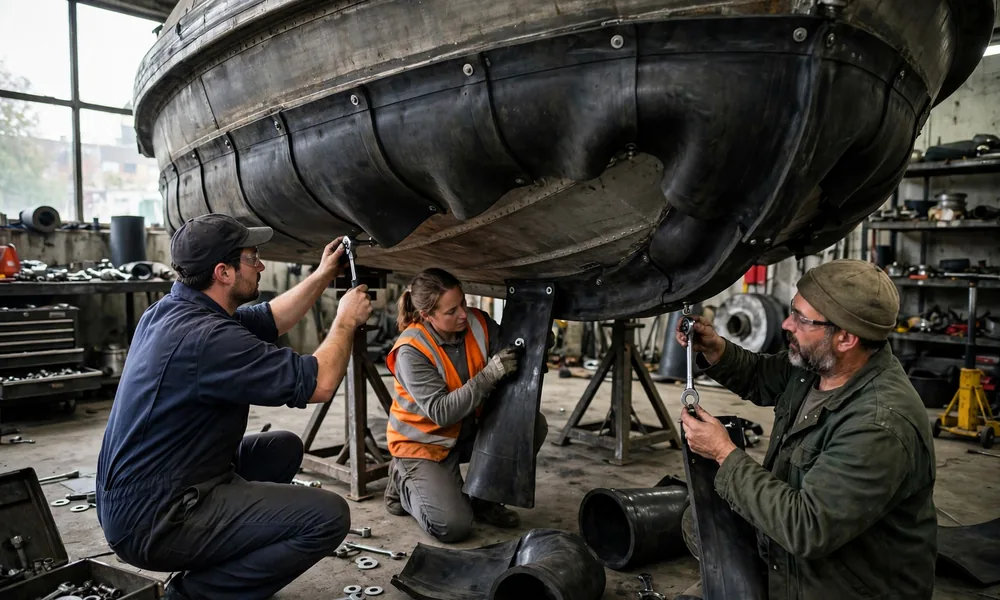
Fitting the skirt is a job for a whole team. The hovercraft is raised on supports, and the skirt is hauled underneath it, unfolded and pulled into place around the edge of the hull. Workers bolt the top of the bag to a rail around the hull, section by section, tightening the fixings so the skirt hangs evenly. The fingers are attached one by one, each one clipped or bolted to the bag, until the whole ring is complete. The hull it hangs from is built by the same heavy fabrication behind container ship hull work, only here the steel must carry a machine that never touches the water at all.
Step 5: Inflating and testing the cushion
With the skirt fitted, the fans are started and the cushion is tested for the first time. The craft is lifted on its cushion while still on its supports, and engineers walk around it with their hands, feeling for leaks in the bag and watching how the fingers settle. The testing is slow and fiddly, but it is the moment the hovercraft becomes a hovercraft: a machine that floats on air it makes itself.
Step 6: Trials on water and land
The real test is outside. The hovercraft is driven down a slipway and onto the water, where it lifts, turns and stops, and then it is driven straight up a beach and across grass, to prove it can cross from sea to land without a pause. The trials prove that the fabric, the sewing and the fitting were all done right, as in the sea trials of a superyacht steel hull, where the last tests are always done on the water, not in the yard.
Step 7: Maintenance and finger replacement
A hovercraft skirt is a wearing part, and it is designed to be repaired, not replaced whole. The fingers at the front and sides wear fastest, dragged over sand and shingle, and a working hovercraft can go through dozens of fingers in a season. Replacing one is a simple job: unclip the worn finger, bolt a new one in its place, and carry on. The bag itself lasts longer, but it too is patched and re-coated as it ages, and a full re-skirt — a brand-new skirt for an old craft — is a routine job in a hovercraft workshop. The same logic keeps the great deep-diving machines in service for decades, as in deep-sea submersible maintenance, where the parts that wear are made to be swapped, not mourned.
Specs
| Specification | Typical figure |
|---|---|
| Skirt type | Bag-and-finger, rubber-coated woven fabric |
| Fabric | Nylon or polyester, coated both sides with neoprene rubber |
| Fingers | Several hundred separate replaceable fingers per craft |
| Lift height | Typically 200 to 500 mm above the surface |
| Cushion pressure | Only slightly above atmospheric pressure |
| Skirt weight | Several hundred kilograms on a large craft |
| Finger life | Months to a few years, depending on the surface |
| Design life | Bag 5 to 10 years, fingers replaced as they wear |
Price
A hovercraft skirt is one of the few parts in this series that can actually be bought on its own. As an estimate, a replacement finger typically costs roughly $50 to $200, while a complete new skirt for a large passenger hovercraft typically costs roughly $50,000 to $150,000 — these are estimates, and the final figure depends on the size of the craft, the fabric used and the supplier. It is a small share of the price of the hovercraft itself, but it is the share that wears out fastest.
A Rare Fact
The hovercraft was invented by Christopher Cockerell, a British engineer who got the idea from a simple experiment in his kitchen: he put a tin can inside a coffee tin, blew air between them with a hair dryer, and watched the inner can float. When the first working hovercraft finally crossed the English Channel in 1959, it did so on a skirt made from rubberised fabric — and the basic design of that skirt, a bag with hanging fingers, is still the design used on hovercraft today.
From a roll of rubberised cloth to a machine that glides from sea to shore without ever touching either, the hovercraft skirt proves the simplest ideas are often the hardest to build.