A wheel is the simplest part of a car — a circle that turns. But on a hypercar, the wheel is also the most stressed part of the whole machine. It must hold the car up, steer it, brake it, and survive potholes at 300 kilometres per hour, all while weighing as little as possible, because every kilogram of wheel is weight the suspension has to control. A carbon fibre wheel does all of this at roughly half the weight of an aluminium one. It looks like jewellery, but it is built like an aircraft part.
What makes a carbon wheel remarkable is that it is not made by casting or forging at all. It is woven. Thousands of carbon fibres, each thinner than a human hair, are laid by hand into a mould in carefully chosen directions, soaked in resin, and then baked under pressure in an oven until the soft fabric becomes a rigid structure stronger than steel. The process takes days, not minutes, and a single mistake in the layup can scrap a wheel worth thousands. It is slow, expensive, and strangely beautiful to watch.
How Hypercar Carbon Wheels Are Made
Step 1: Designing the weave
Before any fibre is cut, engineers design the wheel on a computer, deciding exactly which direction each layer of carbon should run. Fibres carry load only along their length, so a wheel needs layers running in many directions — around the rim to resist the tyre’s pressure, across the spokes to carry braking forces, and diagonally to handle cornering. The layup schedule — the list of every layer, its angle and its position — becomes the instruction sheet the technicians will follow by hand.
Step 2: Cutting the carbon cloth
Carbon fibre arrives as rolls of woven cloth, or as pre-impregnated sheets already coated with resin and kept cold until use. Each layer is cut to a pattern, like dressmaking, using templates and computer-controlled cutters, and every piece is labelled with its position in the layup. The workshop is kept clean and dry, because a speck of dust trapped between layers becomes a weak spot, and moisture in the resin can cause bubbles during baking. The cloth is stored in freezers and brought out only when it is needed.
Step 3: Laying up the wheel
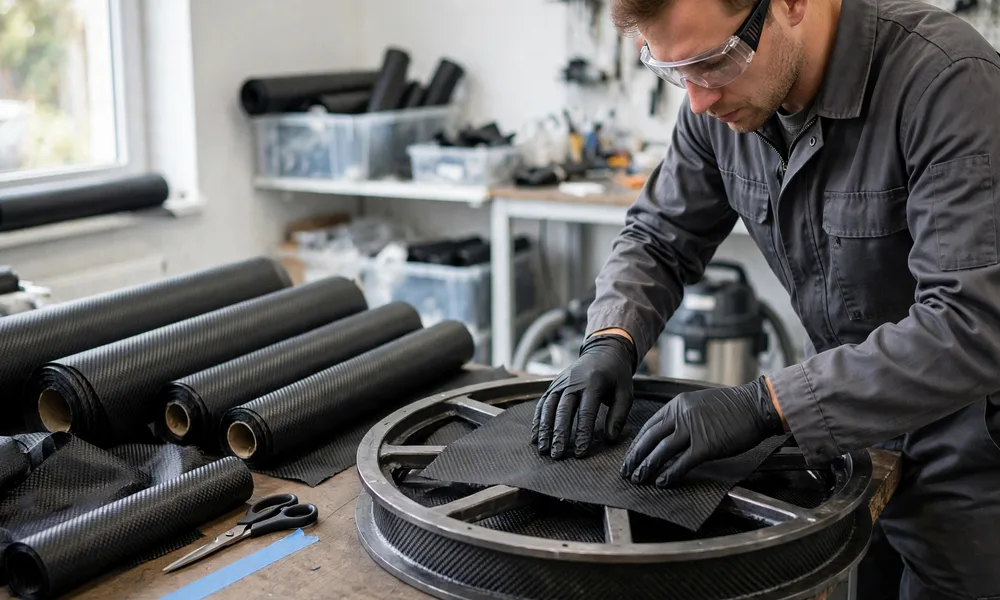
Technicians lay the carbon into the mould one piece at a time, pressing each layer down by hand and rolling out any air bubbles. A single wheel can take more than a hundred layers, and the work is done in a clean room, with gloves, because skin oils can spoil the bond between layers. The rim and the spokes are laid up as one piece, which is the great advantage of carbon: there is no joint between the centre and the rim, so there is no joint to fail. The layup takes a full day for one wheel, and it is checked layer by layer as it goes.
Step 4: Curing in the autoclave
Once the layup is complete, the mould is sealed in a vacuum bag and placed in an autoclave — a huge pressurised oven. The autoclave heats the wheel to around 120–180 degrees Celsius while squeezing it with several atmospheres of pressure, which forces the resin into every gap and presses the layers together until they bond into a single solid. The cure cycle lasts hours, and the temperature is raised and lowered on a strict schedule: too fast, and the resin boils; too slow, and it never fully hardens. The same baking discipline shapes the brakes that must stop this car, as the making of carbon-ceramic brakes shows.
Step 5: Trimming, machining and balancing
The cured wheel comes out of the mould as a rough black shape, and it is trimmed with diamond tools — ordinary cutting tools wear out almost instantly on carbon. The hub mounting face is machined flat, the bolt holes are drilled, and the valve hole is cut. Then the wheel is balanced on a machine that spins it at speed and measures the tiniest wobble, and small weights are added to correct it. A carbon wheel must run perfectly true, because at 300 kilometres per hour, a wobble of a fraction of a millimetre becomes a shake the driver can feel through the steering wheel.
Step 6: Coating, inspection and the final test
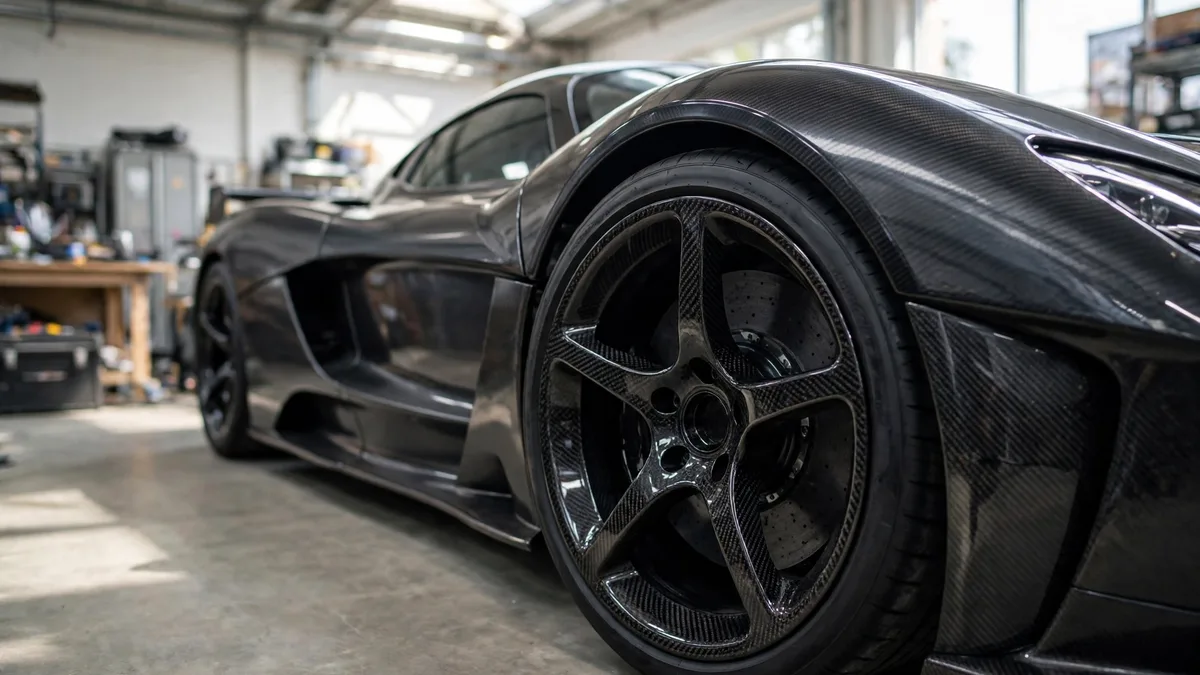
The finished wheel is coated with a clear lacquer that protects the carbon from sunlight and stone chips, and shows off the weave underneath — the visible pattern is not decoration, it is the structure itself. Then comes the inspection: ultrasound scans look for voids or delaminations inside the wheel, and X-rays check the hub area. Finally, a sample from each batch is tested to destruction on a rig that bends and hammers it far beyond anything a road can do. Only a wheel that passes every test is allowed onto the car.

Hypercar Carbon Wheels at a Glance
| Specification | Detail |
|---|---|
| Material | Carbon fibre cloth in epoxy resin, laid up by hand |
| Weight saving | Roughly 40–50% lighter than an equivalent aluminium wheel |
| Typical weight | About 6–8 kg per wheel, depending on size |
| Layers per wheel | Often more than 100 individual layers |
| Cure method | Autoclave, 120–180 °C under several atmospheres of pressure |
| Finishing | Diamond trimming, machining, balancing, clear lacquer coat |
| Key test | Ultrasound and X-ray inspection, plus destruction testing |
| Main weakness | Damage from a hard kerb strike is hard to see and costly to repair |
What Does It Cost?
A set of four carbon fibre wheels for a hypercar typically costs around $15,000 to $25,000 as an option, with a single replacement wheel running roughly $4,000 to $7,000. The price reflects days of hand labour, the cost of the autoclave time, and the testing — every wheel is scanned and inspected, and the ones that fail are destroyed, not sold. Those figures are estimates, not quotes. The engine those wheels have to keep up with is no less extreme, as the story of a hypercar V12 engine shows: it is built by hand, one at a time, by a single technician.
A Rare Fact
Carbon fibre wheels were first used not on road cars but in Formula 1, where teams in the 1990s began experimenting with carbon wheel rims to cut unsprung weight. The idea spread slowly to road cars because the wheels were so expensive and so hard to certify for road use — a racing wheel only has to survive a race, while a road wheel must survive a decade of potholes, kerbs and winter salt. The first road-legal carbon wheels appeared on limited-run hypercars in the 2010s, and they are still rare today.
A carbon wheel is a strange object: it is woven like cloth, baked like bread, and strong enough to hold up a car doing 300 kilometres per hour. It saves only a few kilograms per corner, but on a hypercar, those kilograms matter more than anywhere else on the car — they are the weight the suspension does not have to control, the mass the brakes do not have to stop, and the inertia the steering does not have to fight. The wheel is the simplest part of the car and the hardest to make, and that contradiction is the whole point. Every gram saved here is felt everywhere else, including in the wing that presses the car into the road — a hypercar spoiler that only works because the wheels beneath it stay glued to the tarmac.


