The pit lane is quiet just before dawn, the kind of quiet that makes every small sound feel loud. A mechanic in gloves lifts a fuel cell out of a hypercar, and it does not look like much: a dark, flexible bladder, a little larger than a suitcase, with a handful of fittings and hoses. It weighs less than a bag of groceries, yet it can cost more than a brand-new family car.
It seems absurd until you understand what the thing has to do. A hypercar fuel system must feed an engine making more than a thousand horsepower, at full throttle, under braking forces that would empty an ordinary tank’s pickup, in a crash, in heat that would boil ordinary fuel, and it must do all of it without leaking a single drop. It is a racing safety device and a precision delivery system squeezed into a space barely bigger than a rucksack. This is why it costs so much.
Why It Costs So Much
Reason 1: The fuel cell is a crash-proof bag, not a tank
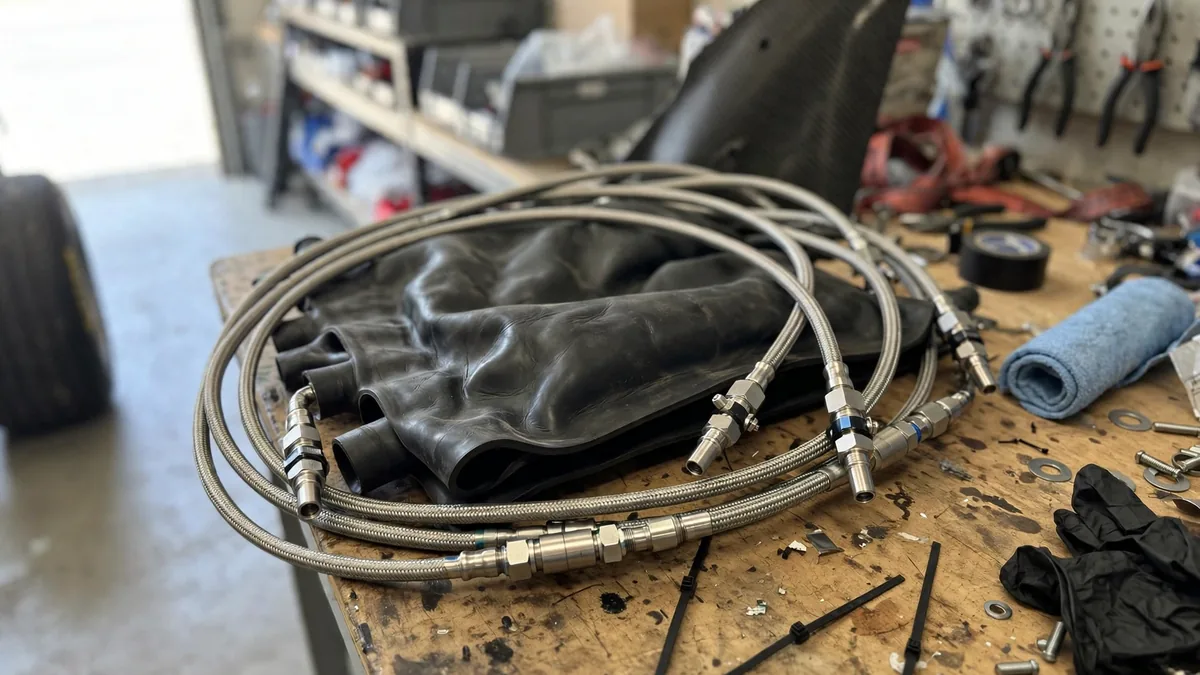
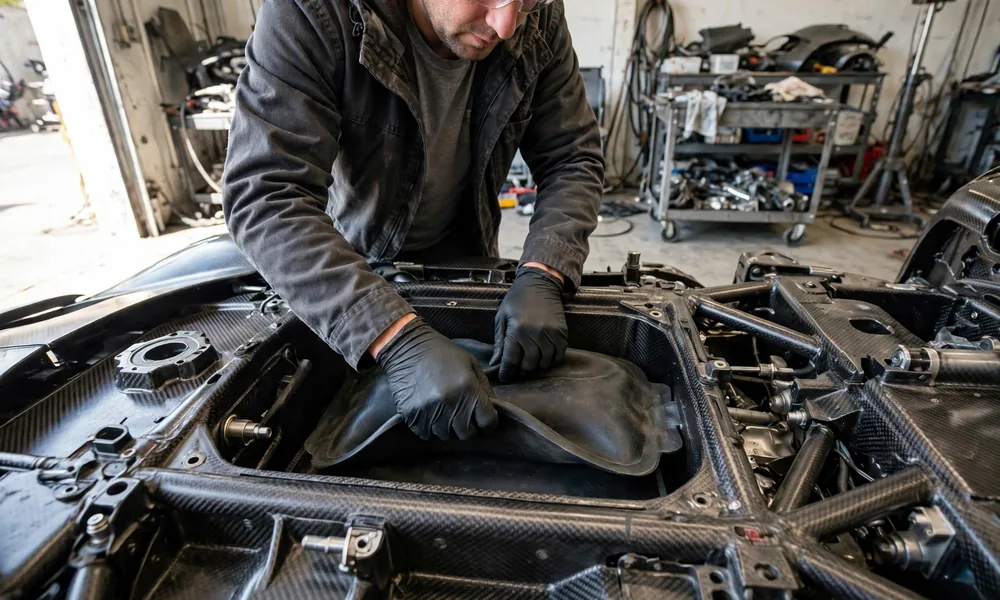
An ordinary car carries fuel in a steel or plastic tank. A hypercar carries it in a flexible bladder of layered rubber, nylon and aramid fibre, built to deform in a crash instead of splitting open. It must resist petrol, ethanol blends and racing fuel for years without softening, and every seam is bonded and tested rather than simply welded. How such a cell is put together is told in how a hypercar fuel system is made, where the layering, curing and pressure testing set the tone for everything that follows. A single cell takes days to build, and a flaw at the final test means starting again.
Reason 2: The pumps must feed a thousand horsepower without faltering
At full throttle a hypercar engine drinks fuel at an astonishing rate, and the pumps must deliver it at high pressure without a hiccup, lap after lap. These are not the simple pumps found in a family hatchback. They are compact, high-flow, brushless units, often fitted in pairs so one can take over if the other fails, and they run submerged in fuel that cools them. Each pump is bench-tested and matched to the injectors, and the wiring and connectors are built to motorsport standards. At 200 miles per hour there is no second chance, so testing alone adds a large share of the cost.
Reason 3: The plumbing is aerospace-grade, and every joint matters
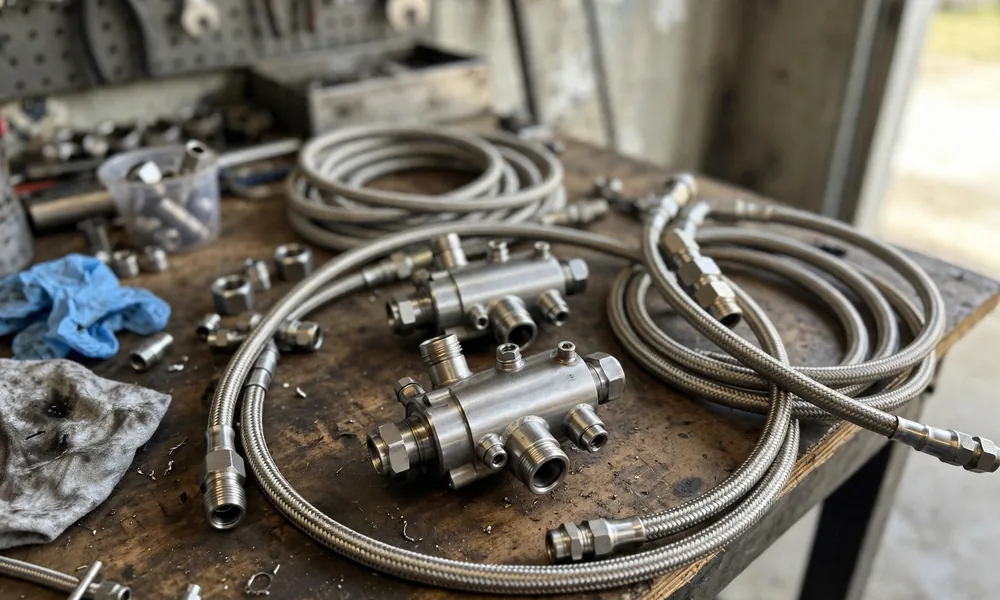
Fuel lines in a hypercar are braided stainless steel or aramid over a smooth inner liner, fitted with machined aluminium or titanium connectors that seal under pressure and vibration. Every joint is torqued, marked and inspected, and the routing is planned so no line chafes, kinks or sits near a hot exhaust. The lines must flex with the chassis, survive heat soak after the engine stops, and still seal years later. This is the same world of precision machining and exotic metal that feeds the engine itself, as explained in how the Bugatti W16 engine works, where fuel delivery and combustion are inseparable.
Reason 4: It must keep feeding fuel under forces that empty ordinary tanks
Under hard braking a hypercar can pull more than twice the force of gravity, and under cornering the fuel is thrown violently to one side of the cell. An ordinary tank would leave its pickup sucking air, and the engine would stumble at the worst possible moment. Inside the cell, a collector box, trap doors and one-way flaps keep a small reserve of fuel around the pickups at all times, no matter which way the car is turning. Designing that maze takes simulation, track testing and several revisions, and the parts are made in tiny batches, by hand, for one model only.
Reason 5: Fire safety is engineered in, not added on
Fuel and heat are a dangerous pair, and a hypercar carries both close together. The cell sits inside a protective container, often lined with fire-resistant material, and the system includes rollover valves that shut off flow if the car turns over, dry-break couplings that seal the instant a hose is pulled, and foam filling that stops sloshing and suppresses explosion. Each safety feature is tested to racing standards, and the certification paperwork alone takes time and money. Few workshops in the world are qualified to build and sign one off.
Reason 6: Tiny production runs spread the cost over a handful of cars
A hypercar maker may build a few hundred cars in total, sometimes fewer than a hundred. The tooling, moulds, test rigs and certification for a fuel system are spread across that tiny run, so each car carries a large share of the development cost. There is no economy of scale, no shared parts bin, and no cheap aftermarket alternative. Its packaging is coordinated with systems like the one in how a hypercar cooling system works, where heat, space and airflow are fought over millimetre by millimetre.
Hypercar Fuel System at a Glance
| Feature | Detail |
|---|---|
| Fuel cell | Flexible multi-layer bladder, aramid and rubber, crash-resistant |
| Capacity | Typically around 80 to 100 litres |
| Fuel pumps | Usually two high-flow brushless pumps, in-tank, with redundancy |
| Fuel lines | Braided stainless steel or aramid, dry-break couplings |
| Delivery pressure | High-pressure direct injection, several hundred bar at the rail |
| Safety features | Rollover valves, anti-slosh foam, fire-resistant container |
| Service life | Cell typically replaced every five to ten years |
| Typical build | Hand-built in small batches for one model |
What Does It Cost?
As rough estimates, a replacement hypercar fuel cell alone typically costs around $15,000 to $30,000, pumps and hardware add roughly $5,000 to $10,000, and a complete fitted system can run from about $30,000 to $60,000 or more. Those figures are estimates, not quotes, and the real number depends on the model, the fuel specification and the workshop. The cell itself is usually the largest single share, followed by labour, with pumps, lines, fittings and certification making up the rest of the bill. A fuel cell also has a limited life, so the cost returns every few years.
| Part of the system | Estimated share of the cost |
|---|---|
| Fuel cell bladder | About 40 to 50 percent |
| Pumps, lines and fittings | About 20 to 30 percent |
| Labour and fitting | About 15 to 20 percent |
| Testing and certification | About 10 to 15 percent |
A Rare Fact
The foam inside a hypercar fuel cell is not packaging. It is a special open-cell foam that does two quiet jobs at once: it stops fuel sloshing under braking and cornering, and it breaks up the empty space so a spark cannot turn fuel vapour into an explosion. Racing regulators made it mandatory after a series of terrible fires in the 1960s and 1970s, and it now protects road hypercars too. A soft black sponge, hidden where nobody sees it, is one of the most important safety devices in the car.
A hypercar fuel system looks like a bag and some hoses and is priced like a car, because it is really a crash structure, a fire-safety system and a precision instrument in one small package. It costs so much because the materials are exotic, the work is done by hand, the testing is relentless, and only a handful of workshops on earth can build one to the required standard. Pay for all of that and the engine never misses a beat; cut corners and the consequences arrive at the worst possible speed.


