The straight is long enough to feel endless, and the speedometer is climbing past numbers most drivers will never see. At three hundred kilometres an hour, the car is covering more than eighty metres every second, and the smallest movement of the driver’s hands would be enough to send it across a lane. Yet the steering wheel barely moves. A few millimetres of input, a whisper of angle at the front wheels, and the car changes direction with a calm that feels impossible at this speed.
A hypercar steering system is one of the most finely tuned mechanisms in any machine on the road. It has to do two contradictory jobs at once. At parking speed it must be light and quick enough to thread a two-million-dollar car into a tight space. At top speed it must be so stable and so precise that a sneeze cannot unsettle it. The way it squares that circle is a chain of small decisions, each one engineered to the millimetre.

How a Hypercar Steering System Works
1. The driver’s input starts at a wheel built like an instrument
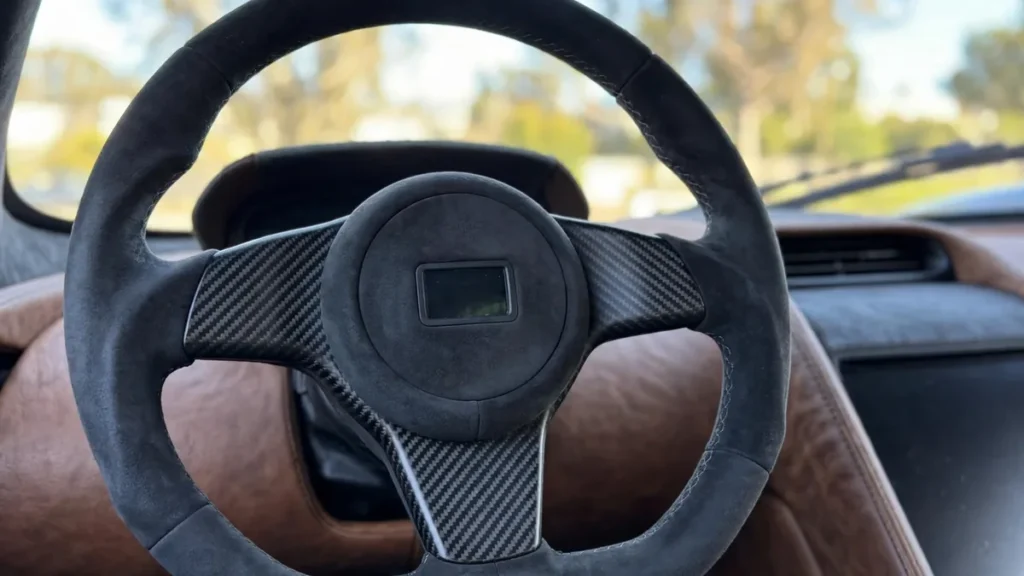
The steering wheel in a hypercar is not a wheel so much as a control panel shaped like one. It is usually a flat-bottomed rectangle with grips moulded to the driver’s hands, and it carries the controls for drive modes, suspension, and aerodynamics so the driver never has to look away. Behind it sits a column far stiffer than anything in an ordinary car, because any flex would blur the feel of the road. The wheel turns a pinion gear, and the ratio is quick: roughly twelve to fourteen degrees of wheel movement for every degree at the road wheels.
2. A rack and pinion turns rotation into sideways movement
The pinion meshes with a toothed rack, a steel bar that slides sideways inside the steering housing. Turn the wheel and the rack moves left or right, pushing and pulling the tie rods that connect to the front wheel hubs. The whole assembly is machined to tolerances measured in hundredths of a millimetre, and it is mounted on the stiffest part of the chassis so that nothing bends under load. In a hypercar the rack is often a variable-ratio design, geared to be quicker near the centre so small corrections feel instant.
3. Power assistance is tuned, not just added
No human could steer a hypercar at speed without help. The front tyres are enormous, the grip is immense, and the forces at the wheel would exhaust a driver in minutes. So an electric motor assists the rack, adding force in proportion to what the driver asks for. The trick is in the tuning. At low speed the assistance is generous, so the car is easy to park. As speed rises, the assistance fades and the steering grows heavier, so the driver feels the road loading up through their hands. The best systems filter out the worst vibration from bumps while letting through the fine texture of the surface, the information a driver needs to know how much grip is left.
4. The geometry keeps the tyres honest
Steering is not only about the rack. The angles at which the front wheels sit decide how the car behaves when it turns. Caster angle tilts the steering axis so the wheels naturally want to return to straight ahead, which is what gives the car its stability at speed. Camber tilts the wheels inward at the top so the outside tyre stands flat on the road in a corner instead of rolling onto its edge. Toe angle points the wheels very slightly inward, so the car tracks straight instead of wandering. In a hypercar these angles are set with racing precision, and the suspension is stiff enough that they barely change under load.
5. Active aerodynamics and rear steering join in
Many hypercars add a second layer of control that ordinary cars never get. At high speed, flaps and wings shift to press the car into the road, and the steering system works with them: the car knows how fast it is going and how much downforce it has, and it adjusts the weight of the steering to match. Some hypercars also steer the rear wheels, turning them slightly in the same direction as the fronts at high speed for stability, and in the opposite direction at low speed to shrink the turning circle. The driver never feels the handover. It simply feels like the car is shorter than it is.
6. Feedback is the final ingredient
The last step is the one no diagram can show: feel. A hypercar steering system is tuned so the driver can sense, through the wheel, the exact moment a front tyre begins to lose grip. That information travels up through the tyres, the tie rods, the rack, and the column as tiny vibrations, and the engineers spend months deciding which vibrations to keep and which to damp out. Too much and the wheel buzzes. Too little and the driver is blind. When it is right, the car talks, and a good driver listens.

Hypercar Steering System Specs at a Glance
| Specification | Typical range |
|---|---|
| Steering type | Electric power-assisted rack and pinion |
| Steering ratio | About 12:1 to 14:1 |
| Turns lock to lock | About 2.0 to 2.4 turns |
| Turning circle | About 11 to 13 metres |
| Rear-wheel steering | Up to about 3 degrees, on some models |
| Front tyre width | About 265 to 325 millimetres |
| Steering wheel diameter | About 340 to 370 millimetres |
The cost of this precision is as extreme as the cars themselves. A complete hypercar steering rack and column assembly is estimated at about 8,000 to 20,000 dollars as a replacement part, and the steering wheel alone, with its integrated controls and displays, is estimated at about 5,000 to 15,000 dollars. A full hypercar is estimated at about 2 to 4 million dollars, and the steering system is a small fraction of that total, but it is one of the parts owners notice most, because it is the part they touch every second they drive. Prices are estimates and vary by model and market.
The steering does not work alone. The gearbox that feeds it speed and torque is covered in the dual clutch gearbox specs explained guide, the brakes that work with it in a corner are covered in the carbon ceramic brakes specs explained guide, and the engine that makes the whole car possible is covered in the Bugatti W16 engine specs explained guide.

A Rare Fact About Hypercar Steering
Here is something few people outside the industry know: some hypercars deliberately make the steering heavier the faster you go, not just by reducing assistance but by using the aerodynamics. As downforce builds with speed, the front tyres are pressed harder into the road, and the steering naturally loads up, so the wheel itself becomes a speedometer the driver can feel. Engineers tune the wings and the steering together so that the weight in the driver’s hands rises in a smooth, predictable curve.
That is the real secret of a hypercar steering system. It is not about turning the wheels. It is about turning the driver’s intentions into motion so faithfully that the car disappears, and all that is left is the road, the speed, and a few millimetres of movement in the hands.