There is a strange moment in every first ride in a luxury autonomous car, and it has nothing to do with the car driving itself. It comes a minute or two later, when you stop watching the steering wheel and start noticing the silence. No engine note to judge, no gear changes to feel, no driver to watch. The car is simply moving, smoothly and without ceremony, through traffic that it seems to have read before you have. The question that follows is the natural one: what exactly is inside this machine that lets it do that?
The answer is written on the spec sheet, but it is written in a language most buyers have never needed before. Horsepower and leather grades are still there, but the figures that actually define an autonomous car are counted in sensors, teraflops, redundancies and milliseconds. A luxury autonomous car is less like a traditional car with a clever feature and more like a data centre that happens to have seats. Its specifications describe a machine that must perceive the world, decide what to do about it, and then do it — all without asking you anything.

The numbers that matter
Here is the shape of a current high-end luxury autonomous car — the figures buyers compare when the showroom talk turns serious.
| Specification | Typical luxury figure |
|---|---|
| Autonomy level | Level 3–4 (conditional to high automation) |
| LiDAR units | 1–3, up to 300 m range |
| Cameras | 8–12 surround cameras |
| Radar | 4–6 units, including long-range |
| Compute power | 500–1,000+ TOPS |
| Sensor range | Up to 250–300 m ahead |
| Reaction time | Under 100 milliseconds |
| Electric range | 500–700 km per charge |
| Power | 400–750 hp (electric) |
| Price | Estimate: $120,000–$250,000 |
The figure to start with is the compute power, measured in TOPS — trillions of operations per second. A luxury autonomous car carries somewhere between 500 and more than 1,000 TOPS of processing, which is roughly the power of a small server rack, running on a car battery, in all weathers. That power exists because the car is not doing one job. It is tracking dozens of moving objects, predicting where each of them will be in three seconds, reading signs and lane markings, and planning a path through all of it, several times a second.
Sensors: the car’s eyes, in triplicate
No single sensor can be trusted to see the world correctly, so a luxury autonomous car carries three different kinds and makes them agree with each other. LiDAR fires laser pulses and measures how long they take to return, building a three-dimensional map of everything within up to 300 metres — precise, but weakened by heavy rain and fog. Cameras see colour, signs and lane markings, and read the world the way a human does, but they struggle in darkness and glare. Radar sees through rain and fog and measures the speed of other vehicles directly, but it cannot read a sign or tell a plastic bag from a child.
The car’s software fuses all three into a single picture, and the fusion is the point. If the camera says the road is clear but the radar says something is ahead, the car believes the radar and slows down. If the LiDAR sees an object the camera cannot identify, the car treats it as real. Redundancy is not a luxury feature in an autonomous car; it is the whole safety case.
That promise of redundancy extends beyond sensors. The most advanced cars carry duplicate steering, braking and power systems, so that a single failure cannot leave the car without a way to stop safely. It is the same philosophy that governs the largest autonomous machines at sea, and the autonomous cargo ship’s specifications tell a similar story at a very different scale — more sensors, slower decisions, and the same insistence that no single failure should be fatal.
Compute: a data centre on wheels
The car’s computers sit in a liquid-cooled housing, usually under the floor, and they are the reason the electric range figures matter twice over. Driving itself consumes a serious amount of electricity — the sensor suite and the compute platform can draw several kilowatts continuously, which is enough to shave a noticeable slice off the car’s range. Luxury manufacturers quote their range figures with the autonomy systems running, which is honest, and it is one reason the battery packs on these cars are so large.

Range, power and the driving experience
As a car first and a robot second, the luxury autonomous car still has to be a good car. Electric motors deliver 400 to 750 horsepower, usually through two motors for all-wheel drive, and the instant torque makes the car feel effortless at any speed. Range of 500 to 700 kilometres per charge is typical, and the flat floor and long wheelbase — needed to package the battery and the computers — give the cabin more space than a conventional car of the same length.
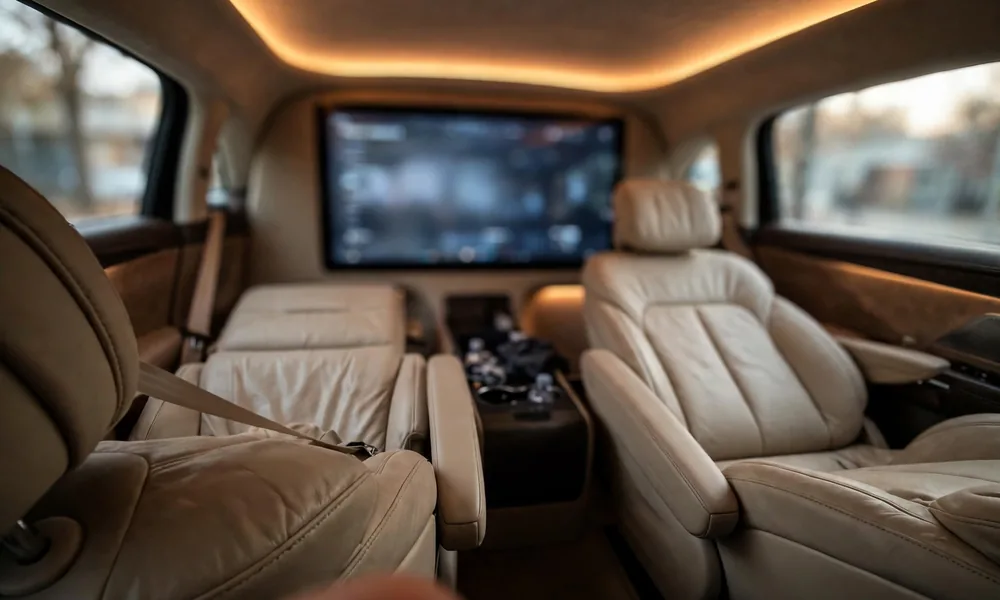
The interior is where the luxury shows. With no need for the driver to face forward at all times, seats recline further, screens are larger, and the cabin is quieter, because the car’s smooth, machine-planned driving wastes no energy on sudden braking or sharp acceleration. The irony is that the most relaxing car to be driven in is also the most powerful computer you will ever sit inside. Its step-by-step behaviour on the road is a separate story, and how a luxury autonomous car works walks through that process in order.
What the spec sheet does not tell you
Three figures matter enormously and rarely appear in brochures. The first is the operational design domain — the conditions under which the car is allowed to drive itself. A car may be fully autonomous on a divided highway in daylight and entirely manual on a wet country lane at night. The second is the handover time: how long the car gives you to take over when it reaches the edge of what it can handle. Ten seconds is comfortable; three seconds is not.
Price, for the record, starts at an estimate of around $120,000 for a well-equipped luxury autonomous car and rises past an estimate of $250,000 for the flagship models with the full sensor suite and the longest range. Much of that money is in the sensors and the compute platform, and both are getting cheaper every year. The debate about whether that is a good thing is already lively, and the case against autonomous yachts makes the same argument on the water.
A rare fact
Here is the number the engineers whisper about: the hardest thing for an autonomous car to see is not a pedestrian or a truck. It is a traffic cone. Cones are small, low, often knocked over, and they appear exactly where the road is changing — at roadworks, where the lanes have been repainted and the car’s map is suddenly wrong. A fallen cone lying on its side can confuse all three sensor types at once: too low for the LiDAR, too pale for the camera, and too small for the radar. Some manufacturers now train their systems on thousands of images of fallen cones specifically.
Read as a whole, the luxury autonomous car’s spec sheet is a portrait of a machine built to be careful. The sensors overlap, the computers duplicate each other, the brakes and steering have backups, and the range is quoted honestly with the computers running. It is a very different kind of luxury from horsepower or hand-stitched leather: the luxury of a machine that has thought about what happens when things go wrong, and built the answer into the numbers before you ever need it.


