There is a particular sound a paddle steamer makes that no other boat can copy: a slow, deliberate churning, water slapping against wooden floats as the great wheel turns, and beneath it the deep breathing of a steam plant doing honest work. Stand on the bank of a river at dawn and you can hear a paddle steamer coming long before you can see it. It arrives the way it has arrived for two hundred years — unhurried, enormous, and entirely unbothered by the hurry of the modern world.
That unhurried quality hides a remarkable piece of engineering. A luxury paddle steamer is not a museum piece with a new coat of paint. The best of them are working steamships, rebuilt and maintained to modern safety standards, carrying passengers in a level of comfort their original builders could never have imagined. Their spec sheets mix the nineteenth century and the twenty-first in the same column: a paddle wheel diameter measured in metres, a boiler pressure measured in bar, and a navigation suite that would not shame a modern cruise ship.
Reading those numbers properly is the only way to understand what a paddle steamer is. It is not a slow boat. It is a shallow-draft machine built to go where no other large vessel can go, powered by a system that was perfected before the internal combustion engine existed and has never really been bettered for its particular job.

The numbers that matter
Here is the shape of a large modern luxury paddle steamer — the figures that define it, from the wheel to the boiler.
| Specification | Typical luxury figure |
|---|---|
| Length | 60–90 m |
| Beam | 12–18 m over the paddle boxes |
| Draft | 1.2–2.0 m |
| Paddle wheel diameter | 5–7 m |
| Boiler pressure | 10–14 bar |
| Engine power | 800–2,000 hp |
| Service speed | 12–16 knots (22–30 km/h) |
| Passengers | 150–400 |
| Cabins | 40–100 luxury cabins |
| Price (new build) | Estimate: $30–80 million |
The figure that explains everything else is the draft: just 1.2 to 2.0 metres. A paddle steamer draws less water than most small yachts, despite being the length of a city block. That shallow draft is the whole reason the paddle wheel exists. A propeller needs deep water to work; a paddle wheel does not. It can push a huge vessel up rivers barely deeper than a swimming pool, over sandbars and through channels that would ground any screw-driven ship of the same size.
The paddle wheel: a machine with no secrets
The wheel itself is a marvel of visible engineering. Five to seven metres across, it carries twenty or more floats — flat wooden or steel blades, each the size of a door — mounted around its rim. As the wheel turns, each float dips into the water, pushes a mass of it backwards, and lifts clear again, in a cycle so slow you can follow it with your eyes. The wheel turns at only 20 to 30 revolutions per minute, and that slowness is its strength.
There are two kinds. A stern-wheeler carries one wide wheel at the back, which is simple and cheap but steers poorly. A side-wheeler carries a wheel on each side, and the captain can drive them independently — one forward, one back — to turn the ship almost in its own length. Luxury river steamers are almost always side-wheelers, because a river is narrow and a captain who cannot turn quickly is going to meet the bank.
Boilers and engines: steam, properly done
The steam plant is the heart of the ship, and its numbers are the ones engineers argue about. Boiler pressure of 10 to 14 bar is modest by power-station standards, but it is more than enough to drive the ship’s engines, and it keeps the plant simple enough to be maintained by a small crew. Modern luxury steamers burn oil or gas rather than coal — the romance of the coal bunker is real, but the smoke, the ash and the labour are not what today’s passengers want — and the boilers are fitted with modern controls, water treatment and safety systems.
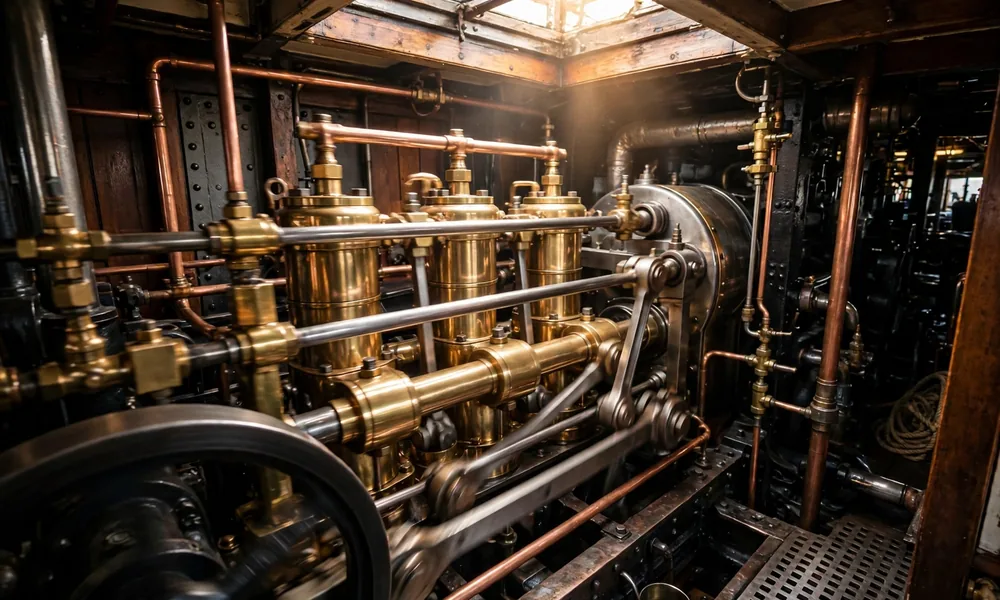
The engines themselves are usually compound or triple-expansion steam engines, in which the steam is used two or three times over, at falling pressures, before it is condensed and returned to the boiler. It is a technology perfected in the 1880s, and it is still remarkably efficient for its purpose. The engine room of a luxury paddle steamer is one of the great sights of the maritime world: brass, steel and polished wood, everything moving slowly and visibly. How all of this is put together is a craft in its own right, and how a luxury paddle steamer is made follows that build from the first steel plate to the first sailing.
Speed, range and the river
A service speed of 12 to 16 knots sounds slow next to a modern ship, and it is. But speed was never the paddle steamer’s job. Its job is to move a floating hotel up a river that no other vessel of its size can use, and to do it smoothly enough that the passengers in the dining room never notice the current. The shallow draft means the ship can operate on rivers that fall and rise with the seasons.
Cabins and the luxury question
The slowness is part of the product. A paddle steamer covers in a day what a train covers in an hour, and its passengers pay for exactly that. They pay to watch a riverbank pass at walking pace, to eat well, and to arrive somewhere they could not have reached any other way. The expedition yacht makes a similar promise on the open sea, and what a luxury expedition yacht is describes a vessel built around the same idea.
Price: what a new steamer costs
A new-build luxury paddle steamer costs an estimate of $30 to $80 million, depending on size, cabin count and the level of finish. That is a fraction of a modern cruise ship, but the economics are different: a paddle steamer earns its money on short river routes, with high occupancy and high fares, rather than on volume. Restoring an original nineteenth-century steamer can cost as much as building new, because every part of the steam plant and the hull must be brought to modern safety standards without losing the character that makes the ship worth restoring.
Keeping that engine healthy is a discipline of its own, and the way electric boat motors are cooled is the modern version of the same problem, solved with water jackets and pumps instead of condensers and feedwater.
A rare fact
Here is the detail the spec sheet hides in plain sight: a paddle steamer can be steered by its paddle wheels alone, without a rudder at all. Because the two side wheels can be driven independently, the captain can turn the ship by running one wheel forward and the other backwards, spinning it almost in place. In the days before powerful rudders, this was how river steamers manoeuvred in narrow channels, and it is still used today when a steamer has to turn in a stretch of river barely wider than the ship itself. The rudder is still there, but on a paddle steamer it is almost a courtesy — the wheels do the real steering, just as they do the real driving.
Read that way, the paddle steamer’s spec sheet stops looking old-fashioned and starts looking like a list of answers. Shallow draft, because the river is shallow. A big slow wheel, because a propeller cannot work there. Modest pressure and honest steam, because the plant must be maintainable by a small crew far from a shipyard.