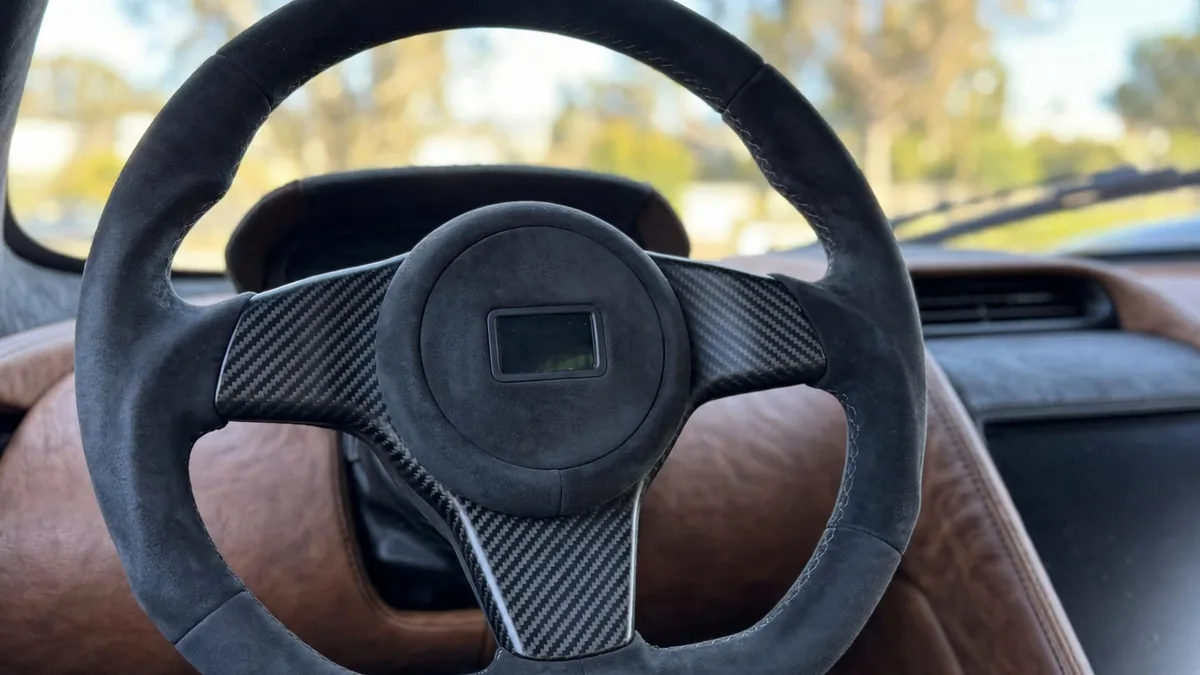
Steering is the one part of a hypercar the driver never stops touching. The engine can be silent and the gearbox can shift itself, but the wheel in the driver’s hands is still a direct conversation between human and road. The best hypercar steering systems make a 1,000-horsepower machine feel small, readable, and calm at speed.
This ranking judges steering systems, not individual cars, because the same ideas appear across many hypercars, and a great system is defined by its engineering rather than the badge on the nose. The order is decided by feel, feedback, precision, and ratio. For the mechanical basics behind the list, see how a hypercar steering system works.
How the ranking works
Four things decide the order. First, feel: the weight of the wheel should build naturally as cornering force rises, so the driver can sense grip through their hands. Second, feedback: the road surface, the tyres, and the first hint of slip should reach the rim instead of being filtered away. Third, precision: a small input should produce a small, exact change of direction, with no dead zone around the centre. Fourth, ratio: the steering should be quick enough for a tight corner without being so nervous that the car darts at motorway speed.
1. Hydraulic rack-and-pinion — the feel benchmark
The hydraulic rack-and-pinion is still the benchmark for steering feel, and it tops this list for one reason: nothing between the driver and the road is translated by software. A pump pressurises fluid, a valve meters assistance according to the torque the driver applies, and the rack pushes the tie rods directly. It is heavier and thirstier than an electric rack, and it cannot offer the driver modes modern buyers expect, but on a fast road it remains the system every other steering setup is judged against.
2. Variable-ratio electric rack — the best all-rounder
The variable-ratio electric rack is the system most modern hypercars actually use, and it ranks second because it is the most complete compromise ever fitted to a fast car. An electric motor assists the rack instead of a hydraulic pump, which saves weight, and the ratio changes with speed and steering angle: quick and light at parking pace, slower and heavier as speed rises. The worst feel numb around the centre, which is why tuning, not hardware, decides whether this system delights or disappoints.
3. Rear-wheel steering — the agility trick
Rear-wheel steering ranks third because it changes what a hypercar feels like more than any single front-end improvement. At low speed the rear wheels turn the opposite way to the fronts, shrinking the turning circle of a long, wide car so it behaves like something much smaller. At high speed they turn the same way, in a small estimated range of a degree or two, steadying the car in fast direction changes and making lane changes feel calm rather than nervous.
4. Quick-ratio track rack — the precision tool
The quick-ratio track rack is steering reduced to a single purpose: precision. With a ratio in the estimated range of 12:1 to 13:1, a small movement of the wheel produces a large change at the road wheels, so the driver can place the car to within centimetres and correct a slide with a flick of the wrists. It ranks fourth because it is the most precise system here, held back only by how demanding it is outside its natural home.
5. Dual-pinion electric rack — the strong, quiet worker
The dual-pinion electric rack splits the work between two pinions on the same rack: one driven by the steering column, the other by the assistance motor. That separation matters in a hypercar, because the front tyres are wide, the loads are enormous, and a single pinion can flex or wear under repeated track use. It is heavier and more expensive than a simpler electric rack, and its feel depends entirely on software tuning, but as a piece of engineering it is the most robust electric steering system a hypercar can carry.

6. Electro-hydraulic steering — the old compromise, done well
Electro-hydraulic steering keeps a hydraulic rack but drives its pump with an electric motor instead of a belt from the engine. The driver still gets the natural, load-based feel of hydraulics, while the car gains the efficiency and packaging freedom of an electric system, and the pump can rest when the car is travelling straight. It ranks sixth because it is a compromise in both directions, yet its feel is good enough that drivers rarely notice the compromise.
7. Active front steering — the adaptable ratio
Active front steering adds a planetary gearset to the steering column, so an electric motor can add or subtract steering angle on top of what the driver asks for. At low speed it sharpens the ratio for easy parking and tight corners; at high speed it relaxes the ratio so the car tracks straight and calm. The danger is that the car can feel as though it is steering itself, and a badly tuned system leaves the driver unsure how much of the cornering came from their own hands. Done well, it is invisible; done badly, it is the most distracting system on this list.
8. Steer-by-wire — the future, still learning
Steer-by-wire removes the mechanical connection between the wheel and the road wheels entirely, replacing it with sensors, motors, and software. The promise is enormous: any ratio the engineers want, a wheel that never kicks back over a bump, and a steering feel that can be programmed like a driving mode. It ranks eighth because its ceiling is the highest on this list, but its floor is still too low for a car that asks the driver to trust it completely at speed.
9. The minimal-turn yoke — the boldest interface
The minimal-turn yoke replaces the round wheel with a yoke that needs only a small rotation, in some designs an estimated half-turn or less from lock to lock, so the driver never takes their hands off the grips. On the road it is the most divisive steering idea in modern hypercars: tight roundabouts and three-point turns become awkward, and a driver who grabs for a full wheel in a slide finds only air. It ranks ninth for its brilliance in its element and its awkwardness everywhere else.
10. Column-mounted electric assistance — the simple, honest rack
Column-mounted electric assistance puts a small motor on the steering column rather than on the rack, which keeps the system light and easy to package. The limit is strength. Wide front tyres and huge cornering loads can overwhelm a column motor, so assistance fades or feels inconsistent when the car is worked hard, and the column itself can flex under load. It ranks tenth because it is a good system in a light car, but a hypercar asks more of its steering than this layout can comfortably give.
The verdict
The hydraulic rack wins because feel is still the thing that matters most in a hypercar, and no system communicates grip as honestly as pressurised fluid and a direct mechanical link. Whatever system a hypercar uses, it succeeds only when it works with the rest of the car: the best hypercar suspension systems keep the tyres in contact with the road, and the best hypercar brakes decide how late the driver can brake into the corner that the steering must then carry them through.


