Inside a jet engine, a few centimetres from a flame burning hotter than a crematorium, there is a row of metal blades spinning at thousands of revolutions per minute. Ordinary steel would soften, sag and tear itself apart in seconds. The blades do not, because they are made from Inconel, a family of nickel-chromium superalloys that behaves less like a metal and more like a stubborn refusal to melt. It is the material engineers reach for when the temperature is too high, the pressure is too great, and failure is not an option.
Inconel was developed in the middle of the twentieth century, when jet engines and rocket motors started demanding more than steel could give. Its secret is a combination: nickel for toughness, chromium against rust and corrosion, and smaller amounts of iron, molybdenum and niobium that lock the crystal structure in place even when it glows. The result is an alloy that keeps its strength at temperatures where most metals turn to putty, and that shrugs off salt water, acids and exhaust gases that would eat other metals alive.
How Inconel Alloy Works
Step 1: Nickel forms a tough, stable base
Every Inconel grade starts with nickel, usually more than half of the mix, and nickel is the reason the alloy works at all. Nickel’s crystal structure stays stable across a huge range of temperatures, where iron-based steels turn brittle or soft. It also resists corrosion naturally and stays ductile, bending slightly without snapping. Around that nickel base, the other elements are added like spices, and the exact recipe decides whether the alloy ends up in a jet engine, a nuclear reactor or a chemical plant. The same careful matching of material to job runs through all of engineering, and the way steel is joined to survive heat and stress is its own craft, as the steel welding materials guide explains.
Step 2: Chromium builds an invisible shield
Chromium, typically fifteen to twenty-five percent of the mix, is the alloy’s defence against corrosion. When exposed to air, the chromium at the surface reacts with oxygen to form a thin, invisible layer of chromium oxide, only a few atoms thick, that seals the metal underneath away from attack. If the surface is scratched, the layer simply reforms, as long as oxygen is present. This self-healing skin lets Inconel survive salt spray, hot exhaust gases and corrosive chemicals. It is the same idea that protects stainless steel, but Inconel’s high nickel content makes the shield far more durable at high temperatures.

Step 3: Niobium and molybdenum lock the structure
The real magic of Inconel happens inside the crystal lattice. Elements such as niobium and molybdenum dissolve into the nickel and form tiny, hard particles that pin the crystal grains in place. At high temperatures, ordinary metals fail because their crystals slowly slide past each other, a process called creep, until the metal stretches and breaks. In Inconel, those particles act like grit in a sliding door, resisting the movement. Some grades are also strengthened by heat treatment, which grows the particles to exactly the right size over hours in a furnace. It is this resistance to creep that lets a turbine blade hold its shape while spinning in gas hotter than its own melting point would suggest possible.
Step 4: The alloy is cast, forged or printed into shape
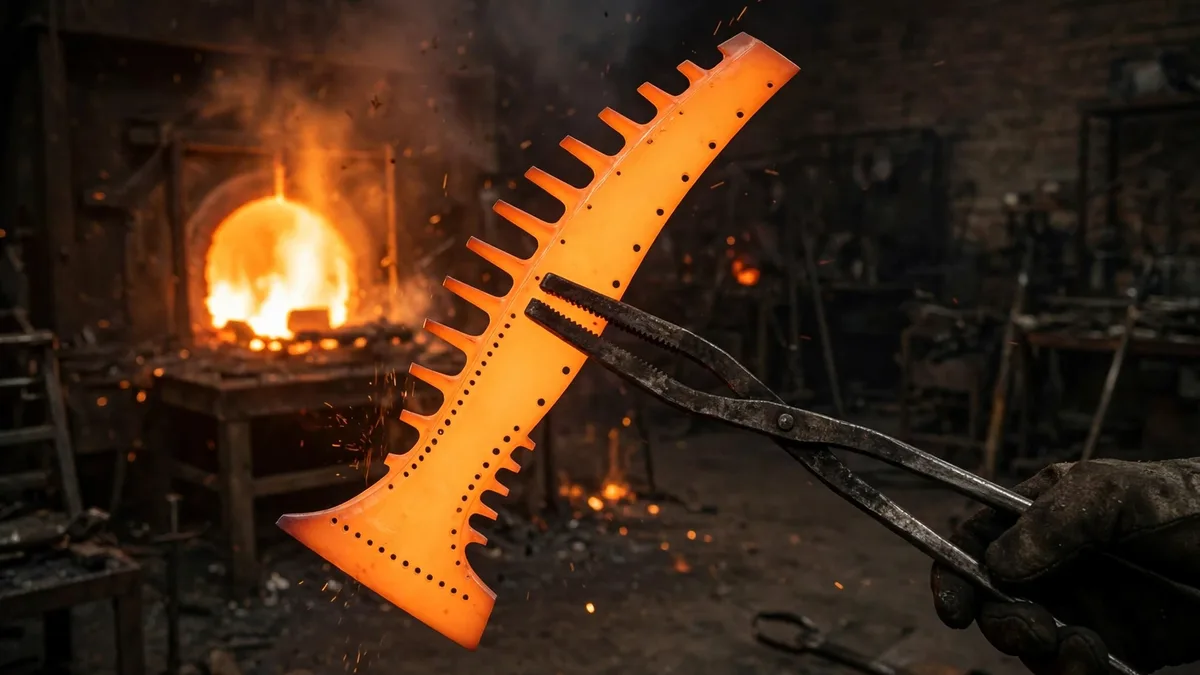
Making something from Inconel is famously difficult, because the very properties that make it strong also make it hard to cut and shape. Turbine blades are often cast in a single crystal, grown slowly from a mould so that the whole blade is one unbroken crystal with no grain boundaries to crack along. Other parts are forged under enormous presses, or machined with cutters that wear out quickly against the tough metal. More recently, engineers have turned to additive manufacturing, building Inconel parts layer by layer from metal powder, which allows shapes that no mould or mill could produce. Lightweight woven composites face the opposite problem, being easy to shape but hard to make strong, and their own story is one of clever layering, as the carbon fibre weave materials guide shows.
Step 5: It works where other metals give up
Once in service, Inconel works where lesser metals would be destroyed: turbine blades, combustion chambers and exhaust nozzles in jet engines, spinning in gas above a thousand degrees; rocket nozzles channelling burning propellant; reactor parts surviving heat, pressure and radiation for decades; and oil and gas valves carrying corrosive fluids from deep underground. In each case the alloy is chosen not because it is cheap or easy, but because nothing else survives the conditions.
Step 6: It is inspected, repaired and recycled
Inconel parts do not last forever, and because they are expensive, they are inspected with unusual care. Engineers use ultrasound, X-rays and dye tests to find cracks too small to see, and a flawed blade is pulled from service long before it could fail. Worn parts can sometimes be repaired by welding on new material and re-heat-treating the whole piece, a slow and skilled job. When a part is finally beyond repair, the metal is recycled, because the nickel and chromium inside it are valuable enough to recover. The most demanding engines ever built rely on exactly this combination of exotic material and careful maintenance, and the materials inside them are a catalogue of engineering extremes, as the Bugatti W16 engine materials guide shows.

Inconel Alloy at a Glance
| Specification | Detail |
|---|---|
| Base metal | Nickel, usually more than 50 percent of the alloy |
| Key additions | Chromium 15 to 25 percent, plus iron, molybdenum, niobium |
| Maximum service temperature | Approximately 1,000 to 1,100 degrees Celsius, depending on grade |
| Main strength | Keeps its strength and shape at extreme heat |
| Corrosion resistance | Self-healing chromium oxide skin, resists salt and acids |
| Main uses | Jet engine turbine blades, rocket nozzles, reactors, chemical plant |
| How it is shaped | Single-crystal casting, forging, machining, additive manufacturing |
| Main advantage | Strength at heat plus corrosion resistance in one alloy |
| Main drawback | Very expensive, extremely hard to machine and weld |
What Does It Cost?
Inconel is sold by the kilogram, not by the part, and it is one of the most expensive common engineering alloys. As rough estimates, raw Inconel bar or sheet costs tens of dollars per kilogram, several times the price of stainless steel, while a single finished turbine blade can cost thousands of dollars once casting, machining and inspection are included. Those figures are estimates, not quotes.
A Rare Fact
Inconel is so hard to machine that workshops have a saying about it: the metal work-hardens as you cut it, which means the act of cutting makes the surface harder, which makes the next cut even more difficult. A drill bit can be ruined in seconds if the feed rate is wrong. Yet the same stubbornness is why engineers love it: a metal that refuses to be cut also refuses to be torn apart by a jet engine.
Inconel works because it was designed, element by element, for a job that no natural metal could do. Nickel gives it stability, chromium gives it armour, and niobium and molybdenum lock its crystals against the slow creep of heat. The next time a jet climbs into the sky, the reason its engines do not melt is a row of blades made from an alloy that refuses to give up.