Hold a piece of Kevlar composite in your hand and it feels wrong. It is light — lighter than the steel plate it can replace — and a little springy, like a very stiff fabric. Yet this is the material that stops bullets, armours racing boats, and holds together the hulls of canoes that bounce off rocks. It does not work by being hard. It works by being almost impossible to pull apart.
Kevlar is a fibre, spun from a liquid polymer into golden threads five times stronger than steel for their weight, and a composite is what happens when those threads are woven, stacked, and glued into a solid shape with resin. The result is a material that absorbs a blow by stretching, spreading, and sharing the load across thousands of fibres instead of letting one spot take it all. This is how it works.

How It Works
Step 1: Tiny chains line up into a giant fibre
Kevlar begins as a chemical called an aramid, a polymer whose long molecules are stiff, rod-like chains. When the polymer is dissolved and spun through tiny holes, those chains line up in the same direction, like dry spaghetti in a box, and lock together with strong hydrogen bonds. The alignment is everything: a single Kevlar fibre is made of millions of these chains all pulling in the same direction, which is why the fibre is so strong along its length and yet can be cut across it. The golden colour is natural, a signature of the chemistry itself.
Step 2: Fibres are woven into cloth
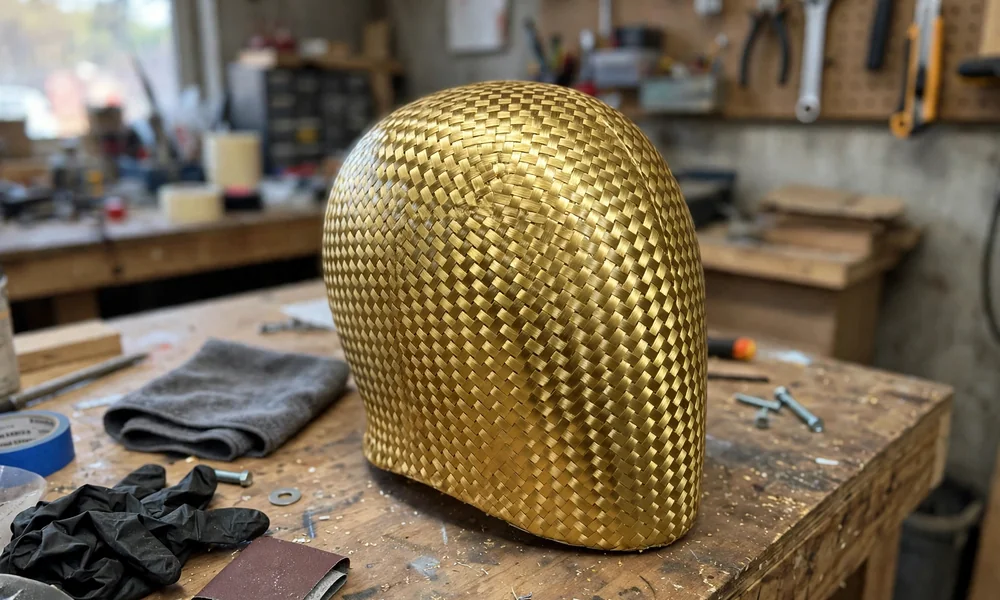
Spun fibres are gathered into yarns, and the yarns are woven into cloth on looms much like those that make denim or canvas. The weave matters: a plain weave, where each yarn passes over and under its neighbours, gives a stable, balanced fabric, while other weaves trade stability for drape or strength in one direction. A single layer of Kevlar cloth is already tough to tear, but it is still flexible, and it can be cut and draped over a mould the way a tailor drapes fabric over a form. This is the stage where a flat sheet begins to imagine itself as a helmet, a hull, or a vest.
Step 3: Layers are stacked in different directions
One layer is strong in only one direction, so a composite stacks many layers with their fibres pointing in different directions — zero degrees, ninety degrees, forty-five degrees, and so on. Each layer covers the weakness of the one below it, so the finished panel is strong whichever way a force arrives. This is called the lay-up, and it is designed like a recipe: more layers where impacts are expected, fewer where weight must be saved, and the orientation chosen to match the loads the part will see. A bulletproof vest may use dozens of layers; a canoe hull may use only a handful.

Step 4: Resin glues the layers into one solid
Cloth alone would slide and fray, so the layers are soaked in resin — usually epoxy — which hardens into a rigid plastic that locks every fibre in place. The resin does two jobs: it holds the fibres exactly where the designer put them, and it spreads a load from one fibre to its neighbours, so a force hitting one spot is shared across the whole panel. The trick is to use just enough resin: too little and dry fibres rub and weaken; too much and the part becomes heavy and brittle. Vacuum bags and careful rolling squeeze out air bubbles and excess resin before the part is cured.
Step 5: Heat and pressure cure the composite
Once laid up, the part is cured — baked under heat and pressure, often in an oven or an autoclave, until the resin cross-links into a hard solid. Curing is a chemical change, not just drying, and the temperature and time are controlled precisely: too cool and the resin stays soft; too hot and it can degrade. When the part comes out of the mould, it holds its shape permanently, stiff and light, and the golden weave is often visible through the surface like a fingerprint. Trimming, drilling, and finishing follow, with special tools, because ordinary blades dull quickly on aramid fibres.
Step 6: A blow is caught, stretched, and shared
This is the step the whole material exists for. When a bullet, a stone, or a crash hits a Kevlar composite, the impact does not meet a hard wall. The fibres under the impact stretch, and as they stretch they pull on their neighbours through the resin, spreading the energy over a wide area and over time. Fibres break one by one instead of all at once, and each break absorbs more energy. In a vest, the layers deform into a cone that catches the bullet like a net; in a boat hull, the panel flexes and springs back instead of cracking. The material fails slowly, gracefully, and locally — which is exactly what you want when something is trying to get through.
Specs
| Specification | Typical figure |
|---|---|
| Fibre | Aramid (Kevlar), spun from liquid polymer |
| Tensile strength | About 3,000 MPa, roughly five times steel by weight |
| Density | About 1.44 g/cm³, lighter than glass fibre |
| Weave | Plain, twill, or satin weave cloth |
| Resin | Usually epoxy |
| Lay-up | Multiple layers at 0°, 45°, and 90° |
| Curing | Heat and pressure, often in an autoclave |
| Weakness | Poor in compression; degrades in sunlight over time |
| Uses | Vests, helmets, boats, aircraft, ropes, and tyres |
Price
Kevlar composite typically costs roughly $50 to $200 per square metre as an estimate for cloth and resin, depending on the weave, weight, and grade — these are estimates, and the final price depends on the supplier and the quantity ordered. A finished part costs far more once the lay-up labour, moulds, and curing are counted, which is why a Kevlar helmet or hull carries a premium over glass-fibre equivalents. The making of the material is told in how Kevlar composite is made, the reason for the premium is explained in why Kevlar composite costs so much, and the deeper material story is covered in the Kevlar composite story.
A Rare Fact
Kevlar was invented by accident. In 1965, chemist Stephanie Kwolek at DuPont was looking for a lighter fibre for tyres, and a cloudy, low-viscosity polymer solution that her colleagues wanted to throw away turned out to spin into fibres of extraordinary strength. She persisted with the strange solution, and the result became one of the most famous materials on Earth. It also has a quiet weakness: sunlight slowly degrades it, which is why Kevlar vests and ropes are kept covered — the fibre that can stop a bullet is itself afraid of a sunny day.
From aligned molecules to woven cloth to a cured panel that catches a blow like a net, Kevlar composite works not by resisting force with hardness, but by sharing it across thousands of golden threads.