Turn the key of a Bugatti Chiron and sixteen cylinders wake up in a sound that is closer to a jet spooling up than to a car starting. The engine behind you is eight litres of metal, four turbochargers, and more than a thousand horsepower — and it was built by hand, by a small team, in a workshop where every bolt is tightened to a number, not a feeling. The engine alone costs more than most houses. People who have never seen one ask why. People who have seen one being built stop asking.
The W16 is two narrow-angle V8 engines joined on a single crankshaft, in a W shape that packs sixteen cylinders into a space barely longer than a conventional V8. It was designed to do something no other road-car engine had done: make 1,000 horsepower and still be smooth enough, reliable enough, and cool enough to drive to the shops. That brief — extreme power plus everyday manners — is what makes it so expensive.
The money goes into materials no ordinary engine uses, machining no ordinary factory can do, and a build process that treats every engine like a prototype. Here is where it goes.

Why the Bugatti W16 Engine Costs So Much
1. Sixteen cylinders in the space of eight
The W layout is the engine’s defining trick and its defining cost. Two V8 blocks share one crankshaft at a narrow angle, which makes the engine short enough to fit behind the driver but fiendishly complex inside — four cylinder heads, four camshafts per bank, and a crankshaft that must carry the firing forces of sixteen pistons without flexing. The block is cast, then machined on equipment that can hold tolerances a human hair would fail. A mistake at this stage scraps a casting worth thousands, and every engine is measured again after machining to prove it is right. How the whole assembly comes together is covered in our guide to how the Bugatti W16 engine is made.
2. Four turbochargers, sequenced like an orchestra
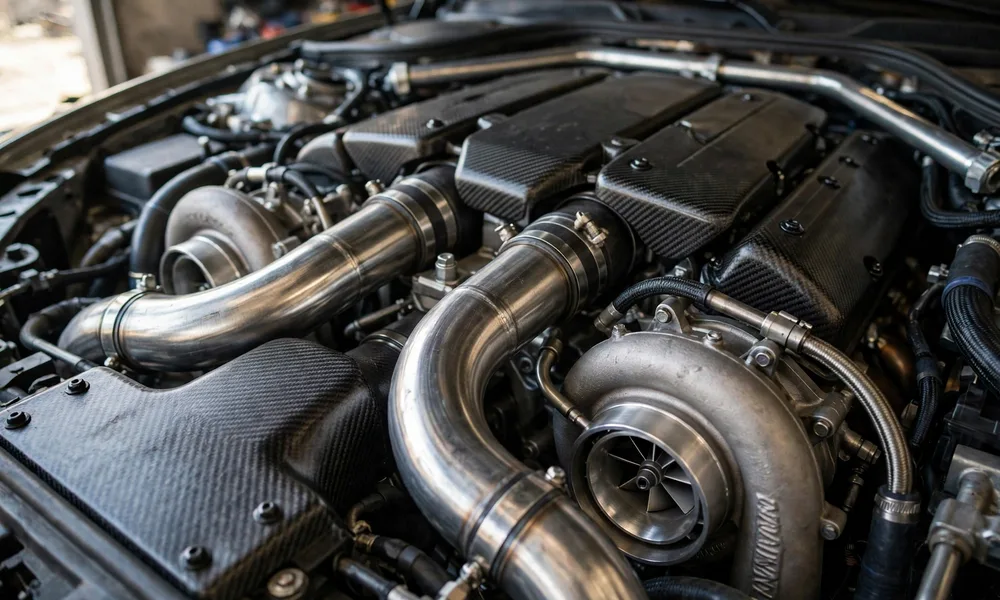
A single turbo big enough to feed sixteen cylinders would lag badly at low revs, so Bugatti uses four smaller ones, working in sequence — two at low speed, all four at full throttle. The plumbing alone is a work of art: exhaust manifolds, intercoolers, and pipes routed through a space with almost no spare room, each joint sealed against heat that would melt lesser metals. The turbos themselves are precision balanced to spin at well over 100,000 revolutions per minute. One unbalanced turbo would destroy itself in seconds, so each is tested on its own rig before it ever meets the engine.
3. Materials borrowed from racing and aerospace
The pistons, connecting rods, and valves live in heat and force that would kill ordinary steel. Bugatti uses forged alloys, titanium in places, and coatings that reduce friction to a whisper. The crankshaft is forged from a single billet and then ground to a finish measured in microns. These materials are expensive to buy and harder to machine — a titanium part that takes an hour to cut can take a day if the tooling is wrong, and tooling wears out fast on hard alloys. The materials and why engineers chose them are explained in our look at the engine’s engineering, as covered in our guide to Bugatti W16 engine specs.
4. Cooling that has to tame a furnace
At full power the W16 makes enough heat to warm a house, and all of it must be carried away while the car is moving at over 400 kilometres per hour. The Chiron carries ten radiators and three separate cooling circuits — one for the engine, one for the intercoolers, and one for the oil — with pumps that move more than 800 litres of coolant a minute. The cooling system is part of the engine’s cost because it is engineered as one system with the engine, not bolted on afterwards. The way the engine breathes, burns fuel, and sheds heat is covered in our look at how the Bugatti W16 engine works.
5. Built by two people, not a production line
Each W16 is assembled by a pair of technicians in Molsheim, France, in a clean workshop where the engine is built up over days, not minutes. Every fastener is torqued to a recorded value, every clearance is measured and logged, and the finished engine is run on a dynamometer for hours — including full-power runs — before it is allowed near a car. If a reading is off, the engine comes apart again. There is no line speed to protect and no volume to spread the labour over: a few hundred engines a year carry the cost of the whole workshop.
6. Testing that treats every engine as a prototype
Before delivery, each engine is tested to its limits on the bench, then tested again in the car on the road and track. The test programme includes sustained high-speed running, heat-soak trials in desert temperatures, and cold starts in winter conditions. The cost of that testing — the fuel, the rigs, the engineers, and the engines that fail and must be rebuilt — is folded into every engine that passes. A mass-market engine spreads its development cost over millions of cars; the W16 spreads its over a few hundred.
Bugatti W16 Engine Costs at a Glance
| Part of the cost | What drives it |
|---|---|
| Engine block | W16 layout, four heads, micron-tolerance machining |
| Turbochargers | Four sequenced turbos, balanced beyond 100,000 rpm |
| Materials | Forged alloys, titanium, low-friction coatings |
| Cooling | Ten radiators, three circuits, 800 litres per minute |
| Assembly | Two technicians per engine, days of hand building |
| Testing | Full-power dynamometer runs, road and track trials |
What Does a Bugatti W16 Engine Cost?
A replacement W16 engine is estimated at $400,000 to $900,000, depending on specification, with some reports putting a fully dressed unit above $1 million once turbos, cooling, and electronics are included. Prices are estimates only and vary with model year and specification. The engine is not sold separately in any normal sense — it arrives inside a car that costs several million dollars — but the estimate reflects what it takes to build sixteen cylinders to this standard by hand.
A Rare Fact
At the Chiron’s top speed of over 400 kilometres per hour, the engine burns fuel so fast that the car’s 100-litre tank would empty in under ten minutes — and the tyres, specially made for the car, would last only about fifteen minutes at that speed before the heat destroyed them. Bugatti limits the car’s top speed electronically, not because the engine cannot go faster, but because the tyres cannot. The W16 was ready for more speed than the rest of the car could survive.

The W16 is the last of its kind — a sixteen-cylinder engine built the slow way, by people who measure twice and torque once. Its successor will be a smaller hybrid, which makes the cost of the W16 easier to understand: it is the price of an idea that will not be repeated, built to a standard no production line could match.


