In Sant’Agata Bolognese, there is a room where the loudest car Lamborghini has ever built begins in near silence. No stamping presses, no sparks flying from a production line, just a clean bench, a set of torque wrenches laid out in order, and a single technician who will build one engine from the first bolt to the last. The engine is the Revuelto’s V12, a 6.5-litre naturally aspirated twelve-cylinder that revs to 9,500 rpm and works alongside three electric motors. It is the most powerful series-production Lamborghini engine ever made, and it is still put together by hand.
The Revuelto’s V12 matters because it is the end of a line and the start of another. It carries the torch of Lamborghini’s great naturally aspirated twelves, the engines that made the Miura, the Countach, the Diablo and the Aventador famous, yet it was designed from a clean sheet to live inside a hybrid hypercar. It is lighter than the Aventador’s engine, it revs higher, and it produces 825 horsepower on its own before the electric motors add their share. Building it takes patience no robot has. This is how the Lamborghini Revuelto V12 is made.
How It’s Made
Step 1: Casting the block and heads
Every Revuelto V12 begins as molten aluminium alloy, poured into sand moulds to form the engine block and the two cylinder heads. The block is the skeleton of the engine, and its casting must be flawless: any hidden porosity in the metal will become a crack under the heat and pressure of a V12 at full throttle. After cooling, the castings are heat-treated and left to age so internal stresses settle out before any cutting begins. A rushed casting warps later, so the foundry gives it time. The finished castings are heavy, grey and rough, and they look nothing like an engine yet. The same obsession with lightweight structure runs through the whole car, and it is why the car’s body is built the way our guide to Lamborghini Revuelto V12 materials engineering describes.
Step 2: Precision machining
The rough castings travel to a machining centre, where computer-controlled cutters bore the twelve cylinder liners, face the decks flat and drill the oil and coolant passages. Tolerances are measured in microns, because a bore a fraction too wide means the piston rings never seal, and a deck a fraction out of flat means the head gasket fails at 9,500 rpm. Each block is probed and measured at every stage, and the numbers are recorded against that engine’s serial number for life.
Step 3: Forging the crankshaft, pistons and rods
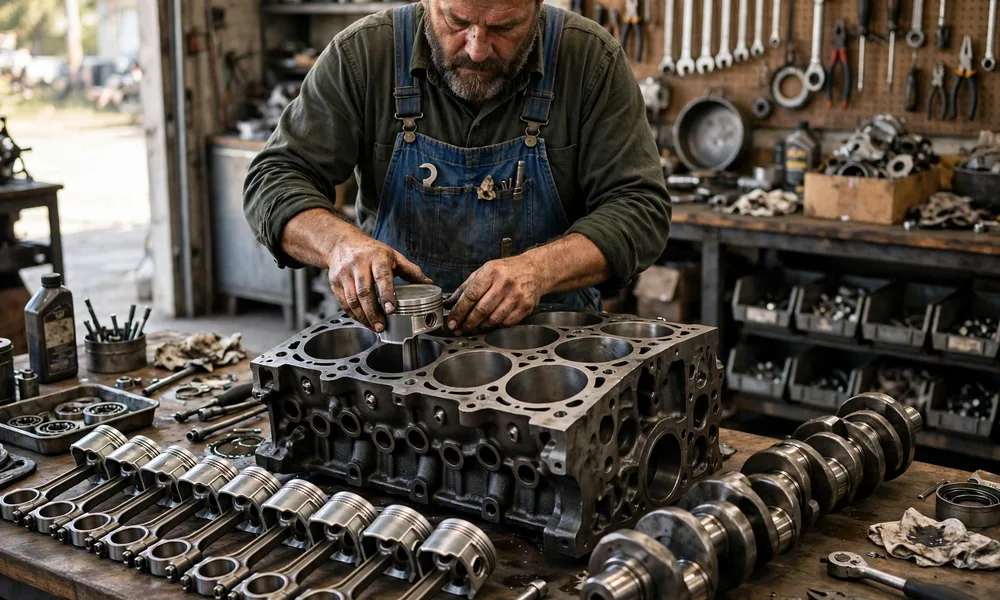
While the block is being machined, the moving parts are made separately. The crankshaft is forged from steel, then ground and balanced until it spins perfectly true. The pistons are forged from aluminium alloy, light enough to change direction thousands of times a minute, and the connecting rods are forged from titanium, strong enough to survive the enormous forces at the redline while adding almost no weight. Each piston and rod is weighed and matched into sets, so all twelve cylinders pull with exactly the same force. It is the same craft that built the great twelves before it, as our look at how a hypercar V12 engine is made shows, but the Revuelto’s parts are lighter and stronger than any Lamborghini V12 before it.
Step 4: Building the valvetrain and intake
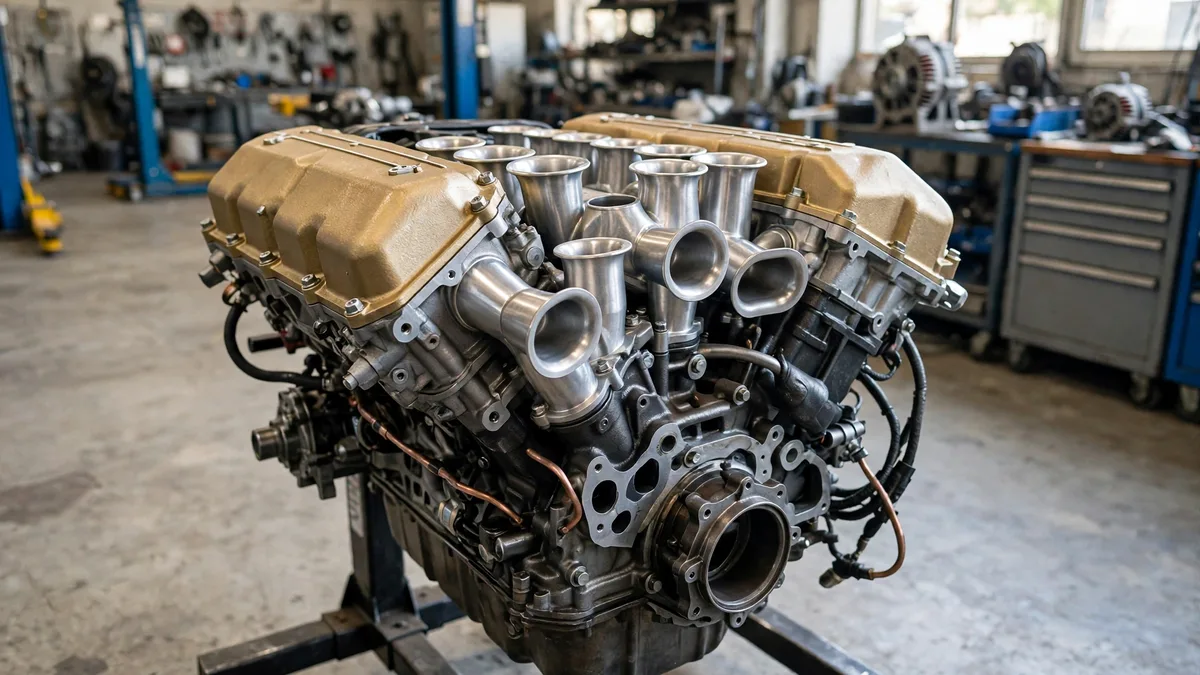
The Revuelto’s V12 breathes through a new intake system with long, tuned trumpets that feed each cylinder individually, and it is here that the engine earns its voice. The camshafts, valves and finger followers are fitted into the heads, and the valve clearances are set by hand with feeler gauges, one valve at a time, forty-eight of them in total. There is no shortcut: a clearance a fraction too tight and the valve burns; a fraction too loose and the engine loses power and gains a rattle. The intake trumpets are then bolted on, their lengths tuned so the pulses of incoming air arrive at each cylinder at exactly the right moment, a trick that helps the engine pull hard all the way to its redline.
Step 5: Hand assembly by one technician
Now the engine comes together, and this is the step no machine does. A single master technician builds each Revuelto V12 from start to finish: fitting the crankshaft and its bearings, sliding in the pistons, torquing the cylinder heads, setting the timing and fitting the dry-sump lubrication system that keeps oil pressure steady under hard cornering. Every bolt is tightened with a torque wrench to a figure in the build manual, and many are marked with paint so any movement is visible later. The work takes days, not hours, and at the end the builder’s name goes on the engine. One person, one engine, one signature, the same tradition that built every great Lamborghini V12 before it.
Step 6: Dyno testing and the hybrid marriage
A finished V12 is not trusted until it has proved itself. It is bolted to a dynamometer, a machine that loads the engine as if it were driving a car, and run through its rev range while engineers watch power, temperatures, oil pressure and vibration. The engine is run in gently at first, then pushed to full power, and if anything is wrong, a noise, a temperature spike, a drop in pressure, it comes off the dyno and goes back to the bench. Only when it passes every test is it mated to the Revuelto’s eight-speed dual-clutch gearbox and the electric motor that sits between them, ready to be lowered into the car. The result is a powertrain of 1,015 horsepower, yet it is the V12, not the motors, that gives the car its soul, a lesson the W16 era taught in its own way, as our guide to how the Bugatti W16 engine is made explains.
Specs
| Specification | Detail (Lamborghini Revuelto V12) |
|---|---|
| Configuration | 60° V12, four valves per cylinder |
| Displacement | 6.5 litres |
| Power (engine alone) | 825 hp at 9,250 rpm |
| Redline | 9,500 rpm |
| Combined system power | 1,015 hp with three electric motors |
| Block material | Cast aluminium alloy |
| Connecting rods | Forged titanium |
| Build | Hand-assembled by a single technician over several days |

Price
The Revuelto’s V12 is among the most expensive engines in the world to make, and it is fitted only to a car built in small numbers at Sant’Agata. The Revuelto itself typically costs from around $600,000 (estimate, based on typical pricing of the Revuelto in major markets), and the engine accounts for a large share of that figure: days of skilled hand labour, forged titanium and exotic alloys, and hours of dyno testing for every single unit. There is no cheaper way to build a 9,500 rpm V12 by hand, and Lamborghini has never tried to find one.
Rare Fact
The Revuelto’s V12 is the lightest V12 Lamborghini has ever built, and it is also the most powerful, yet it weighs less than the Aventador’s engine it replaced. Engineers saved weight everywhere, from the cylinder heads to the block itself, and the engine is 17 kilograms lighter than its predecessor despite producing far more power. It is a neat summary of the whole car: more of everything, and less weight carrying it.


