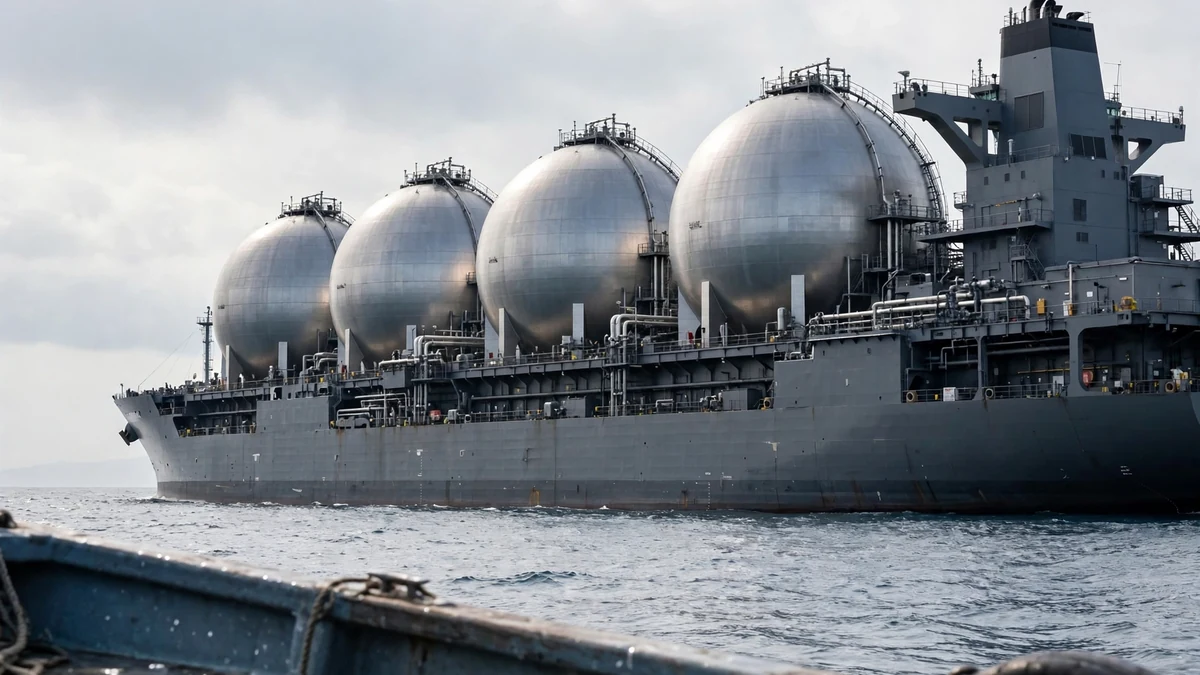
On a winter night in the middle of the Pacific, a ship the length of three football fields is carrying enough natural gas to heat a small city for a year. The gas is not in steel cylinders or under crushing pressure. It is sitting in four enormous aluminium spheres, each one colder than the coldest night ever recorded on Earth, and the only thing keeping it liquid is a vacuum, a layer of insulation, and a design that has never been allowed to fail.
Natural gas becomes a liquid when it is chilled to minus 162 degrees Celsius. At that temperature it shrinks to about one six-hundredth of its volume as a gas, which is what makes it possible to ship across oceans at all. But a liquid that cold will freeze ordinary steel until it shatters, and it will boil away the moment it warms. The tanks of an LNG carrier are therefore thermos flasks the size of houses, built inside a ship to keep the cold in and the ship safe.
How It Works
Step 1: Chilling the gas into a liquid
The process starts on shore, at a liquefaction plant. Natural gas is cleaned of water, carbon dioxide and other impurities, then passed through a series of refrigeration stages until it reaches minus 162 degrees Celsius and condenses into a clear, colourless liquid. It is pumped aboard the carrier through insulated loading arms, and the tanks are cooled down slowly first, because pouring liquid that cold into a warm tank would shock the metal and crack it. The cooldown alone can take many hours.
Step 2: Holding the cold in the Moss sphere
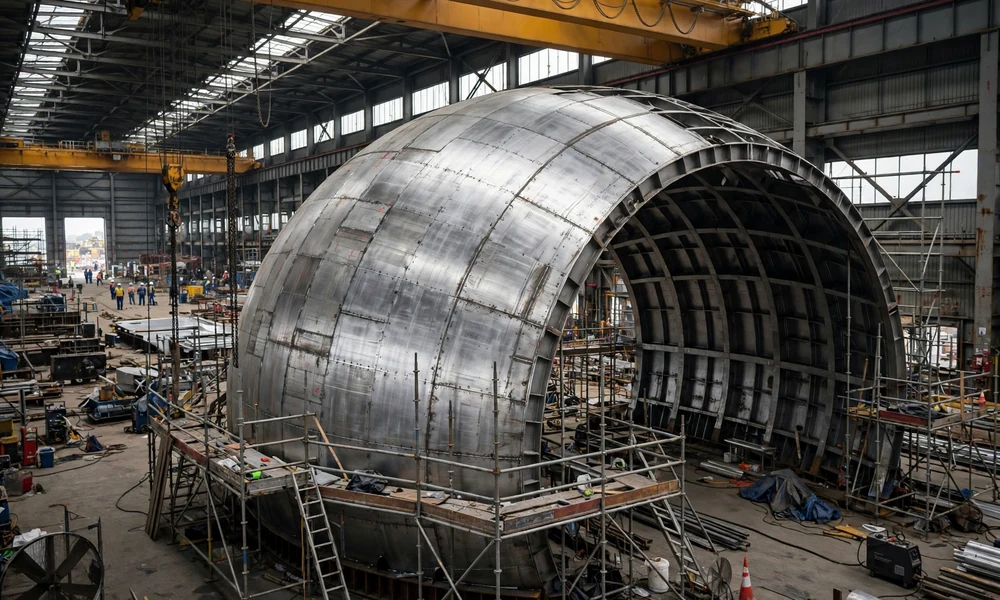
The most recognisable LNG carriers are the Moss type, with their four or five giant spheres rising above the deck. Each sphere is made of aluminium alloy, which stays tough at cryogenic temperatures where ordinary steel turns brittle. The sphere is not attached rigidly to the ship: it sits in a steel skirt, held by a single equatorial ring, so it can shrink as it cools and expand as it warms without stressing the hull. Around the aluminium shell is a thick blanket of insulation, and around that, a steel cover that keeps the weather out. The spherical shape spreads pressure evenly and has the least surface area for its volume, which means the least heat leaking in.
Step 3: The membrane alternative
The other great family of LNG tanks is the membrane tank, which is built directly into the shape of the ship’s hull. Here the tank wall is a thin membrane of stainless steel or Invar, an alloy of iron and nickel that barely contracts when it gets cold, and behind it are two layers of insulation, usually plywood boxes filled with perlite or rigid polyurethane foam. The membrane is not the structure at all: the ship’s hull carries the load, and the membrane only has to stay liquid-tight. Membrane ships can carry more cargo in the same hull, which is why most new LNG carriers use them, and the design owes much to the way a container ship’s hull is shaped around its cargo, as in how a container ship hull works.
Step 4: Managing boil-off gas
No insulation is perfect, so a small amount of heat always leaks into the tanks and a small amount of LNG always boils back into gas. This is called boil-off, and on a modern carrier it amounts to roughly 0.1 percent of the cargo per day. Rather than being wasted, the boil-off gas is collected and piped to the ship’s engines, where it is burned as fuel. The newest carriers run on dual-fuel engines that burn the boil-off gas, so the cargo itself helps power the voyage.
Step 5: The secondary barrier
Every LNG tank has a second line of defence. Behind the primary membrane or sphere wall is a secondary barrier, designed to contain the cargo for a limited time if the first wall ever leaks. In a membrane tank this is a second, thinner membrane inside the insulation; in a Moss ship it is a drip tray and a steel cover that directs any leak safely away. The space between the barriers is filled with nitrogen and monitored for gas, so the crew knows about a leak long before any liquid escapes, the same philosophy as a submarine’s pressure hull, as in how a submarine pressure hull is made.
Step 6: Keeping the liquid still
A partly filled LNG tank is dangerous in rough seas, because the liquid can slosh from side to side and slam into the tank walls with enormous force. For that reason LNG carriers sail either almost full or almost empty, and the tanks are fitted with baffles to break up the movement of the liquid.
Step 7: Unloading and warming up
At the receiving terminal the process runs in reverse: the LNG is pumped ashore, vaporised back into gas and fed into pipelines, while the tanks are left cold with a small heel of liquid to keep them chilled for the next loading. If a ship has to go into dry dock, the tanks are warmed up slowly over days and purged with nitrogen before anyone is allowed inside.

Specs
| Specification | Typical figure |
|---|---|
| Cargo temperature | Minus 162°C |
| Volume reduction | About 600 to 1, gas to liquid |
| Large carrier capacity | 170,000 to 180,000 cubic metres; Q-Max up to about 266,000 |
| Moss sphere diameter | About 40 metres |
| Sphere material | Aluminium alloy, about 50 mm thick |
| Membrane material | Stainless steel or Invar, 0.7 to 1.2 mm thick |
| Insulation thickness | 250 to 530 mm, depending on the system |
| Boil-off rate | About 0.1 percent of cargo per day |
| Service speed | About 19 to 20 knots |
| Design life | 30 to 40 years |
Price
An LNG carrier is one of the most expensive merchant ships ever built. As an estimate, a new large LNG carrier cost roughly $250 million to $260 million in the mid-2020s, and the biggest Q-Max vessels cost more, with the final figure depending on yard, size and propulsion. The tanks themselves are a large share of that cost: the aluminium for a Moss sphere, or the precision membrane and insulation system, takes years of specialist work to build and test. These are estimates, and prices move with the shipbuilding market and the price of steel and aluminium.
A Rare Fact
The first ocean-going LNG carrier, the Methane Pioneer, sailed in 1959 carrying just 5,000 cubic metres of LNG in aluminium boxes supported inside the hull by balsa wood, chosen because it is a superb insulator that does not conduct the cold into the ship’s steel. Today’s ships carry fifty times as much, but they still solve the same problem: keeping a liquid colder than Antarctica inside a steel ship, in the middle of the ocean, for weeks at a time.
From a gas field to a power station on the other side of the world, the LNG carrier’s tanks carry winter itself across the equator, and they do it so reliably that the world has come to depend on it. The work that goes into an icebreaking hull shows the same obsession with steel and temperature taken to the opposite extreme, as in how an icebreaker hull is made.


