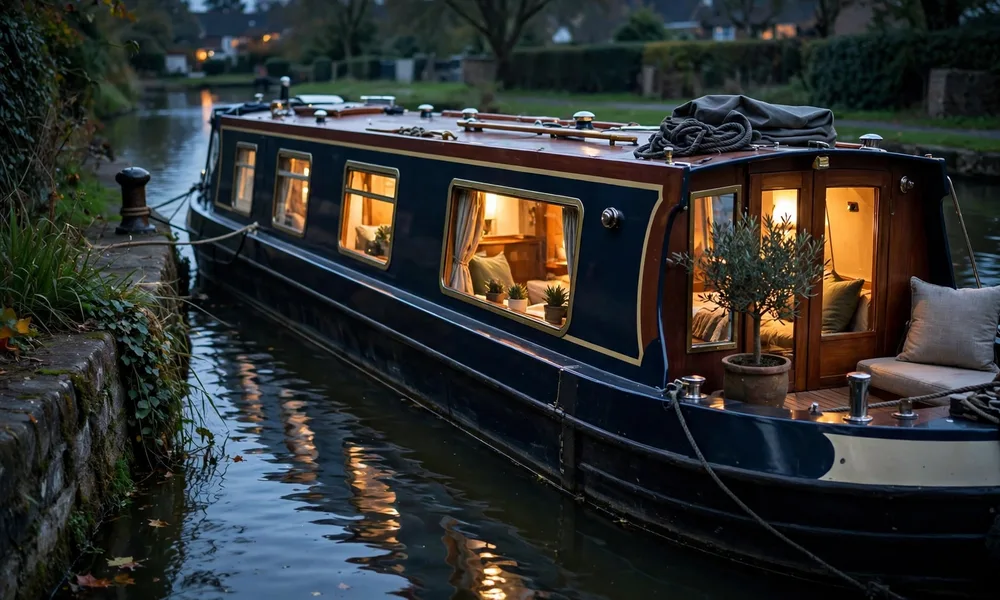
Stand on the towpath of a quiet canal in the early morning and you will hear it before you see it: a soft wash against the bank, the low putter of a diesel engine, and then a long, low shape sliding into view, wider than a house and painted in deep green and cream. It is a barge, a boat built for canals dug two hundred years ago, and this one is no working freighter. Through its portholes you can see a galley kitchen, a brass lamp, and a bookshelf, and on its roof a small garden of herbs grows in wooden boxes. Someone lives here, in comfort, on water that barely moves.
A luxury barge begins life not as a boat but as a pile of steel plate in a yard, and the difference between a cargo barge and a floating home is made long before the first coat of paint. Building one is slow, heavy, and exacting work, and this is how it is done, from the first cut of steel to the first night aboard.

How It’s Made
Step 1: The hull is cut from flat steel plate
Every luxury barge starts as flat sheets of mild steel, usually ten millimetres thick on the bottom and six on the sides, delivered to a boatyard and marked out with chalk lines. A plasma cutter or a gas torch follows the lines, cutting the plates into the shapes of the base, the sides, the bow, and the stern, and each piece is numbered so the builders know exactly where it belongs.
Step 2: The base plate is welded into a long, flat shell
With the base plate laid flat, the builders weld the side plates to its edges, standing them upright and holding them in place with clamps and temporary braces while the welds are made. The bow is formed by bending and welding the front plates into a gentle point, and the stern is shaped to hold the propeller and rudder, with a swim, a tapered section underneath, that lets water flow smoothly to the propeller. This is the moment the boat first looks like a boat, a long steel shell open to the sky, and the welders work along every seam, inside and out, until the shell is watertight. The shape matters too, since a barge that works well on canals, as how a luxury barge works shows, depends on this flat bottom and its gentle curves.
Step 3: Frames, ribs and ballast give the hull its strength
Once the shell is watertight, steel ribs are welded across the inside at regular intervals, stiffening the sides and tying the base to the gunwales, the top edges of the hull. Bulkheads, vertical steel walls, divide the hull into sections and stop a leak in one part from flooding the whole boat, and the engine bay at the stern is framed in steel strong enough to carry the weight of the engine and its mounts. Then comes ballast, usually concrete blocks or steel ingots laid low in the bilges, which pulls the boat down to its designed waterline and keeps it stable. The builders adjust it by eye and by measurement, flooding the hull with water to check the trim, and only when the boat floats level is the shell ready for the next stage.

Step 4: The engine, propeller and steering are fitted
The engine is lowered into its bay at the stern, usually a small diesel of forty to sixty horsepower, bolted to steel bearers and connected to a propeller shaft that runs through a sealed tube in the hull. The propeller, often a three-bladed bronze screw, is fitted outside, and the rudder hangs behind it on a steel post, linked to a tiller or a wheel in the steering position. At this stage the boat can move under its own power for the first time, and the builders take it for a short trial run, checking that the engine reaches its revs, the steering answers, and the hull does not leak at speed. The numbers that describe the finished boat, in the luxury barge specs, all trace back to the choices made in this cramped, noisy engine bay.
Step 5: The cabin and the fit-out turn steel into a home
With the hull finished, the cabin is built on top, usually a steel or timber superstructure with a gently curved roof, windows, and a side hatch, and then the inside is fitted out like a small house. Insulation goes in first, sprayed foam or rigid boards glued to the steel, because bare steel sweats with condensation and a cold boat is a miserable one. Then come the floor, the kitchen with its hob and fridge, the bathroom with a shower and a pump-out toilet, the bedroom, and the saloon with its stove, a small wood-burning stove being the heart of many barges. The fit-out is where the luxury appears: solid oak worktops, brass fittings, a proper mattress, and a stove that will keep the boat warm through a winter on the water.
Step 6: Painting, blacking and the final float test
The last stage is protection. The hull below the waterline is coated in bitumen blacking, a thick tar-like paint that keeps canal water off the steel, and the cabin is painted in the owner’s colours, often a deep green or red with cream trim and a hand-painted name on the bow. The builders check the waterline against the marks they painted on the hull, run the engine, test every tap and light, and look for any sign of a leak. Only then is the barge handed over, and the owner can load their books, their clothes, and their herbs for the roof garden. A boat built this carefully explains its price, as why a luxury barge is so expensive shows, because almost everything in it is hand-made, and nothing in it is mass-produced.
Luxury Barge Specifications
The figures below describe a typical new-build luxury narrowboat barge on the English canal network. Sizes vary by yard and owner, but the working principles are the same.
| Specification | Typical value |
|---|---|
| Length | About 17 to 21 metres |
| Beam (width) | About 2.1 metres |
| Hull steel thickness | 10 mm base, 6 mm sides |
| Engine | Diesel, about 40 to 60 hp |
| Cruising speed | About 3 to 4 mph |
| Build time | About 6 to 12 months |
What It Costs
A new-build luxury barge costs an estimated $180,000 to $400,000, depending on length, engine, and the standard of the fit-out, and the hull alone is a large share of that. Those are estimates, not quotes, and they reflect months of welding and joinery, much of it done by hand, plus the cost of the steel itself. The running costs are modest by boating standards, a mooring, a licence, fuel, and blacking every few years, which is part of why a barge appeals to people who want a home that moves slowly and costs little to keep.
A Rare Fact
Here is a detail most people never guess. A narrowboat barge is built to a width of about 2.1 metres because the locks on the English canals were dug for boats pulled by a single horse, and a boat even a few centimetres wider would be trapped on the wrong side of a lock gate for the rest of its life.


