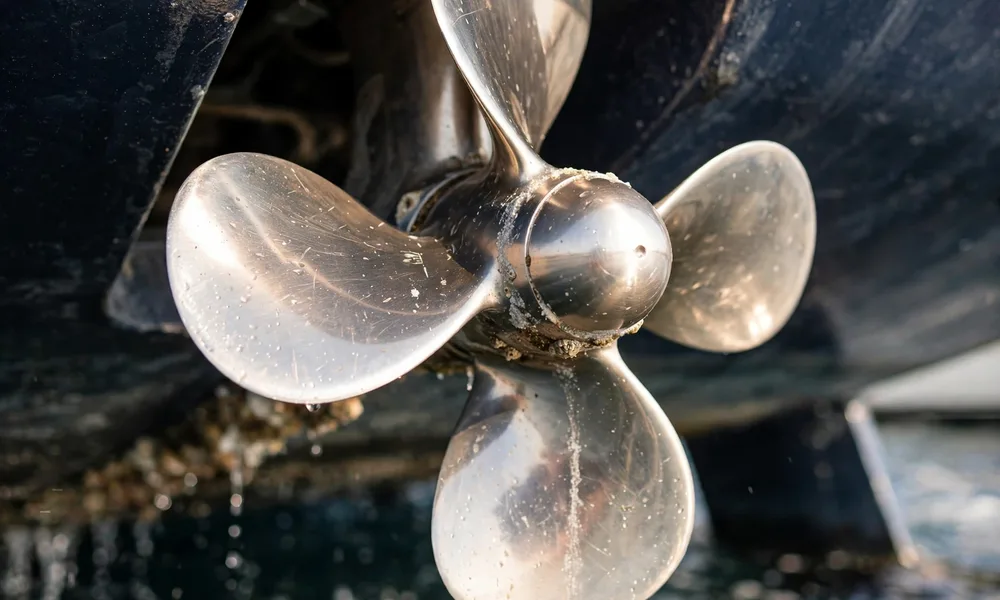
Look at the stern of a superyacht in dry dock and you will see it: a gleaming, sculpted piece of metal hanging below the hull, its blades curved like the petals of a flower, polished to a dull silver shine. It is the propeller, and on an ordinary boat it is a modest piece of bronze that costs a few thousand dollars. On a luxury yacht it can be made of titanium, and then the same piece of metal can cost as much as a car, or more. The question is why, and the answer begins with the metal itself.
Titanium is one of the most remarkable metals in engineering: as strong as steel but barely more than half the weight, and almost completely immune to corrosion in seawater. A bronze propeller slowly corrodes and erodes in salt water and must be replaced or repaired every few years; a titanium propeller barely changes at all, year after year, in the harshest water on earth. That durability is the promise, and the price is the cost of keeping it.

The Metal Itself Is Rare and Difficult
Titanium is the ninth most common element in the earth’s crust, but it is rare in the form engineers can use, because it is extraordinarily difficult to extract and refine. The ore must be turned into titanium tetrachloride, then reduced with magnesium in a sealed vessel at high temperature, in a process that takes days and produces a spongy mass of metal that must then be melted, in a vacuum, more than once, to remove impurities. The whole process is slow, energy-hungry, and expensive, and the price of aerospace-grade titanium runs to tens of dollars per kilogram before anyone has even begun to shape it.
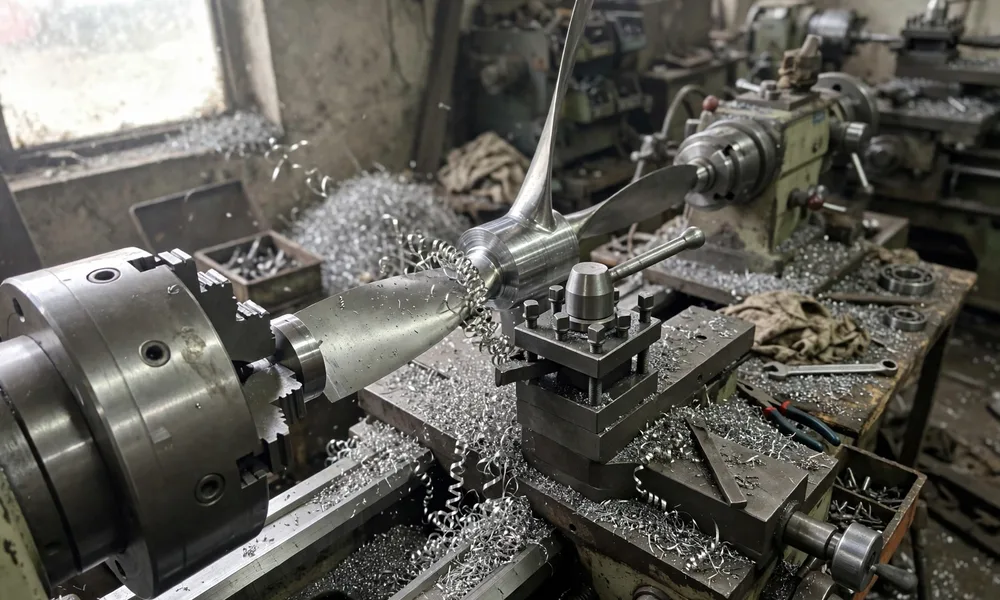
That is only the start. Titanium is also difficult to work with: it is hard, it wears out cutting tools quickly, and it catches fire if it is machined too fast, because the fine chips it produces can ignite in air. A propeller maker must use slow cutting speeds, special tooling, and careful cooling, and every hour of machining costs more than it would for bronze or steel. The metal fights the workshop at every step, and the workshop charges for the fight.
Shaping a Propeller Is a Craft, Not a Casting
A luxury titanium propeller is not cast in a mould and polished; it is machined from a solid block or forging, and that is where most of the cost lives. A propeller for a large yacht starts as a forging of titanium weighing hundreds of kilograms, and a five-axis milling machine then spends days, sometimes weeks, carving away most of that metal to leave the blades. More than half the titanium ends up as chips on the workshop floor, and those chips are valuable but cannot simply be melted back into a propeller without losing quality, so the waste is part of the price.
The shape itself is a work of engineering. Each blade is twisted and curved so that it bites the water evenly along its length, and the exact curve is designed for one specific yacht, its engines, and its cruising speed. A change of a millimetre in the blade can change the vibration, the noise, and the fuel consumption, so the finished propeller is measured with laser scanners and balanced to a fraction of a gram. A bronze propeller can be cast and finished by hand; a titanium propeller is a precision instrument, and it is priced like one.
Why Titanium, and Why Only Sometimes
The case for titanium is strongest where the propeller works hardest. On a fast yacht, the propeller spins at high speed in water full of tiny bubbles, a phenomenon called cavitation, and the collapsing bubbles eat away at bronze blades, pitting and eroding them over time. Titanium resists cavitation damage far better than bronze, so a titanium propeller keeps its shape and its efficiency for far longer, and the yacht burns less fuel and vibrates less. On a submarine or a naval vessel, titanium also has another advantage: it is non-magnetic, so it does not trigger magnetic mines or sensors, which is why navies have used it for decades.
But the advantages come with a catch. Titanium is so stiff and so strong that it transmits vibration more readily than bronze, and if the propeller is not perfectly matched to the yacht, the whole stern can hum. That is why most yachts still use bronze, and titanium is reserved for the largest, fastest, and most demanding vessels, where the performance gain is worth the risk and the bill.
What a Titanium Propeller Costs
Here are estimates, labelled as such. A titanium propeller for a 30-metre yacht, roughly 800 millimetres in diameter, costs in the region of $50,000 to $100,000, including design, machining, and balancing. A larger propeller for a 50-metre superyacht can cost $150,000 to $300,000, and a set of two can exceed half a million dollars. By comparison, a bronze propeller of the same size costs roughly $10,000 to $30,000, so titanium runs three to five times the price of bronze, and sometimes more.
The lifetime cost is where titanium starts to make sense. A bronze propeller on a hard-working yacht may need repair or replacement every five to eight years, and each haul-out, repair, and rebalancing costs money and takes the yacht out of service. A titanium propeller can last the life of the yacht with little more than cleaning and inspection, and over twenty years the total cost can end up similar, or even lower. The catch is that the owner must pay the whole bill up front, in one piece, and most owners would rather pay less now and deal with the repairs later. How a titanium propeller works explains the physics that makes the metal worth the money, and the making of one shows where the hours go.
One Rare Fact Worth Knowing
Here is the rare fact that surprises even engineers: titanium propellers were first used not on yachts but on submarines and torpedoes, where their silence mattered more than their price. A bronze propeller sings in the water, a faint hum that sonar can hear from far away, while a titanium propeller, shaped and balanced to perfection, runs quieter, and on a military vessel that silence is worth almost any price. Luxury yacht owners inherited the technology from the navy, and they pay naval prices for it, even though their only enemy is a noisy dinner party on the aft deck. The metal that hides a submarine is now the metal that pushes a yacht, and the price followed it from the dockyard to the marina.
A titanium propeller, then, is expensive because the metal is hard to make, harder to machine, and shaped to a precision that bronze never needs, all for a part that spends its life underwater where nobody can see it. It is the most invisible luxury on a yacht, and also one of the most honest: every dollar goes into performance and longevity, not into decoration. How a titanium propeller is made shows the workshop where the bill is built, and how a hydrofoil is made shows another piece of metal that earns its price the same way, by doing a hard job in unforgiving water. Next time you see a yacht’s stern out of the water, look for the silver blades: if they are titanium, you are looking at a small fortune, spinning quietly beneath the waves.


