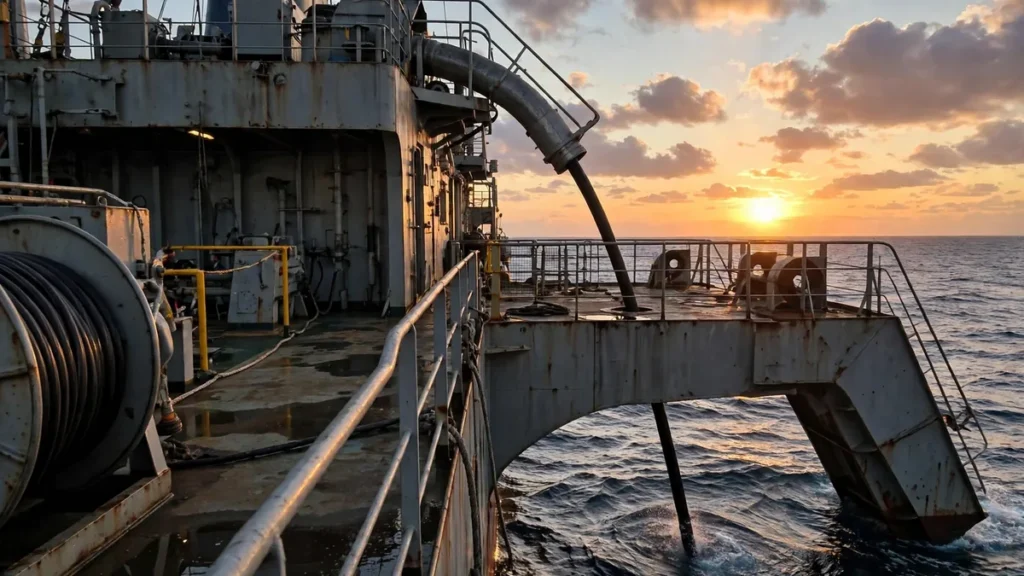
Every email, video call and bank transfer that crosses an ocean travels through a cable lying on the seabed, and every one of those cables was put there by a ship. A cable-laying ship is not a glamorous vessel. It has no casino, no swimming pool and no guests in evening dress, but it carries the internet on its back, and the work it does decides whether continents can talk to each other. Building a ship that can do this is a strange piece of engineering, because the ship is really a floating factory, a warehouse and a precision instrument all at once, and it has to hold its position in open sea while handling a cargo that must never be kinked, stretched or dropped.
Step 1: A hull built to hold still in open sea
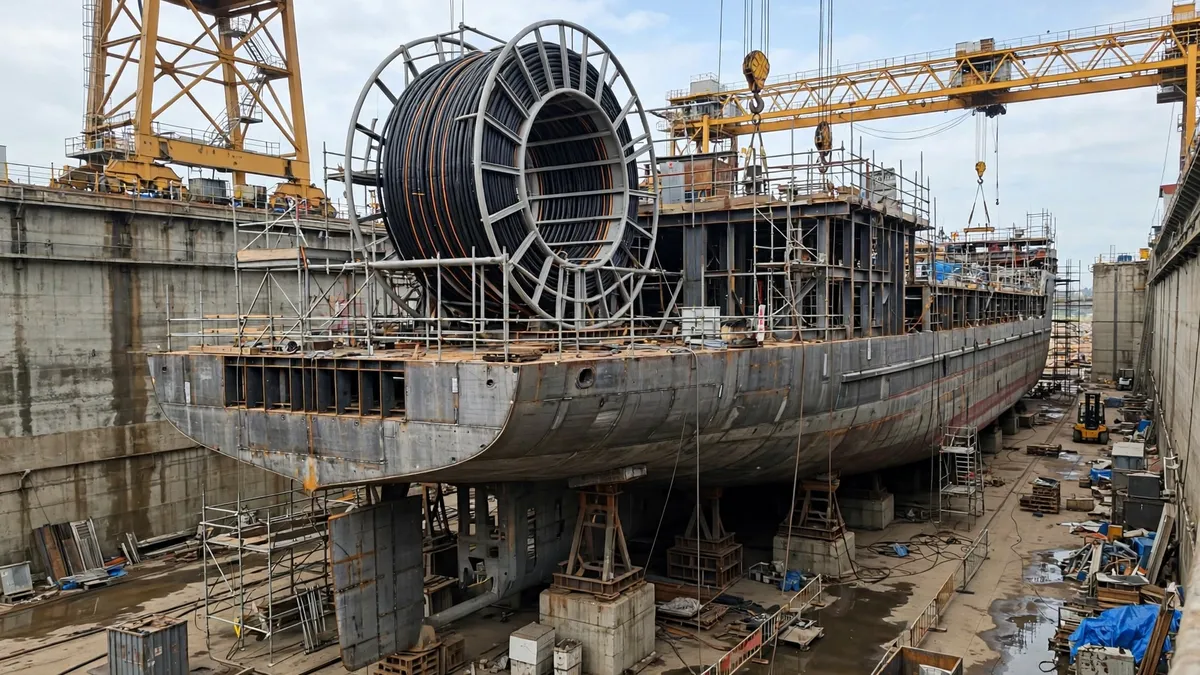
A cable-laying ship begins with a hull designed for station-keeping rather than speed. It is broad and stable, with a flat working deck and a high bow to keep green water off the cable gear, and it is fitted with dynamic positioning, a system of thrusters and satellite navigation that holds the ship within a few metres of its planned track without an anchor.
The hull is divided into tanks for ballast and fuel, and into a large hold for the cable itself. Steel plate is cut, shaped and welded in blocks, as on any large ship, but the blocks around the cable hold are built with extra care, because the cable must be loaded without a single sharp edge or rough weld to catch it.
Step 2: The carousel that stores the cable
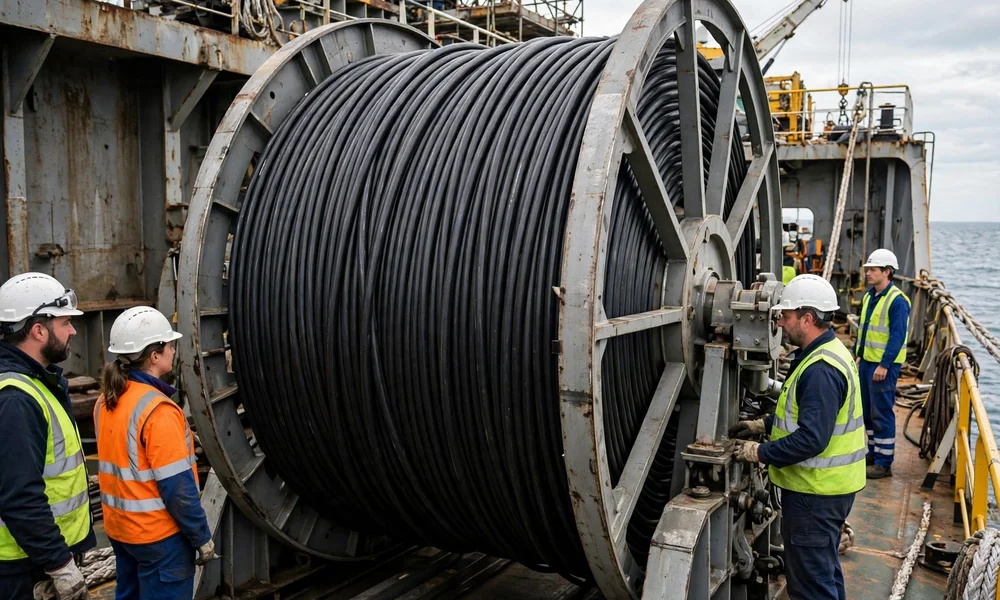
The heart of the ship is the cable carousel, a huge circular tank or drum that holds the cable in a single continuous coil. A modern carousel can hold several thousand kilometres of cable, wound in neat layers like thread on a spool, and the cable is loaded by a shore machine that feeds it aboard at a steady speed while the ship sits at the quayside.
Below the carousel, the cable passes through a series of rollers and a tensioning machine that controls how fast it leaves the ship. The machine is the ship’s most delicate instrument, because it must pay out cable at exactly the speed the ship is moving, plus a little slack, so the cable lies gently on the seabed instead of hanging in loops or being pulled taut.
Step 3: The stern chute and the plough
At the stern, the cable leaves the ship over a large curved chute, a smooth steel ramp that guides it from the deck down into the water without a sharp bend. Behind the ship, a plough or a jetting machine often follows the cable down, cutting a trench in the seabed and burying the cable under a metre of sand or mud, where fishing trawlers and anchors cannot reach it.
The plough is a heavy steel frame towed on the seabed, and it is one of the most brutal-looking pieces of equipment on a civilised ship. It cuts through the bottom with a blade while water jets soften the ground ahead of it, and the cable drops into the trench behind it. The support vessel works beside such ships in the offshore world, as the guide to how a luxury support vessel is made describes, carrying the equipment and the people the cable ship needs for a long job.
Step 4: Engines, thrusters and power for the whole operation
A cable ship needs far more power than a ship of its size would normally carry, because it runs the cable machinery, the dynamic positioning thrusters and the deck cranes all at once, for weeks without a break. Most modern cable ships use diesel-electric power, with several generators feeding electric motors that drive the propellers and the bow and stern thrusters.
The thrusters are the key to the whole operation. There are usually two at the bow and two at the stern, and together with the main propellers they can push the ship sideways, hold it against wind and current, or turn it in its own length.
Step 5: Cabins, labs and a workshop for a long voyage
Above the working deck, the ship is a small town built for a long stay at sea. There are cabins for the crew and the cable engineers, a galley and a mess room, a laboratory where the cable is tested before it goes over the side, and a workshop where a damaged section can be cut out and spliced.
The ship also carries remotely operated vehicles, small unmanned submarines on tethers, that swim down to inspect the cable on the seabed and report back by camera. The offshore supply vessel carries similar tools to the same waters, as the guide to luxury offshore supply vessel specs explained sets out, and the two kinds of ship often work the same offshore fields, one laying the lines and the other keeping the platforms supplied.
Step 6: Sea trials, cable tests and the first lay
Before a cable ship is accepted, it is tested in ways no ordinary cargo ship ever is. The dynamic positioning system is proved by holding the ship still in a strong current, the carousel is loaded and unloaded with a test length of cable, and the tensioning machine is run at full speed to prove it can pay out smoothly.
Then the ship sails to its first job, and the real test begins. The research vessel sails the same oceans for a different reason, as the guide to luxury research vessel specs explained describes, studying the seabed the cable ship is quietly crossing, and both ships depend on the same skill: holding still and working carefully in open water.
Specifications
| Detail | Specification |
|---|---|
| Length | Around 130 to 170 metres |
| Beam (width) | Around 25 to 30 metres |
| Cable capacity | Around 5,000 to 8,000 kilometres |
| Laying speed | Around 5 to 10 kilometres per hour |
| Propulsion | Diesel-electric, dynamic positioning thrusters |
| Crew | Around 60 to 100 |
| Endurance | Around 60 days at sea |
| Working depth | Down to around 3,000 metres |
What it costs
The estimated price of a new luxury cable-laying ship is around 150,000,000 to 300,000,000 dollars, and that figure is an estimate only, because the cost depends on the size of the carousel, the depth rating and the dynamic positioning system. The hull and the cable machinery account for most of the price, followed by the power plant and the accommodation.
A rare fact
Few people know that a cable-laying ship can repair a cable that is already on the seabed, by cutting it, hauling both ends to the surface, splicing in a new section, and lowering the joint back down. The operation is done with a grapnel dragged along the bottom to hook the cable, and it can take days in rough weather, with the ship holding position over a line it cannot see, in water kilometres deep.