Stand beside a luxury car on a bright morning and the paint does something ordinary paint never does. It looks less like a coating and more like a pool of still water, deep enough to fall into, with the sky and the trees reflected so clearly that you can count the leaves in the bonnet.
That depth is not an accident, and it is not one coat of paint. It is many thin layers, each one sprayed, baked, sanded and checked by people who treat a speck of dust like a disaster. This is how luxury car paint is made, from bare metal to a mirror finish.
How It’s Made
Step 1: The steel body is cleaned and primed
Every paint job begins with a bare body shell, fresh from the welding shop and covered in oil, dust and the faint fingerprints of the robots that built it. The shell is washed in a series of chemical baths that strip every trace of grease, then dipped in a phosphate solution that etches the steel so the paint has something to grip.
Next comes the primer, sprayed on as a smooth grey coat that seals the metal against rust. On a luxury car the primer is applied by robots in a sealed booth, but people still walk the body afterwards with rags and lights, feeling for rough spots the machines cannot see. A flaw caught now costs minutes to fix; the same flaw found later costs the whole paint job.
Step 2: The primer is baked and sanded
The primed body rolls into an oven heated to around 180 degrees, where the primer hardens into a tough skin bonded to the steel. Baking is not just drying: the heat triggers a chemical cure that makes the primer far harder and more resistant to stone chips than it would be if it simply dried in the air.
Once cool, the primer is sanded by hand with fine paper until it feels like glass. Workers run their bare palms over every panel, because a hand can feel a bump of a tenth of a millimetre that the eye would miss. Any panel that is not perfectly smooth is sanded again. Nothing moves on to colour until the primer is flawless.

Step 3: The base colour goes on in the booth
The body enters the paint booth, a room cleaner than most hospital wards, where the air is filtered and the workers wear full suits so no hair or fibre can land on the wet paint. Robots spray the base colour in overlapping passes, each one laying down a film only a few microns thick, building the colour up in thin, even layers.
For a luxury car the colour itself is a small piece of engineering. Metallic paints carry tiny flakes of aluminium that catch the light, while pearl paints use mica crystals that shift shade as you walk around the car. The booth is lit to copy daylight exactly, so the colour the sprayers see is the colour the owner will see on the road.
Step 4: The clear coat is sprayed and polished
With the colour down, the body gets its clear coat, a transparent layer that gives the paint its depth and its shine. The clear coat is sprayed thicker than the colour coats, and it is what you are really looking at when you admire a luxury car: the colour sits underneath it, magnified and protected like a photograph under glass.
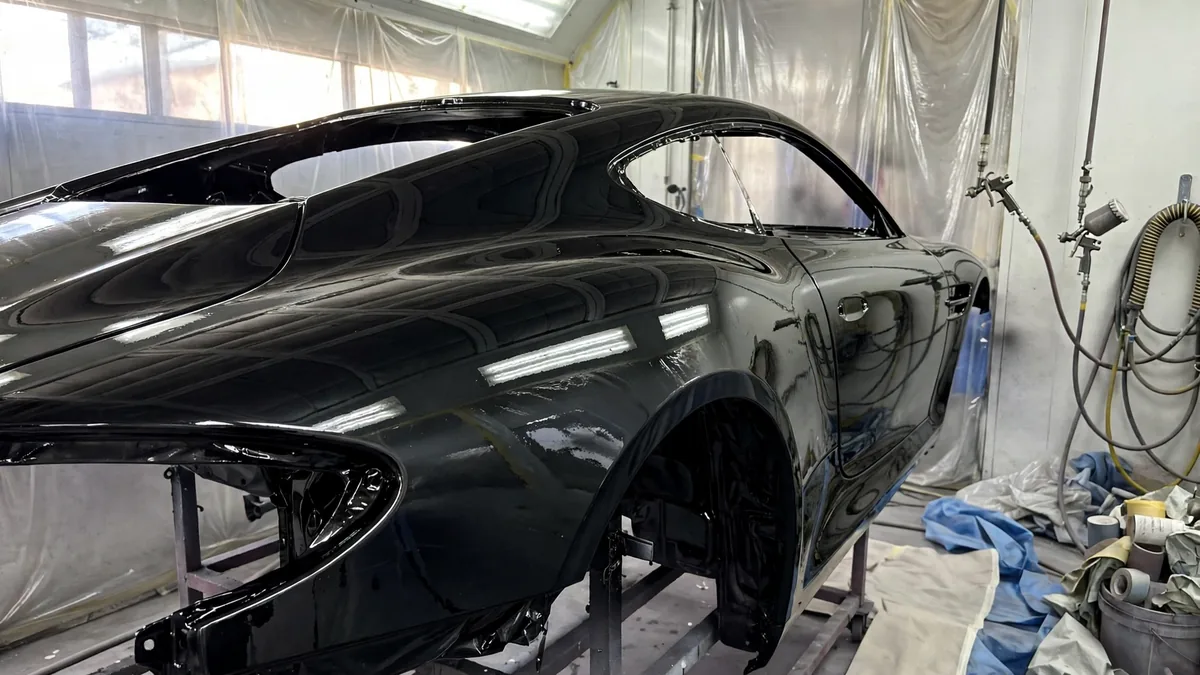
After another bake, the clear coat is polished. First a machine pass with a fine cutting compound levels the surface, then a hand polish brings up the final gloss. The polisher works panel by panel under strip lights, watching the reflection of the tubes slide across the paint. If the reflection wavers, the panel is polished again until the lines run perfectly straight.
Step 5: The paint is inspected under bright light
Inspection is a job in itself. The finished body passes through a light tunnel where rows of bright lamps throw reflections across every curve, and inspectors look for the tiniest defects: a dust nib, a sag in the clear coat, an orange peel texture where the paint did not flow out flat.
Any defect found here is marked with a small sticker, and the panel goes back for local repair. A speck is sanded out with paper finer than anything in a hardware shop, then the spot is resprayed and polished until it matches the panels around it. On a luxury line, a body can be sent back two or three times before it is allowed to move on.
Step 6: The body is cured and protected
The final step is a long, gentle cure. The body rests in a warm room while the paint finishes hardening, a process that continues for days even after the car leaves the factory. Rushing it would leave the paint soft, so the car is handled carefully on the rest of the line, with protective film over the most vulnerable edges.
Before delivery, the paint is washed, waxed and checked one last time in daylight. A thin film is often applied to the nose and sills to guard against stone chips on the first drives. Only then is the body handed to the trim shop, gleaming, to become a finished car.
| Spec | Detail |
|---|---|
| Primer | Corrosion sealing coat, baked at around 180 degrees and hand sanded smooth |
| Base coat | Colour layers sprayed by robots in a filtered booth, metallic and pearl options |
| Clear coat | Transparent protective layer, machine cut then hand polished to a mirror gloss |
| Booth | Filtered air, full protective suits, daylight matched lighting for colour checks |
| Baking | Oven curing after primer and clear coat, hardening the paint chemically |
| Inspection | Light tunnel checks for dust, sags and orange peel, with local repair and re-polish |
The hardest part of luxury paint is not the spraying, it is the patience. A robot can lay down a perfect coat in minutes, but the sanding, the polishing and the inspection take hours of human attention, and none of it can be rushed. Skip a step and the paint looks fine in the factory and tired within a year.
What One Costs
A luxury factory paint finish typically adds an estimated $5,000 to $25,000 to the price of the car, set mostly by the colour and the number of layers. A standard metallic finish sits near the bottom, while a hand finished multi-layer pearl or matte paint costs far more. For the body that carries the paint, how a luxury coupe is made follows the shell from the body shop to the paint booth, and how a luxury carbon-fibre chassis is made shows the lightweight structure underneath it all.
A Rare Fact
All the layers of paint on a luxury car together are only about 120 microns thick, which is barely thicker than a human hair. The entire mirror finish, the colour, the protection and the shine, fits into a skin thinner than a sheet of paper, and it still has to survive stones, sun, salt and a decade of washing.

Luxury car paint is a thin skin with a long story: cleaned steel, baked primer, hand sanded surfaces, robot sprayed colour and a clear coat polished until it holds a reflection like still water. It is the first thing anyone sees and the last thing the factory finishes, and it earns its shine one careful layer at a time. For the car it dresses, how a luxury supercar works explains the machine underneath the mirror.


