Stand beside a supercar at idle and you feel it before you hear it properly. The air trembles, the ground seems to hum, and the car sits so low and so wide that it looks less like something you drive and more like something that has landed. Then the driver touches the throttle, and the whole machine gathers itself and leaps, pressing you back into the seat with a force that makes an ordinary fast car feel like it is standing still.
A supercar works by refusing to compromise. Every part is chosen for speed, and then the engineers work backwards, adding just enough comfort, safety and manners to make the result usable on a real road. The engine is huge, the body is light, the brakes are enormous, and the aerodynamics are designed to push the car into the ground rather than lift it off it. It is a racing car that has learned to behave, most of the time.
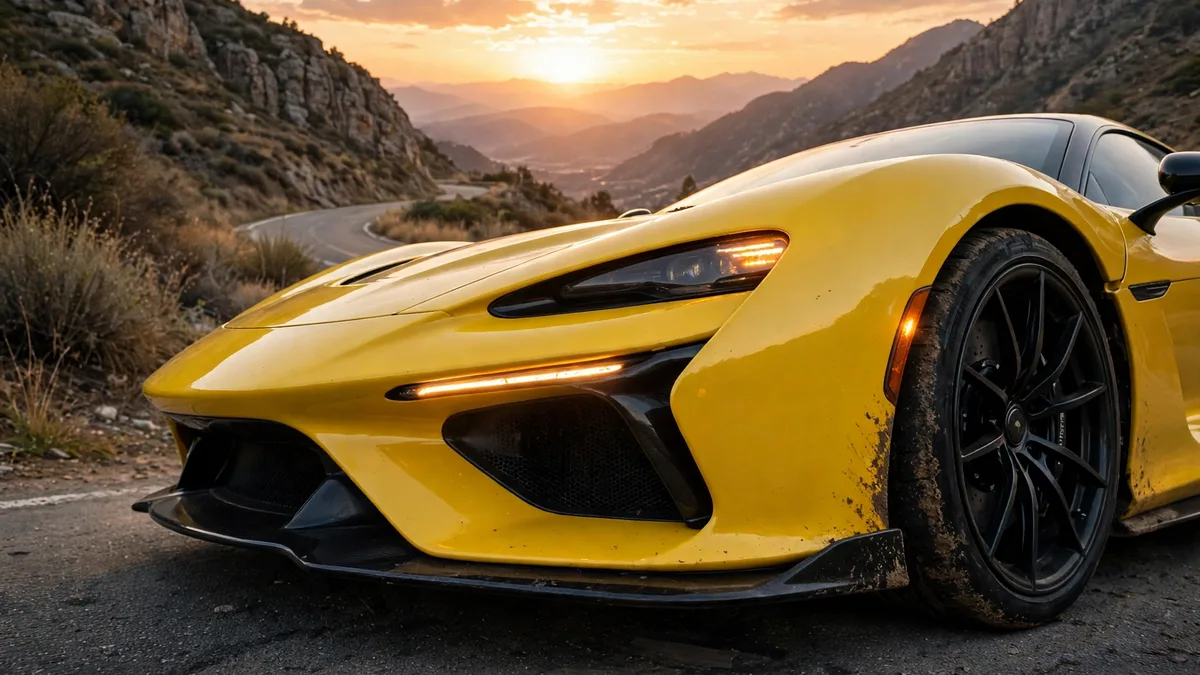
How It Works
Step 1: A big engine in the middle makes the power
At the heart of most supercars sits a large engine, often a V8 or V12, mounted behind the driver rather than in front. Putting the weight in the middle balances the car, so it turns evenly and does not push its nose wide in corners. The engine breathes through huge air intakes, burns fuel in large cylinders, and spins to speeds an ordinary engine would not survive, making 600 horsepower or more. It is built from light alloys, with parts machined to tolerances a human hair would fail, and it is tested at full power for hours before it is allowed into a car. The power is the point, but the placement is the clever part, and a racing car built on the same idea, as the racing car shows, uses the same mid-engine layout for the same reason.
Step 2: A fast gearbox keeps the power flowing
The engine’s power reaches the rear wheels, or all four, through a dual-clutch gearbox that changes gear in a few hundredths of a second, faster than a driver could ever manage with a lever. It is really two gearboxes sharing one housing, one handling the odd gears and one the even, so the next gear is always ready. Paddles behind the steering wheel let the driver choose, or the car can choose for itself, and in the fastest mode it will change gear at the exact revs the engine wants, every time. There is no torque converter to waste power, and no pause in the push, so the acceleration feels like one long, unbroken shove.
Step 3: The body is light, stiff and shaped by the wind
A supercar’s body is made from carbon fibre, a material lighter than steel and stronger than aluminium, laid up by hand in a mould and baked in an oven until it sets. The central tub, the part the driver sits in, is a single rigid shell, so stiff that the suspension can do its job properly instead of the body flexing. The shape is tested in a wind tunnel until it makes downforce, the invisible force that presses the car onto the road as speed rises. A wing at the back, a diffuser underneath and vents over the wheels all work together, and at high speed the car can press itself down with a force greater than its own weight.

Step 4: The suspension and steering talk to the driver
Supercar suspension is firm, but it is not crude. Dampers that adjust in milliseconds read the road and the driver’s inputs, stiffening in a corner and softening over a bump, and the steering is direct, with barely two turns from lock to lock, so a small movement of the wheel is a real change of direction. The driver sits low, close to the ground, and feels the road through the seat and the wheel, which is why a supercar feels alive at speeds where an ordinary car feels numb. The systems work together: the car knows when it is cornering, braking or accelerating, and it adjusts each wheel on its own, a hundred times a second.
Step 5: Huge brakes and clever tyres stop the speed
Going fast is easy; stopping is the hard part. A supercar’s brakes are made from carbon ceramic, discs the size of dinner plates that can survive temperatures that would melt ordinary steel, gripped by callipers with six pistons or more. They are cooled by air ducted from the front of the car, and they are helped by the aerodynamics, which press the tyres into the road, and by the tyres themselves, which are wide, soft and sticky, and warm up as they work. From 60 miles an hour a supercar can stop in about 30 metres, a distance that would embarrass a family car, and it can do it again and again without fading. The price of that performance is steep, as the sports car price explains, and the brakes alone cost more than some whole cars.
Step 6: Electronics keep the thunder tame
The final part is the electronics that stop the car from biting its driver. Traction control watches the wheels for slip and cuts the power in a fraction of a second, stability control brakes individual wheels to keep the car pointing where the driver wants, and launch control manages the perfect getaway, holding the engine at the right revs and feeding the power in just fast enough. The driver can turn these systems down or off, but most leave them on, because 600 horsepower on a wet road is more than any human can manage alone. The result is a car that feels wild and safe at the same time, a trick the electric grand tourer, in the electric grand tourer specs, achieves with motors and software rather than pistons and petrol.

Supercar Specifications
The figures below describe a typical mid-engine luxury supercar. Power and price vary widely, but the layout and the systems are the same.
| Specification | Typical value |
|---|---|
| Engine | 4.0 to 6.5 litre V8 or V12 |
| Power output | 600 to 800 horsepower |
| 0 to 60 mph | 2.8 to 3.5 seconds |
| Top speed | 200 to 220 miles per hour |
| Dry weight | 1,350 to 1,550 kilograms |
| Braking, 60 to 0 mph | About 30 metres |
What It Costs
A luxury supercar costs an estimated $250,000 to $500,000, depending on the brand and the specification, and limited versions pass $1 million. Those are estimates, not quotes, and they are only the start: a service can cost an estimated $3,000 to $8,000, a set of tyres an estimated $2,000, and a single carbon ceramic brake disc an estimated $5,000 or more. Owners accept it because a supercar is not transport, it is an event, and because the engineering inside it, from the hand-laid carbon fibre to the engine built by one person from start to finish, cannot be made cheaply. It is the most expensive way to go fast, and for the people who buy them, the only way that counts.
A Rare Fact
Here is a detail that still surprises people who have never driven one. At high speed, a supercar’s aerodynamics can press it into the road with more force than the car weighs, which means that, in theory, it could drive upside down on the roof of a tunnel. Nobody has tried it, for obvious reasons, but the maths says it would work, and the engineers who built the car are quietly proud of that.


