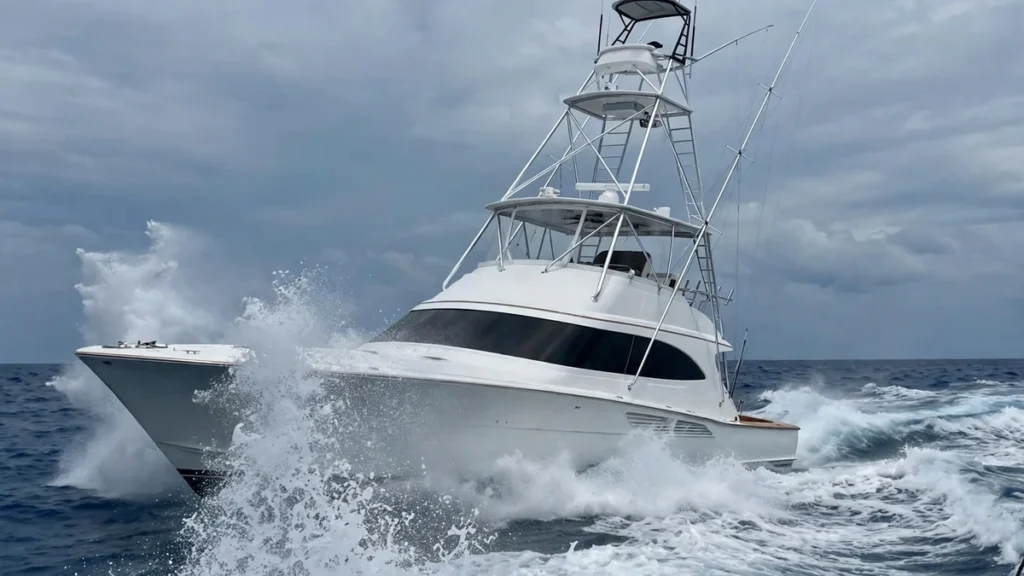
Every superyacht has a shadow, and if you watch a big yacht at anchor in the Mediterranean you will see it: a smaller boat, fast and low, moored a careful distance away, carrying the things the yacht itself cannot. The jet skis, the dive gear, the spare parts, the security team, the guests who want to go ashore without the ceremony of the main tender. That shadow is the chase boat, and it is one of the most quietly expensive machines on the water — a boat that exists to serve another boat, and costs, in some cases, more than a very good yacht of its own.
The price is the puzzle. A chase boat is typically ten to fifteen metres long, carries no cabins worth the name, and does a job that looks, from the outside, like ferrying luggage. Yet a luxury chase boat can cost an estimate of $1 to $5 million, and the most extreme examples go far beyond that. The money is not in the size. It is in the speed, the systems, and the strange fact that a chase boat must be two contradictory things at once: a workhorse that can be loaded with gear and driven hard in rough water, and a luxury object that does not embarrass the superyacht it serves.

Reason one: it has to keep up with a superyacht, then go faster
A chase boat’s first job is to be where the superyacht needs it, when the superyacht needs it, and that means speed. A modern superyacht cruises at 15 to 20 knots and can sprint faster. A chase boat must match that speed fully loaded, in open water, and still have power in reserve to run ahead — to a marina, a dive site, an anchorage — and come back. Most luxury chase boats are built for 40 to 55 knots.
Speed at that level demands power, and power demands engines. A typical luxury chase boat carries two or three outboard engines of 300 to 450 horsepower each, or a pair of inboard diesels with water jets, and the engines alone can cost several hundred thousand dollars. But the engines are only the start. A hull that can run at 50 knots in a seaway without pounding itself — and its crew — to pieces is a serious piece of engineering, usually a deep-V design in carbon fibre, built by hand and tested in conditions that would keep most boats in harbour.
Reason two: it carries a superyacht’s entire toy box
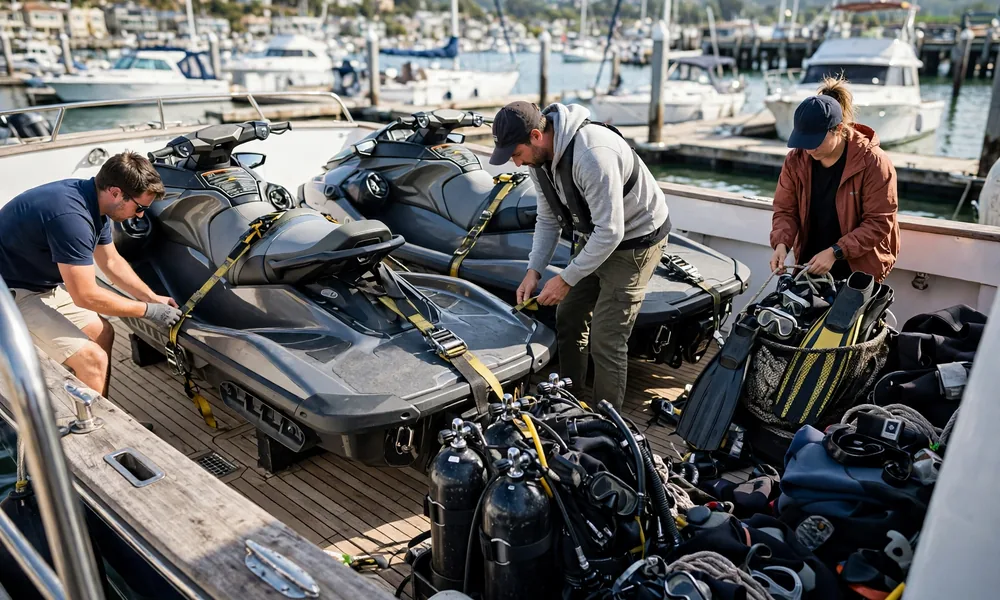
Open the deck of a chase boat and you will find the reason it exists. Jet skis, seabobs, dive compressors, paddleboards, fishing gear, spare parts, fuel, provisions — the whole apparatus of a superyacht holiday, carried separately so the main yacht stays clean and uncluttered. The chase boat is a floating garage, and its deck is designed around the cargo: cranes and davits for launching toys, racks and tie-downs, a dive platform, and enough open space to work in while the boat is moving.
Every fitting on that deck is marine-grade, custom-made, and priced accordingly. A crane that can lift a jet ski off a moving deck in a swell is not a catalogue item. A dive compressor that fills tanks to 300 bar is a specialist machine. And because the chase boat operates in salt water, at speed, with a crew that is often wet, everything must be built to survive conditions that would destroy ordinary equipment in a season. The way a luxury chase boat works day to day is what all that equipment is for.
Reason three: the crew, the systems and the silence
A chase boat is a working boat, but it is a working boat that belongs to a superyacht, and the standard is the superyacht’s standard. That means the electronics suite of a vessel three times its size: radar, chart plotter, AIS, satellite communications, night vision, and a sound system that can be heard over three outboards at full throttle. It means a navigation setup that lets the crew run at night, in fog, to a rendezvous point given only as a set of coordinates.
It also means the boat must look right. A chase boat tied alongside a $100 million superyacht cannot look like a rental. The paint, the upholstery, the teak, the lighting — all of it is finished to yacht standard, by the same yards and craftsmen who finish the yacht itself. The chase boat is, in effect, a miniature superyacht with the cabins taken out and the engines doubled, and its price reflects that. The same logic drives the cost of the biggest sportfishing machines, where the luxury sportfishing yacht’s specifications show how much of a boat’s price can sit in systems and finish.
Reason four: it is built in tiny numbers, by hand
There is no production line for luxury chase boats. Each one is built to order, usually by a specialist yard that produces a handful a year, and each is tailored to its mothership: matched in paint, in styling, in the toys it must carry, and in the speed it must reach. A yard building five boats a year cannot spread its design and tooling costs across thousands of hulls the way a car maker can.
Reason five: the running costs never stop
The purchase price is only the beginning. Three large outboards burn fuel at a rate that shocks even superyacht owners — a chase boat at full speed can use several hundred litres an hour — and the engines need servicing far more often than a yacht’s, because they work far harder. The crew is another cost: a chase boat needs a trained operator and often a deckhand, both of whom must be paid, housed and fed whether the boat is working or sitting at anchor.
Then there is the maintenance that salt water demands. A chase boat lives its life wet, fast and loaded, and the hull, the engines, the electronics and the deck gear all need constant attention. Owners commonly budget an estimate of 10 to 15 percent of the purchase price per year in running costs. The centre console boat, a close cousin that does a similar job for a different owner, carries the same burden at a smaller scale, and why a luxury centre console boat is so expensive tells the same story.

A rare fact
Here is the detail that surprises even yacht owners: the fastest chase boats in the world are not built for superyachts at all. They are built for the military and for offshore racing, and the superyacht world borrows from both. The hull designs, the water jets, the carbon fibre construction — all of it was proven first in places where failure was not an option. A chase boat is, in the end, a racing boat that has been taught manners: the speed and strength of a competition machine, dressed in the finish of a yacht, and asked to spend its life carrying jet skis instead of winning trophies.
A chase boat is expensive because it is asked to do the hardest job on the water — to be fast, tough, loaded and beautiful, all at once, in a hull a fraction of the size of the yacht it serves. The price is not a markup on a small boat. It is the honest cost of building a machine that can do four jobs at the same time, in salt water, at fifty knots, and make it look easy.