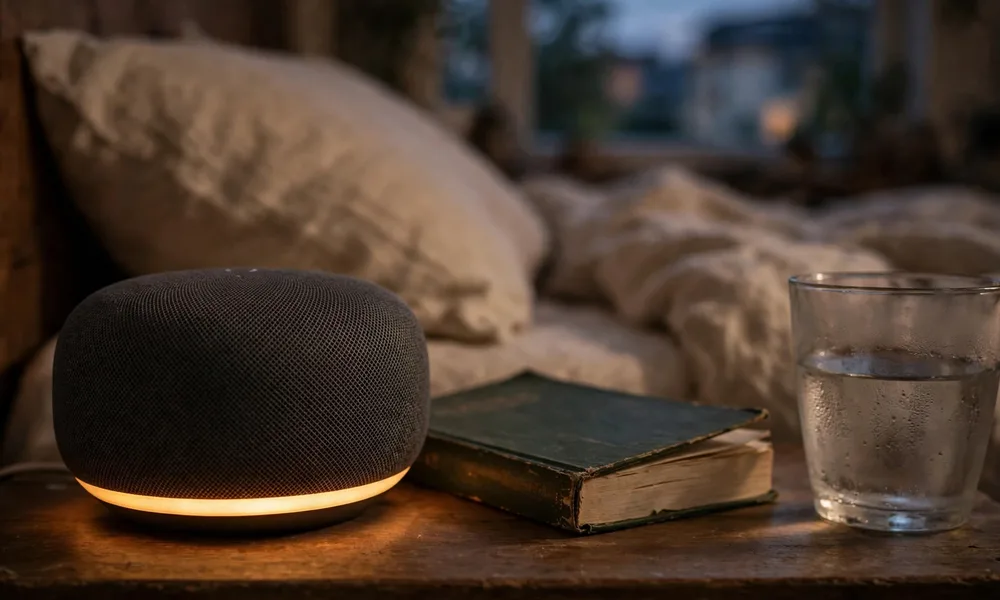
The living room is quiet in the evening, the lights are low, and someone says a single word from the sofa. A small cylinder on the sideboard answers, and a moment later the room fills with music that sounds far bigger than the box it comes from. Nothing on the outside gives the trick away. There is no visible speaker grille worth staring at, no tangle of wires, no dial to turn. Yet inside that modest cylinder sit several drivers, a handful of microphones, an amplifier, a small computer and a power supply, all arguing about how to make a room sound good. A luxury smart speaker is not one speaker at all. It is a small system, and its spec sheet is the only honest way to tell a good one from a pretty one.

The spec sheet at a glance
| Figure | Typical range | What it tells you |
|---|---|---|
| Drivers | One woofer plus two to four tweeters | How the sound is split between bass and treble |
| Frequency response | Roughly 40 Hz to 20 kHz | How low the bass goes and how high the treble reaches |
| Amplifier power | Roughly 30 to 100 watts total | How loud it can play without distorting |
| Microphones | Four to eight, in a ring | How well it hears you over the music |
| Connectivity | Wi-Fi, Bluetooth and AirPlay or Cast | How music reaches the speaker |
| Voice assistant | Built in, with a mute switch | Whether it answers, and whether you can silence it |
| Weight | Roughly 1 to 5 kilograms | How solid the cabinet is, and how much bass it can hold |
| Price | Roughly $300 to $1,500 | What a luxury smart speaker costs, as an estimate |
The drivers: where the sound actually comes from
A driver is the part that moves air, and a luxury smart speaker usually has several of them, each doing one job. A woofer, often around 100 to 130 millimetres across, handles the low notes, while smaller tweeters, sometimes angled in different directions, handle the high notes.
The drivers are driven by separate amplifier channels, so the woofer and the tweeters each get their own power, and a small digital processor decides, many times a second, which frequencies go where. That processor is also what keeps the speaker from distorting at high volume: when the music gets loud it trims the bass a fraction, so the sound stays clean even when the room is full. The guide to how a luxury smart speaker works follows the same signal from your voice to the drivers, and it shows how much quiet work happens between the word you say and the note you hear.
Frequency response: how low, and how honest
Frequency response is quoted in hertz, and it describes the range of notes a speaker can reproduce. A luxury smart speaker typically claims something like 40 hertz to 20 kilohertz, which covers the deep thump of a bass guitar at the bottom and the shimmer of a cymbal at the top. The number alone is not enough, though. What matters is the tolerance, usually written as plus or minus 3 decibels, which tells you how flat the response is across that range.
Amplifier power: watts are not loudness
Amplifier power is quoted in watts, and luxury smart speakers usually total somewhere between 30 and 100 watts across all their channels. That sounds modest next to a hi-fi amplifier, but a small speaker in a living room does not need much power, because the drivers are efficient and the room is small. What matters is headroom: the difference between the power the speaker uses at normal volume and the power it has in reserve. A speaker with plenty of headroom plays a sudden drum hit cleanly, while one running at its limit clips the peak and makes it sound harsh.
The microphones: hearing you over itself
A smart speaker must hear a quiet voice from across a room while it is playing music loudly, and that is a harder job than making the music. Luxury models use four to eight microphones arranged in a ring, and a processor compares what each one hears to work out where your voice is coming from and cancel the sound of its own music. The more microphones, the better it can separate your voice from the television, the kettle and the children, and the further away you can stand and still be understood.

Connectivity: Wi-Fi first, Bluetooth second
Music reaches a smart speaker in two main ways, and the spec sheet should list both. Wi-Fi is the serious route: it carries a full-quality stream from a music service, it lets the speaker join a multi-room system, and it keeps playing even when your phone leaves the room. Bluetooth is the convenient route, quick to connect and handy for a guest, but it compresses the music and ties the speaker to the phone. The same lesson about reading the numbers properly applies across the house, as the guide to luxury robot vacuum specs shows, where the headline figure is rarely the one that decides how well the machine works in a real room. A luxury speaker should do both well, and it should also support the casting standards of its ecosystem, so you can send music to it from any app without opening a special one.
Room calibration and the cabinet
Every room sounds different, and a luxury smart speaker knows it. When you first set it up, or when you move it, it plays a short series of test tones, listens with its own microphones, and builds a picture of the room: the hard floor that reflects treble, the sofa that swallows bass, the corner that booms. Then it adjusts its output to compensate, trimming the frequencies the room exaggerates and lifting the ones it absorbs. The result is not a perfect room, but a speaker that sounds much closer to the same in any room.
What it costs
The estimated price of a luxury smart speaker is around 300 to 1,500 dollars, and that figure is an estimate only, because the cost depends on the drivers, the microphones and the processing inside. A single-room speaker with one woofer and a simple microphone ring sits at the lower end, while a large model with several drivers, eight microphones and room calibration sits at the top. The price also buys the software: regular updates, new voice features and support for new music services, which a cheap speaker stops receiving after a year or two.
A rare fact
Few people know that the first smart speakers were nearly killed by their own microphones: early models could hear a voice across a quiet room, but the moment music played they went deaf, because their own sound drowned out the command. The fix was not a better microphone but a better trick, teaching the speaker to subtract its own output from what it hears, so it can listen while it plays. It is the same kind of quiet sensing that lets a watch read your pulse while you move, as the guide to how a luxury smartwatch works describes, where the hard part is not the sensor but separating the signal from the noise.