In a small workshop at the edge of town, a bicycle frame hangs from a stand like a piece of sculpture. It is light enough to lift with one hand, yet it will soon carry a motor, a battery and a rider up hills that would defeat an ordinary bike.
A luxury e-bike is not a normal bicycle with a motor bolted on. It is designed from the first sketch as one machine, where the frame, the motor and the battery all fit together, and where every part is finished to the standard of a piece of fine furniture. This is how a luxury e-bike is made, from a bare frame to the first silent ride.

Step 1: The frame is drawn, cut and welded
Everything starts with the frame, and with a decision about what it should be made from. Most luxury e-bikes use aluminium for its balance of lightness and strength, while the most expensive use carbon fibre, laid up by hand in a mould and cured until it is rigid. The tubes are cut to the millimetre, because a frame that is a fraction out will never ride straight.
The tubes are then joined, welded for metal frames or bonded for carbon, and the welds are smoothed until they almost disappear. The motor mount is built into the frame at this stage, not added later, so the motor sits low and central, where its weight helps balance rather than fighting the rider.
Step 2: The motor is fitted at the heart of the bike
The motor is the heart of an e-bike, and in a luxury machine it is usually a mid-drive unit, mounted where the pedals meet the frame. A builder lifts the compact motor into its housing and bolts it to the frame with a torque wrench, each bolt tightened to an exact figure from the manual. Get this wrong and the motor will creak, or worse, work loose on a rough road.
Inside the motor, a small gearbox turns the fast spin of the electric motor into slow, strong turning at the cranks, and a torque sensor measures how hard the rider is pedalling, many times a second.
Step 3: The battery is built and slotted into place
The battery is the most expensive single part of a luxury e-bike, and it is treated like one. Dozens of cylindrical cells are tested, matched for capacity and grouped, then welded into a pack with a management system that watches every cell, balancing charge and cutting power if anything gets too hot. The pack is sealed in a slim case that slides into the down tube of the frame, so the bike keeps the clean lines of an ordinary bicycle.
The battery is charged and discharged on a test bench before it ever meets the bike, and the same careful cell matching is described in the guide to how an e-bike battery is made. A luxury builder would rather understate the range than have a customer run out of power ten miles from home, so the figures are tested on hills, in the cold and with a heavy rider, not just on a flat road in perfect weather.
Step 4: Wheels, brakes and gears are assembled
With the frame, motor and battery together, the bike starts to look like a bicycle. The wheels are built by hand, each spoke tensioned by ear as much as by gauge, until the wheel spins true with no wobble. Luxury e-bikes often use wide, puncture-resistant tyres, chosen for grip on wet roads and for a quiet, comfortable ride rather than for racing speed.
The brakes are hydraulic discs, the same principle as a car, with a lever on the handlebar squeezing fluid through a hose to a calliper at the wheel. The gears are fitted at the same time, often an internal hub or a wide-range derailleur, and the chain or belt is measured and tensioned.

Step 5: The cockpit, saddle and finishing touches go on
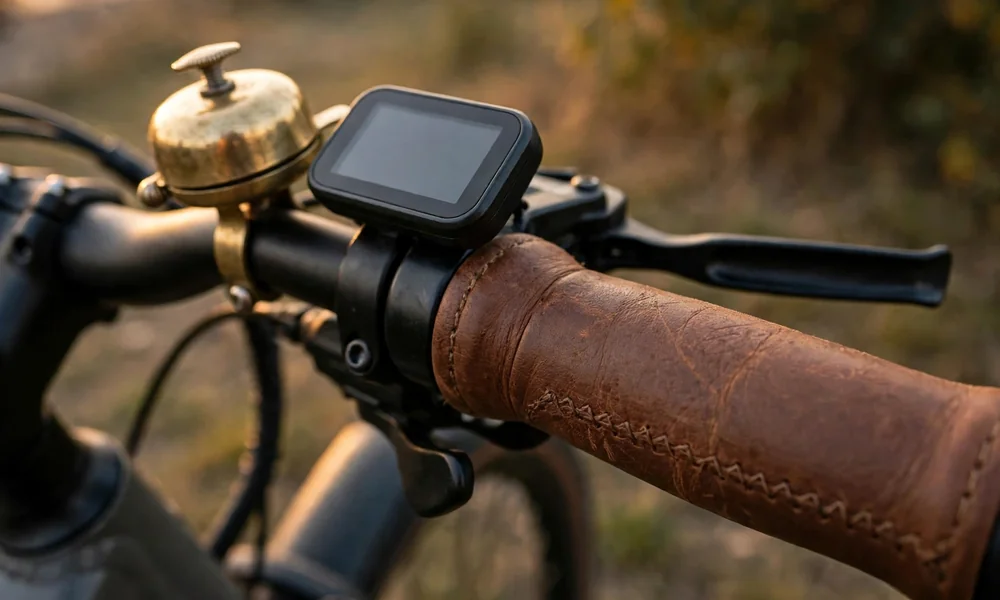
The handlebars, the saddle and the display are where the rider meets the machine, so they get the most attention. The handlebars are fitted with leather grips, stitched by hand, and the saddle is often leather too, shaped and broken in before the bike leaves the workshop.
Then comes the finishing. The frame is painted, often in deep colours with several coats and a clear lacquer, and small details are added: a bell with a clear ring, mudguards that match the paint, a rear rack, and lights wired into the main battery so they never need their own charging. The best builders are ranked in the guide to the best electric bike brands ranked, and the difference between them is usually in these small details, the parts a rider touches every day. A bike that looks finished from every angle is a bike that has been finished properly.
Step 6: Testing, tuning and the first ride
Before handover, every luxury e-bike is ridden, not just switched on. A tester takes it over rough roads and steep hills, listening for creaks, checking that the motor assists smoothly and that the brakes stop the bike without a shudder.
The final inspection is done under bright lights, every bolt checked against its torque figure and every cable tie trimmed. The same quiet routine that proves a finished machine applies to the whole class, as described in the guide to how a luxury e-bike works, where the motor, sensor and battery must agree before the bike earns its name. When it passes, the battery is charged to full, the tyres are pumped to the exact pressure, and the bike is handed over with its first ride already waiting outside the door.
The spec sheet at a glance
| Specification | Typical luxury figure |
|---|---|
| Frame | Aluminium or hand-laid carbon fibre |
| Weight | 18 to 25 kilograms complete |
| Motor | Mid-drive, 250 watts nominal |
| Torque | 65 to 90 newton-metres at the cranks |
| Battery | 500 to 750 watt-hours, in-frame |
| Range | 80 to 160 kilometres per charge |
| Top assisted speed | 25 kilometres per hour in Europe |
| Brakes | Hydraulic disc brakes, front and rear |
| Gears | Internal hub or 11-speed derailleur |
| Drive | Chain or low-maintenance belt |
| Display | Handlebar unit, speed and battery |
| Build time | Two to five days per bike |
What it costs, and a rare fact
A luxury e-bike costs an estimated $5,000 to $15,000, depending on the frame material, the size of the battery and how much of the finishing is done by hand. The motor and battery alone can account for half the price, and the hand-built wheels and leatherwork add the rest.
Here is the rare fact the brochure never mentions. A luxury e-bike frame is often tested by being ridden, hard, by a machine that pedals it for the equivalent of thousands of miles before a single customer rides it, and the test rig counts every flex of the frame until a crack would appear. The frame that survives is then cut apart to check the welds inside, so the bike that reaches the shop is the twin of one that was ridden to destruction on purpose.


