The watchmaker held the case up to the light and turned it slowly, the way a jeweller turns a stone. It was smaller than a coin and thinner than a pencil, yet inside it sat a computer, a heart sensor, a battery, and a screen, all fitted together by hand. Nothing rattled. Nothing showed a seam. A luxury smartwatch is not assembled the way a phone is assembled. It is built the way a fine watch has always been built, one piece at a time, by people who check their work with a loupe and trust their fingers more than any machine.
What makes the luxury version different is not one feature. A mid-range smartwatch already tells the time, counts steps, and reads a pulse. The luxury smartwatch does the same things, but every part is made from better materials, finished to a higher standard, and put together with far more human care. The case is machined from titanium or ceramic rather than stamped from aluminium. The screen is sapphire rather than glass. The strap is cut from a single piece of leather or woven by hand. This is how a luxury smartwatch is made, from a block of metal to a machine that lives on a wrist.
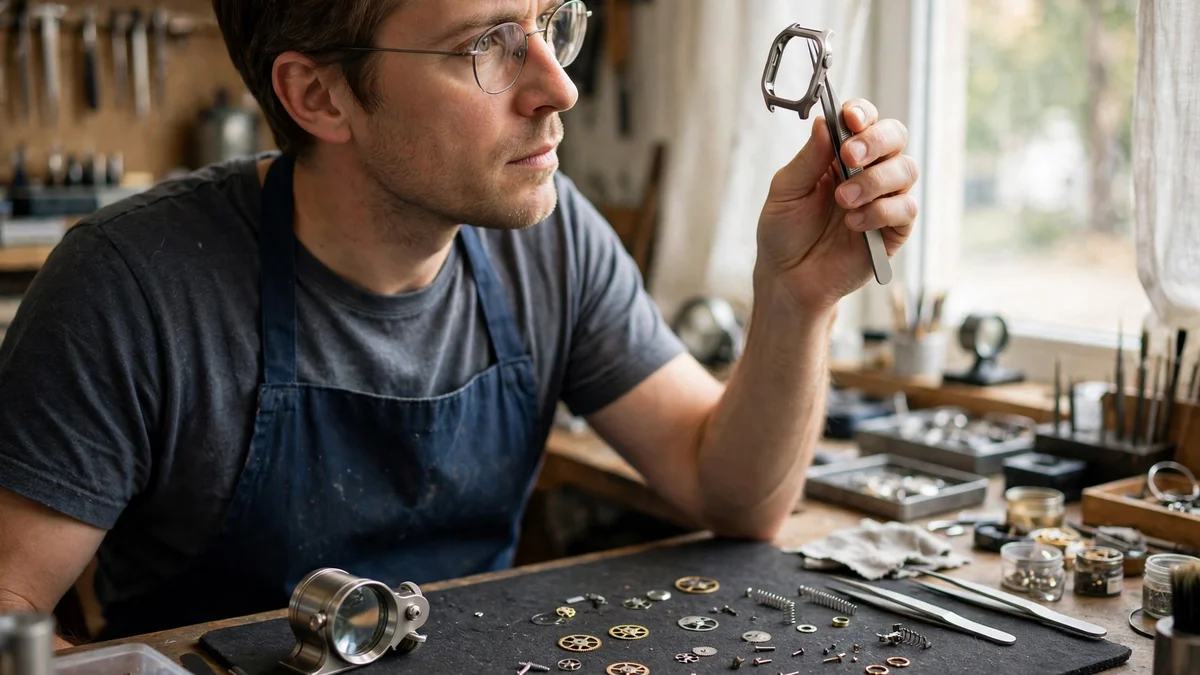
How a Luxury Smartwatch Is Made
Making a luxury smartwatch takes six stages: the case is machined, the screen is fitted, the electronics are assembled, the sensors are calibrated, the strap is made, and the finished piece is sealed and tested. Each stage is done by a small team, and each watch passes through many hands before it is boxed.
Step 1: Machining the case from a solid block
The case begins as a solid block of titanium, stainless steel, or ceramic, never as a moulded shell. A computer-controlled mill cuts the block into the shape of the case, removing more than half of the material to leave a hollow shell with walls only a millimetre thick in places. The cutting takes hours, because the mill moves slowly to keep the surface smooth and the dimensions exact. The titanium watch shows why this metal is chosen: it is light, strong, and kind to skin, but hard to cut and harder to polish, which is exactly why it signals luxury.
Step 2: Fitting the sapphire screen
The screen of a luxury smartwatch is covered in sapphire crystal, a material almost as hard as diamond and far tougher than ordinary glass. The sapphire is grown as a single crystal, sliced into thin sheets, and polished until it is perfectly clear. Fitting it is delicate work: the crystal is set into the case with a gasket and a metal bezel, pressed in with even force so it sits flat and seals against dust and water. Sapphire glass earns its place here because it barely scratches, so the face of the watch still looks new after years on a wrist.
Step 3: Assembling the electronics inside
Inside the case, the electronics are built like a tiny sandwich. At the bottom sits the battery, a slim cell shaped to fit the curve of the case. Above it goes the main circuit board, carrying the processor, the memory, and the radios for Bluetooth and Wi-Fi, all soldered by machine and inspected under a microscope. The display panel is connected last, with a ribbon cable thinner than a hair, and the whole stack is held in place by tiny screws and brackets rather than glue, so it can be taken apart and repaired.
Step 4: Calibrating the health sensors
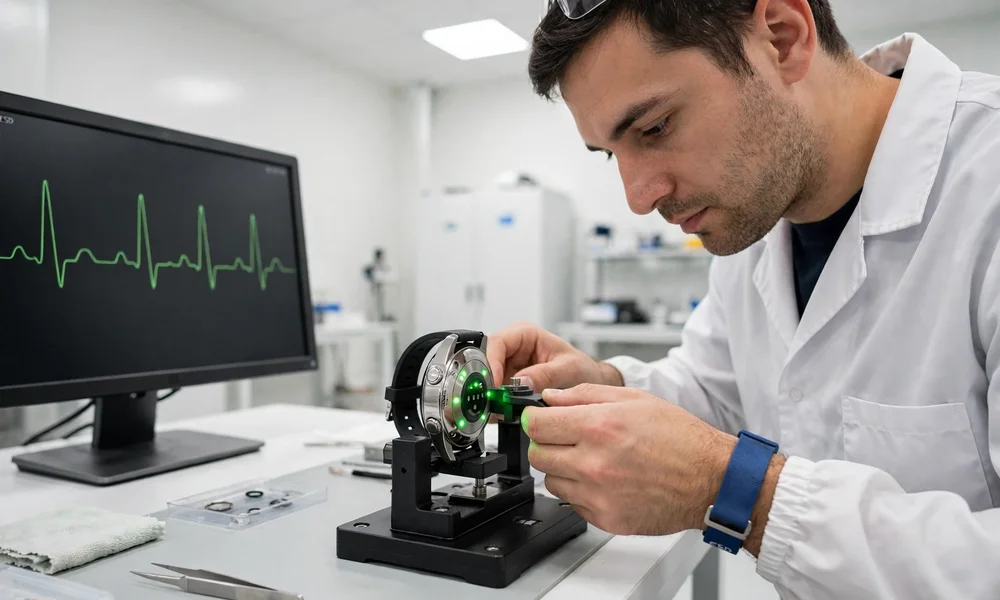
On the back of the watch sits a cluster of health sensors, green lights and photodiodes that shine into the skin and read the blood flowing beneath it. These sensors are fitted into a ceramic or sapphire window on the case back, and each one is calibrated against a reference device before the watch leaves the bench. A smartwatch health sensor is built to this standard, and the luxury version is tested on more wrists and in more conditions before it is signed off.
Step 5: Making the strap by hand
The strap is made separately, by leather workers or weavers who have nothing to do with electronics. A leather strap is cut from a single hide, skived thin at the edges, stitched by hand with waxed thread, and burnished until the edge is smooth. A metal bracelet is made link by link, each link machined, polished, and pinned by hand, then fitted to the case so it moves freely without rattling. The strap is the part the wearer touches most, so it is checked for comfort as well as looks: it must curve naturally, fasten securely, and feel soft against the skin from the first day.
Step 6: Sealing, testing, and the final inspection
Once the case, screen, electronics, and strap are together, the watch is sealed. Every opening is fitted with a rubber gasket, the crown and buttons are sealed with tiny O-rings, and the case back is screwed down with a torque wrench set to an exact figure. The watch is then placed in a pressure chamber and tested at a pressure greater than its rated depth, while a machine watches for the smallest leak. It is then inspected one last time under a loupe, and only then is it placed in its box, with its charger and its papers.
Luxury Smartwatch Specifications
| Specification | Typical figure |
|---|---|
| Case material | Titanium, stainless steel, or ceramic |
| Screen cover | Sapphire crystal, scratch resistant |
| Display | AMOLED, around 1.4 to 2 inches |
| Battery life | 2 to 5 days on a charge |
| Water resistance | 50 to 100 metres |
| Health sensors | Heart rate, blood oxygen, temperature, ECG |
| Weight | 45 to 80 grams with strap |
What a Luxury Smartwatch Costs
A luxury smartwatch typically sells for an estimated $1,000 to $5,000, with the most exclusive models reaching an estimated $10,000 or more when they use precious metals or a hand-made strap. The price is not mostly electronics: a comparable mainstream smartwatch sells for an estimated $300 to $500, and the extra money goes into the case material, the sapphire screen, the hand finishing, and the testing. Owners who buy at this level are paying for a watch that can be repaired rather than replaced, and for a finish that still looks new after years of daily wear.
A Rare Fact About Luxury Smartwatches
Some luxury smartwatches are assembled in the same workshops, and sometimes by the same watchmakers, who build mechanical watches that cost ten times as much. The skills are the same: steady hands, a loupe, and a refusal to accept a flaw that nobody else would notice. A few makers go further and fit their smartwatches with a mechanical touch, such as a hand-wound crown that still clicks like a traditional watch, or a case back engraved by hand. The rarest detail of all is the time it takes: a single luxury smartwatch can pass through the hands of more than thirty people before it is finished.

A luxury smartwatch is a strange object: a computer that pretends to be jewellery, built by people who treat it as both. It tells the time, reads a pulse, and counts steps, but it does so from inside a case that was machined from a solid block, polished by hand, and tested until it could survive a life on a wrist. That is the difference the price buys, and it is visible every time the wearer looks down and sees a face without a single scratch.


