The train is crowded and loud, the doors are hissing, and a commuter is standing in the middle of it all with her eyes closed, listening to a string quartet. The noise of the carriage has simply gone away. In each of her ears sits a bud no bigger than a thumbnail, and inside each one is a speaker, several microphones, a battery, a computer chip and a radio, all working together in a space smaller than a sugar cube. She taps the side of one bud, the music pauses, and she hears the announcement for her stop as clearly as if she were wearing nothing at all.
Luxury earbuds are one of the most crowded pieces of engineering in daily life. Everything a pair of big headphones does has been shrunk into two tiny buds and a case that fits in a pocket, and the result has to sound good, stay in the ear while running, cancel the noise of the world, and keep working for hours on a battery the size of a pea. This is how luxury earbuds work, from the sound in your ear to the case in your pocket.
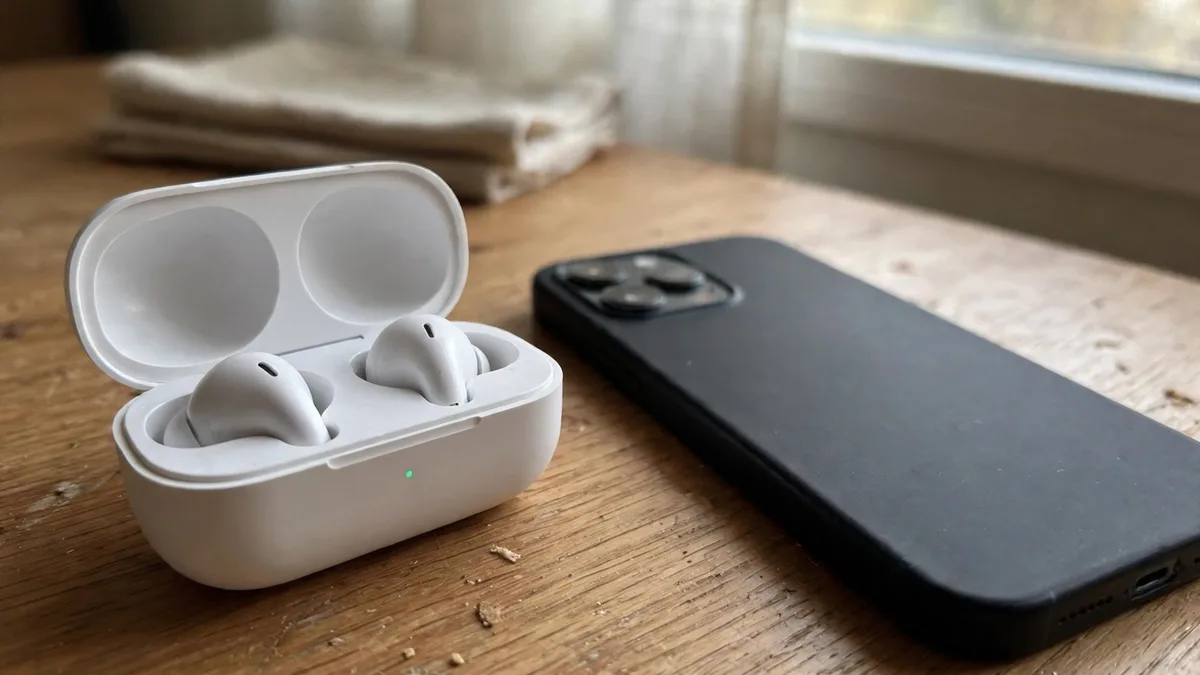
Step 1: The driver turns electricity into music
Inside each bud is a driver, a tiny loudspeaker about ten millimetres across, built around a diaphragm, a voice coil and a magnet, just like the driver in a full-sized headphone, only far smaller. When the music signal reaches the coil, the coil moves the diaphragm back and forth, and the diaphragm moves the air in your ear canal. Because the bud sits so close to the eardrum, it does not need much power to sound loud, and that is why a tiny driver can fill your head with sound.
Step 2: The microphones cancel the noise
The chip does this thousands of times a second, and it has to be fast, because sound moves quickly and a late cancellation is worse than none. The inside microphone checks the result and tells the chip to adjust, so the cancelling stays accurate as the noise changes. Low, steady sounds like engines are cancelled almost completely, while sudden sounds like a voice are let through more, which is why you can still hear someone speak to you. The same idea, on a larger scale, is what makes noise-cancelling headphones work, where bigger microphones and bigger batteries do the same job with more room to spare.

Step 3: Bluetooth carries the music, and the chip keeps time
There is no wire between the buds and the phone, so the music travels by Bluetooth, a short-range radio link. The phone sends the music as a stream of digital data, and each bud receives it, decodes it and turns it into sound. The two buds have to stay in perfect time with each other, because if one is even a fraction of a second late, the music falls apart, so they share a clock over their own tiny radio link and constantly check each other.
Step 4: The sensors know when the buds are in your ears
The outside of each bud is a touch surface, so a tap pauses the music, two taps skip a track, and a long press switches the noise cancelling on or off. There are no buttons, because a button would need space the bud does not have, and a press would push the bud deeper into the ear. The taps are read by a sensor that feels the vibration of your finger, and it is tuned so that chewing or walking does not trigger it by accident. This kind of quiet, watchful sensing is the same idea that lets a luxury smartwatch work on your wrist, reading your body without ever asking you to press anything.
Step 5: The battery and the charging case
Each bud carries a battery about the size of a pea, and it gives roughly five to eight hours of listening, less when noise cancelling is on. That sounds short, but the case is the real battery. The case holds a larger battery of its own, and when the buds sit in it, small metal contacts pass charge into them, topping them up in about fifteen minutes. A full case holds three or four extra charges, so the buds can last a whole day away from a plug.
Step 6: Staying in the ear, through a run and a rainstorm
The buds are also sealed against sweat and rain, with gaskets around the seams and a fine mesh over the microphones that lets sound through and keeps water out. They are tested by being shaken, dropped and sprayed, and they are worn by testers who run, cycle and commute in them for weeks. When a bud stays put through a run in the rain and still sounds good at the end of it, it is ready. The final tuning, by ear in a quiet room, is the same last step that finishes how a luxury smart speaker works, where the numbers are checked first and a human listener has the last word.

At a glance
| Part | Typical luxury build | Why it matters |
|---|---|---|
| Driver | About 10 mm, tuned and matched | Full sound from a bud the size of a thumbnail |
| Microphones | Several per bud, inside and out | Hear the noise so the chip can cancel it |
| Chip | Bluetooth, decoding, noise cancelling | Keeps both buds in time and sips power |
| Battery | Five to eight hours per bud | The case adds three or four more charges |
| Sensors | Wear detection and touch control | Music pauses when the bud leaves your ear |
| Sealing | Sweat and rain resistant | Survives a run in the rain |
Luxury earbuds typically cost an estimated $200 to $550, and some handmade or limited models cost more. The price is not mostly in the materials, which are tiny, but in the engineering: the tuned drivers, the noise-cancelling chips, the batteries and the testing that makes two buds stay in time and stay in your ears. A maker who sells millions of pairs can spread that cost, but a luxury pair still carries the hours of tuning and testing that went into making something so small sound so large.
A rare fact: the battery inside a luxury earbud is so small that it holds less energy than a single peanut, yet it powers a speaker, several microphones, a radio and a computer for hours. Engineers measure the power in microwatts, and every part of the bud is designed to use less of it, because there is simply no room for a bigger battery. It is one of the tightest energy budgets in all of consumer electronics, and it is met by a chip that spends most of its time asleep.
So the next time the noise of a train fades away and the music takes over, remember what is happening in each ear: a driver moving the air, microphones listening to the world, a chip cancelling it out thousands of times a second, and a battery the size of a pea keeping it all going. Luxury earbuds are not just small headphones. They are a whole sound system, shrunk into something smaller than a sugar cube, that fits in your pocket when you are done.


