A city bus is usually the loudest, least loved machine on the street, all diesel rattle and worn plastic seats. A luxury electric bus turns that idea upside down. It glides away from the kerb without a shudder, its doors close with a soft sigh, and inside there is carpet underfoot, leather on the seats, wood on the panels and a quiet so complete that passengers can hear the rain on the roof. Building one is closer to building a small train than a large car, and it happens in a hall big enough to hold several of them side by side.
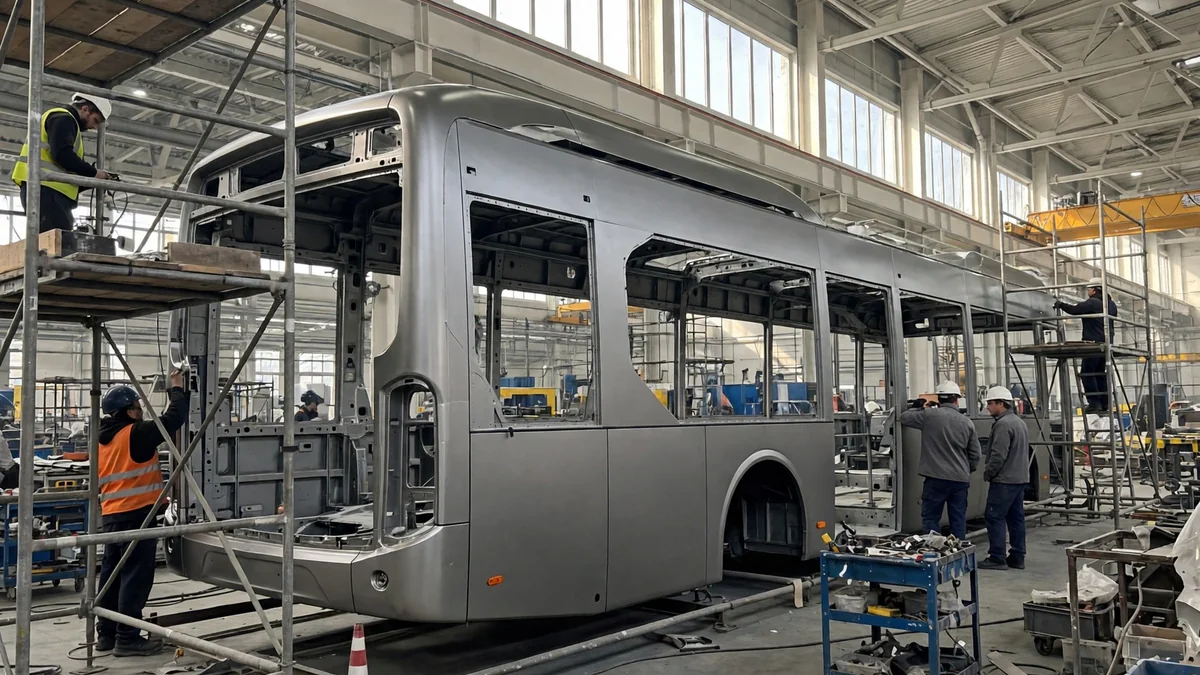
The factory floor is a long, bright space where the skeleton of a bus is welded from steel tubes, where battery packs the size of wardrobes are lowered into the floor, and where the body is skinned, painted and fitted out like a hotel lounge on wheels. Every bus is built to order, with the seating, the doors and the charging setup chosen by the operator who will run it. Here is how a luxury electric bus is made, from the first steel tube to the first paying passenger.
How It’s Made
Step 1: The chassis and frame are welded in a giant jig
A bus begins as a chassis, a long ladder of steel rails and cross members that must carry forty passengers, a heavy battery and a body that will flex over speed bumps for twenty years. Workers lay the rails into a jig the size of a small house, a steel bed with fixed stops that holds every piece in exactly the right place. Welders join the frame in a set order, working from the centre outwards so the heat does not twist it, and inspectors measure the finished frame with lasers, checking that it is straight to within a few millimetres over its whole twelve-metre length.
Step 2: The battery packs are built and fitted low in the floor
The batteries are the heaviest part of the bus, and where they sit decides how the bus handles. Hundreds of lithium cells are tested, matched and packed into sealed metal boxes, each with its own cooling pipes and a management system that watches the temperature of every cell. The packs are lowered into the floor between the axles, keeping the weight low and evenly spread, and bolted in place with mounts that can be undone so a single pack can be swapped without taking the bus apart.
Step 3: The body is skinned and painted
With the chassis and batteries in place, the body takes shape. Aluminium or steel panels are fixed to the frame, the roof is curved to shed rain, and the big windows are bonded into place with a flexible adhesive that lets the body flex without cracking the glass. The bus is then painted in a sealed booth, where filtered air keeps dust off the wet paint and several coats build up a deep, even colour, often a dark green, navy or champagne that suits a premium operator. The way a luxury electric car is made uses the same patient painting method on a smaller scale, with thin coats, a careful cure and a final polish that makes the colour look deep in sunlight.
Step 4: The motors and axles are installed
Most luxury electric buses use one or two motors mounted on the rear axle, driving the wheels directly without a gearbox. The motors are compact but powerful, producing the huge low-speed torque that lets a full bus pull away smoothly from a stop even on a hill. Regenerative braking is built in from the start, so every time the driver slows down the motors act as generators and feed energy back into the battery. The axles are fitted with air suspension, which can kneel the bus down at the kerb so passengers step on easily, then rise again for the road. Steering, brakes and suspension are all tested on a rig before the bus ever moves under its own power.
Step 5: The interior is fitted like a lounge
This is where a luxury bus earns its name. The floor is laid with hard-wearing carpet or wood-effect vinyl, the seats are wide, leather-trimmed and spaced generously apart, and reading lights, charging sockets and small tables appear at the better seats. The driver’s cab gets a curved dashboard with a large display, a comfortable seat with lumbar support and a clear view over the low bonnet. Sound insulation goes into the walls and the floor, so road noise stays outside, and the air conditioning is sized to keep forty people comfortable on the hottest day. The way a luxury electric car works shows the same thinking at a smaller scale, with the cabin treated as a quiet room rather than a box on wheels.
Step 6: The bus is charged, tested and driven on real roads
Before delivery, the bus is charged to full and put through days of testing. Engineers run it on a rolling road to check the motors and brakes, drive it over a rough test track to listen for rattles, and take it out on real city routes with sandbags standing in for passengers. The way a luxury SUV works is checked in a similar way, with road testing as the final proof, because a vehicle that has only ever run on a rig is not ready for passengers. Only when every test passes does the bus get its livery, its plates and its first passengers.

Electric Bus Specifications
| Specification | Typical Luxury Electric Bus |
|---|---|
| Length | 12 metres, single deck |
| Battery | Lithium-ion, 300 to 500 kilowatt-hours |
| Range | 250 to 400 kilometres per charge |
| Motor power | 200 to 350 kilowatts |
| Passengers | 40 to 50 seated, up to 80 total |
| Charging time | 2 to 4 hours with a depot fast charger |
| Top speed | 100 kilometres per hour, limited |
The Price
A luxury electric bus costs an estimated $400,000 to $700,000, depending on its length, battery size and interior fit-out. The battery packs are the single biggest cost, followed by the body and the premium interior. Operators buy them for the running costs rather than the purchase price: electricity is cheaper than diesel, the motors need far less servicing, and the brakes last longer because regeneration does most of the slowing down.
A Rare Fact
Some luxury electric buses can feed power back into the depot when they are parked. If the grid needs help on a hot evening, a row of buses plugged in at the depot can return a little of their stored energy, then recharge overnight when electricity is cheap. The buses spend the night earning their keep instead of simply sitting still.

Riding a luxury electric bus feels less like public transport and more like being looked after. The doors open without a hiss of air brakes, the seat is wide enough to sit properly, and the ride is smooth enough to read a book without the words jumping. It is the kind of bus that makes people choose it over driving, which is the whole point.
A luxury electric bus proves that a machine built for forty people can still be built with care. Its frame is welded straight to the millimetre, its batteries sit low in the floor, its interior is fitted like a lounge, and it is tested on real roads before it ever carries a passenger. It is a big machine, made slowly, and it moves in silence, which is a strange and lovely thing for a bus.