From the outside it looks like a small spaceship that has taken a wrong turn onto a cycle path. Smooth, enclosed, with a canopy instead of handlebars in the wind, a velomobile is the strangest vehicle most people will ever see on the road. Inside, the rider sits reclined like in a deckchair, pedals gently, and glides along at a speed that would leave a racing cyclist breathless. The shell does the hard work; the rider just keeps it moving.
A luxury electric velomobile adds a motor and a battery to that shell, turning an already efficient machine into something close to a car without the car. It is built in small workshops, largely by hand, in numbers so low that each one is practically made to order. Here is how it is made, from a mould to a finished machine that keeps its rider dry, warm and fast.

How It’s Made
Step 1: The shell mould is prepared
Everything starts with the mould, a huge two-part form shaped like the velomobile’s body. The mould is polished until it shines, because every scratch in the mould becomes a flaw in the shell. A release agent is sprayed on so the finished part will come away cleanly, and the mould is warmed to the right temperature. Some workshops keep a single mould for years, turning out shell after shell, while others build a fresh mould for each new model. The mould is the most expensive tool in the workshop, and it decides the shape of every velomobile that follows.
Step 2: The composite shell is laid up by hand
Workers lay sheets of fibreglass or carbon fibre cloth into the mould, one layer at a time, brushing each layer with resin and smoothing out air bubbles with rollers. The layers are arranged so the fibres run in different directions, giving the shell strength in every direction. Around the wheel openings and the cockpit, extra layers are added where the shell takes the most stress. The mould is then closed and left to cure, sometimes under vacuum, which squeezes out excess resin and leaves a shell that is light, stiff and strong. A finished shell weighs only a few kilograms.
Step 3: The shell is trimmed and joined
Once cured, the two halves of the shell are lifted out of the mould and trimmed. Edges are cut with diamond tools, holes are drilled for lights and vents, and the top and bottom halves are bonded together with adhesive and reinforcing strips. The canopy, usually a clear acrylic bubble, is fitted and hinged so the rider can climb in. Then the shell is sanded, primed and painted, often in a bright colour so the low vehicle is easy for car drivers to spot. A luxury shell gets a flawless paint finish, polished by hand until it looks like a car body.
Step 4: The chassis and running gear are built
Under the shell sits a simple aluminium chassis, a spine that carries the three wheels, the seat and the drivetrain. The front wheels steer through a linkage, and the single rear wheel is driven by the pedals and the motor. Suspension is fitted at the front, usually small coil springs, to keep the ride smooth on rough roads. The wheels themselves are small, often twenty inches, with narrow tyres chosen for low rolling resistance. Every bracket and bolt is weighed, because the whole point of a velomobile is efficiency, and a kilogram saved here is speed gained everywhere.
Step 5: The motor and battery are installed
The electric assist is fitted next. A small hub motor in the rear wheel or a mid-drive unit at the cranks is wired to a battery pack tucked behind the seat, low down where it keeps the centre of gravity down. The controller is set to add power smoothly, and a torque sensor in the pedals measures the rider’s effort so the motor helps in proportion. A display is mounted where the rider can see speed and battery level without taking their eyes off the road for long. Then the wiring is secured and waterproofed, because a velomobile’s shell keeps most rain out, but condensation still finds its way in.
Step 6: The cockpit is fitted out
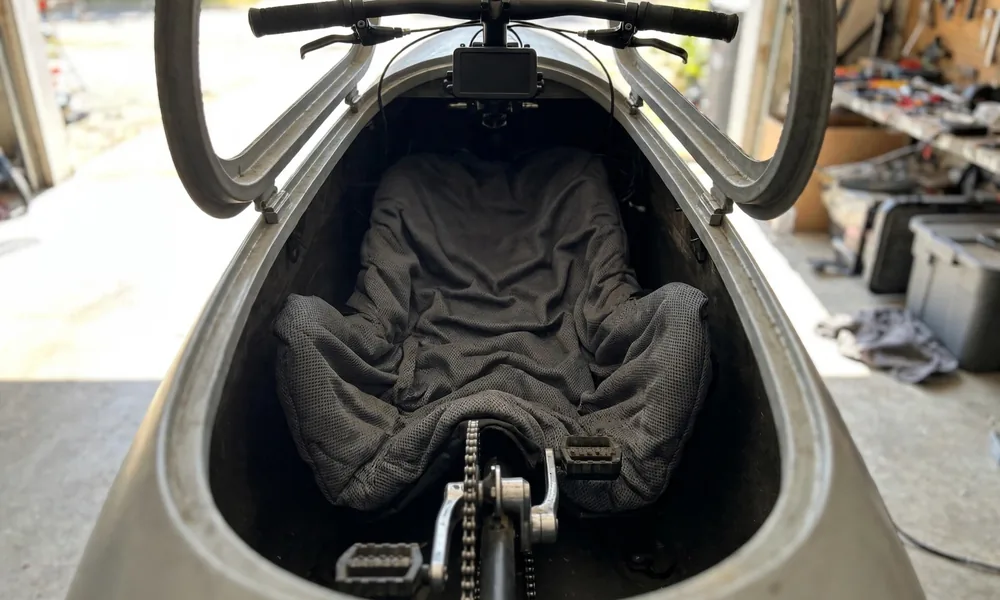
The inside of a velomobile is closer to a car than a bike. A reclined seat is bolted in, shaped to support the rider’s back and shoulders, with a headrest and a ventilation channel to keep them cool. The steering is by a small handlebar or tiller at the rider’s sides, and the gear shifter and brake levers are within easy reach. Mirrors are fitted on stalks outside the shell, and lights are wired into the body. Some luxury builds add a heater, a fan and even a small luggage compartment behind the seat, turning the cockpit into a tiny, weatherproof room.
Step 7: The velomobile is tested on the road
The finished machine is taken out for a road test. A test rider checks the steering, the braking and the motor assistance at every speed, and listens for rattles or rubbing where the shell meets the chassis. The shell’s aerodynamics are checked by coasting down a gentle hill and measuring the speed, and the lights and indicators are tested at dusk. Only when the machine is quiet, straight and fast does it get its final polish and a handover to its owner, often with a lesson in how to climb in and out gracefully, which takes more practice than riding it.

Key Specifications
The figures below describe a typical luxury electric velomobile; individual builds vary.
| Specification | Typical figure |
|---|---|
| Weight | 30 to 40 kg |
| Motor power | 250 W assistance |
| Battery capacity | 500 to 1,000 Wh |
| Cruising speed | 35 to 50 km/h with modest effort |
| Range | 100 to 200 km per charge |
| Shell material | Fibreglass or carbon fibre composite |
| Wheels | Three, two steering at the front |
How Much Does It Cost?
A luxury electric velomobile typically costs from around $10,000 to $18,000, depending on the shell material, the motor and the cockpit fittings. That is an estimate based on current small-batch builds, and a carbon fibre shell can add several thousand dollars on its own. Most of the price sits in the hand-laid shell, the low-volume chassis and the custom cockpit. For a closer relative on three wheels, read the luxury electric trike specs explained for an open-air alternative. The cargo-carrying cousin is covered in the luxury electric cargo bike specs explained, and how a luxury electric bike is made shows where the motor technology comes from.
A Rare Fact
Here is something few people know: velomobiles were once banned from some cycling races because they were too fast, and their riders were accused of hiding motors inside the shell long before electric motors were ever fitted. In the 1930s, a French rider in a streamlined shell broke speed records so convincingly that the cycling authorities changed the rules to exclude enclosed machines from competition. The ban pushed velomobiles off the race track and onto the road, where they became the efficient commuters they are today, still faster than the bikes they were banned for beating.
A luxury electric velomobile is a car, a bike and a room, all in one small shell. From the polished mould to the hand-laid composite, from the tiny chassis to the reclined cockpit, every step exists to make a machine that turns modest effort into remarkable speed. Climb in, close the canopy, and the weather, the wind and the hill all stay outside, where they belong.


