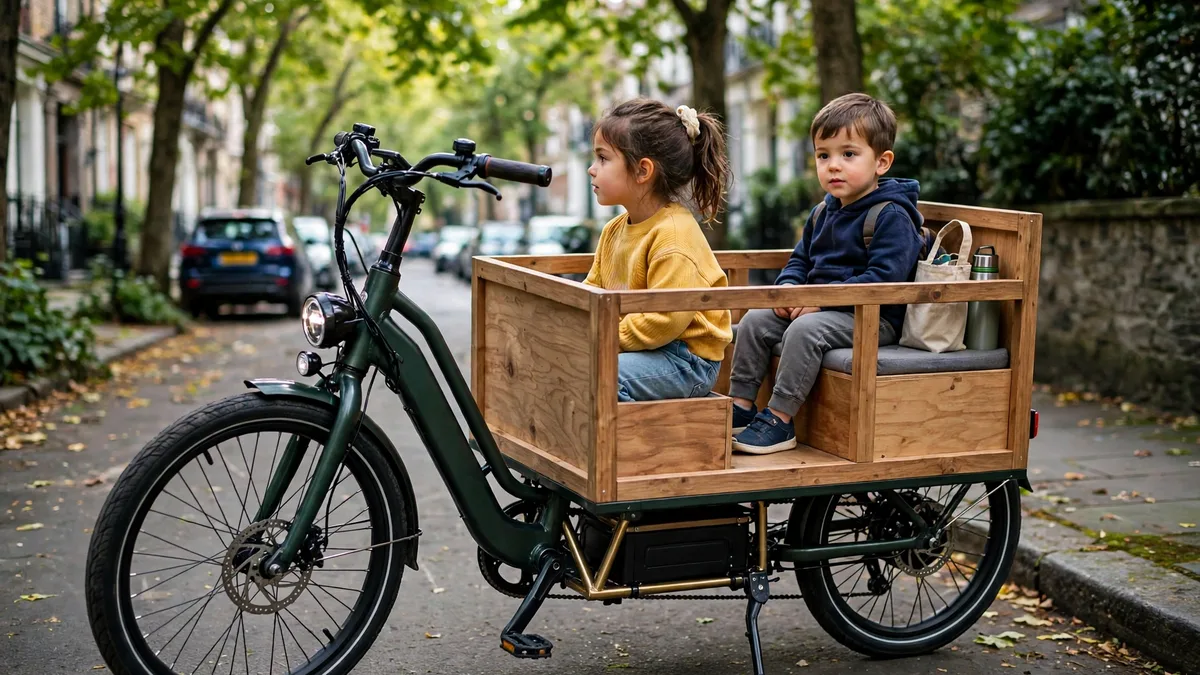
Picture a parent riding through a city street with two children laughing in a wooden box at the front of the bike, a week’s shopping tucked underneath them, and a dog peering over the edge, while the rider pedals easily, barely breaking a sweat, because a small electric motor is doing the heavy lifting. Behind them a delivery rider carries parcels in a long rear rack, gliding past cars stuck in traffic.
A luxury electric cargo bike is a workhorse dressed in fine clothes, a bicycle stretched and strengthened to carry loads of a hundred kilograms or more, with a motor powerful enough to make that weight feel light. It replaces a second car for many families, and a delivery van for many small businesses.
How It Works
Step 1: The frame carries the load, not the rider
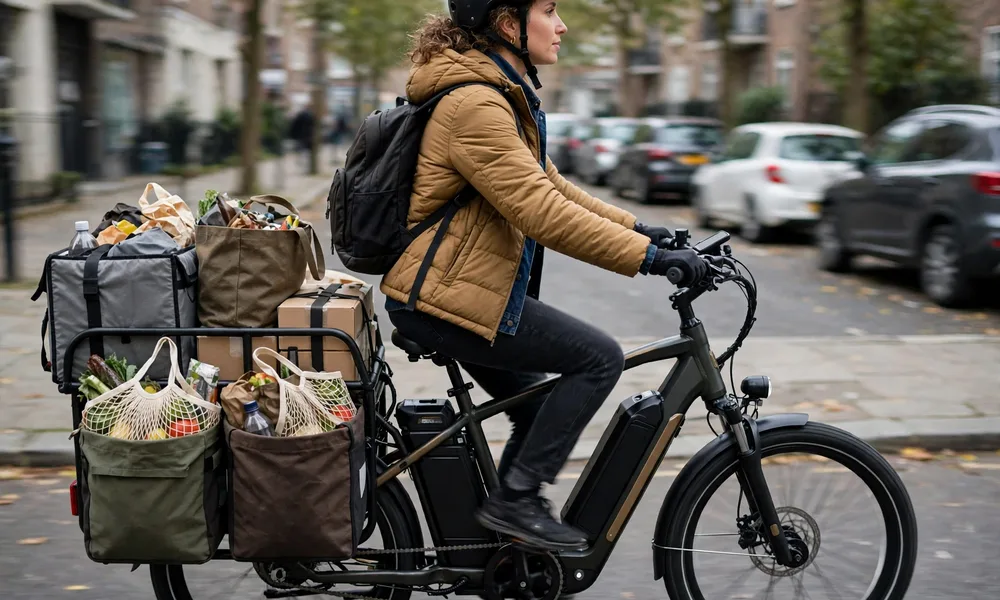
Everything starts with the frame, and a cargo bike frame is a different shape from an ordinary bike frame, because it has to carry its load low and in the middle, where it cannot tip the bike over. On a front-loading cargo bike the box sits between the handlebars and the front wheel, slung low in a cradle of steel tubing, and on a long-tail cargo bike the load sits on a rack stretched out behind the saddle. The frame is thick-walled steel or aluminium, braced to carry a hundred kilograms without flexing, and the steering reaches the far-ahead front wheel by rods rather than a direct fork. The rider’s job is to steer and pedal, and the frame’s job is to hold the weight, and that separation is what keeps a loaded cargo bike stable.
Step 2: The torque sensor reads the rider’s effort
At the pedals, a torque sensor measures how hard the rider is pushing, just as it does on a smaller electric bike, but on a cargo bike the reading matters more, because the load is heavy and the rider’s effort changes constantly. Push gently on flat ground and the motor adds a little, push hard to pull away from a traffic light with two children aboard and the motor adds a lot, and the help arrives in a fraction of a second, before the bike has a chance to wobble. The sensor reads the twist in the crank many times a second, so the motor’s help always matches the rider’s effort.
Step 3: The mid-drive motor turns effort into pulling power
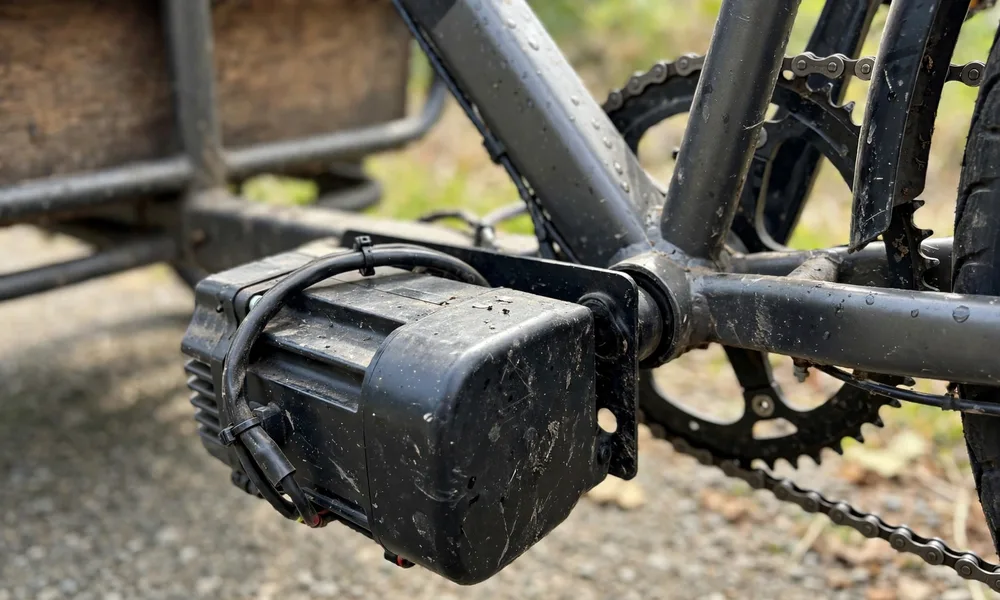
The motor on a luxury cargo bike is almost always a mid-drive unit, sitting at the cranks and driving the chain, because a mid-drive motor can use the bike’s gears, and gears are what make heavy loads manageable. A hub motor spins at the speed of the wheel, but a mid-drive motor spins through the gears, so in a low gear it can produce enormous torque at low speed, exactly what is needed to pull a heavy box up a hill from a standing start. The motor is a compact unit of a few hundred watts, but through the gears it can feel like far more. The motor, the controller, and the gears work as one system, and the way they share the work is the heart of the machine, as how a luxury electric bike works shows in its smaller, lighter form.
Step 4: The battery powers long, heavy days
The battery on a cargo bike is bigger than the battery on an ordinary electric bike, often twice the size, because a heavy load drains a battery far faster than a light one, and a cargo bike is expected to work all day. It sits low in the frame, usually in a case under the box or beneath the rear rack, where its weight helps rather than hurts, keeping the centre of gravity low and the bike steady. The battery is made of lithium cells, managed by a computer, and can be lifted out or swapped for a fresh one in a minute. A full charge gives forty to sixty miles of loaded riding, and the controller watches the remaining charge, easing the assistance as the battery runs low so that the rider is never left suddenly without help halfway up a hill with a full load.
Step 5: The brakes stop a heavy bike safely
Stopping a cargo bike is a bigger job than stopping an ordinary bike, because the bike and its load can weigh twice as much, and twice the weight needs twice the braking. A luxury cargo bike uses large hydraulic disc brakes, with four-piston callipers and thick rotors, the same kind of brake found on a mountain bike built for steep descents, and the brakes are sized so that the bike can stop safely even when fully loaded and rolling downhill. The levers are tuned for gentle braking, because a sudden stop with children in the box would throw them forward. The brakes are tested with the bike fully loaded, because a brake that works empty and fails loaded is no brake at all.
Step 6: The steering, suspension, and stand keep it steady
The last part of the system is the one that keeps a loaded bike upright when it is not moving, and it is easy to overlook until you try to load a cargo bike without it. The steering uses a linkage that keeps the front wheel stable, so the bike does not flop to one side when the rider takes a hand off the bars, and the front suspension, often a sturdy fork with springs, soaks up bumps that would otherwise shake the load. A double-legged kickstand holds the bike upright while it is loaded, and a steering lock keeps the bars still. How they are built together is described in how a luxury electric cargo bike is made.
Luxury Electric Cargo Bike Specifications
The figures below describe a typical luxury electric cargo bike. Front-loading box bikes and long-tail bikes differ in layout, but the way they work is the same.
| Specification | Typical value |
|---|---|
| Battery capacity | About 600 to 1,000 Wh |
| Loaded range | About 40 to 60 miles |
| Motor power | About 250 to 500 W |
| Maximum load | About 100 to 200 kg |
| Weight | About 35 to 50 kg |
| Brakes | Hydraulic disc, four-piston |
What It Costs
A luxury electric cargo bike costs an estimated $5,000 to $11,000, depending on the size of the battery, the capacity of the box, and the level of finish, and a fully fitted family version with a rain canopy and child seats can cost more still. Those are estimates, not quotes, and they reflect the heavy-duty frame, the large battery, and the powerful mid-drive motor. Its simpler cousin is built the same way, as how a luxury electric bike is made shows.
A Rare Fact
Here is a detail most people never guess. A fully loaded cargo bike can weigh more than its rider, and the law in many places still treats it as a bicycle, so it can use cycle lanes, cross parks, and park on pavements where a van cannot go. In a crowded centre a cargo bike can make more drops per hour than a van, because it never circles the block looking for parking.