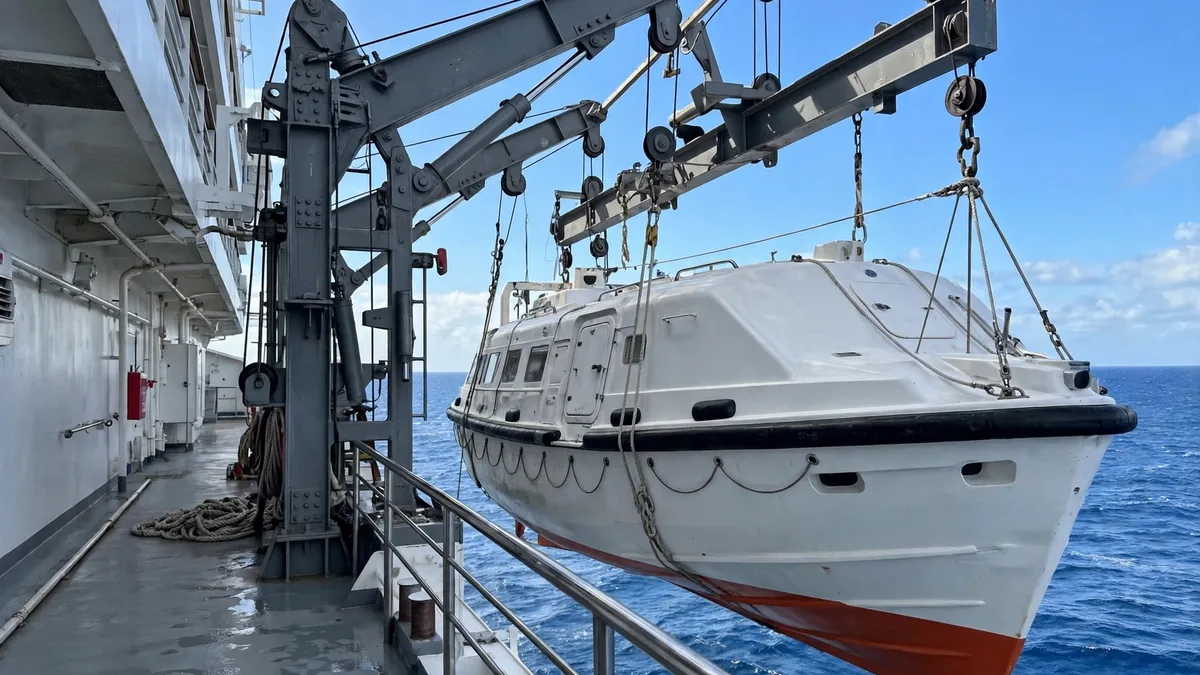
On the deck of a luxury ship, the lifeboat hangs quietly in its cradle, orange or white against the steel of the superstructure, waiting for a day nobody wants. A lifeboat should be invisible until the moment it is needed, and then it should work perfectly, first time, in the dark, in bad weather, with frightened people inside.
The machine that makes that possible is the davit, a strong steel arm that lifts the lifeboat off the deck, swings it out over the water and lowers it gently to the sea. A luxury lifeboat davit is built to do all of that smoothly and safely, even when the ship is rolling, even when the power fails, and even when the crew operating it has never done it for real before. Its specification sheet is where that promise is written down in numbers, and this guide explains what each number means.
How It Works
1. Safe working load, and the weight it really carries
The first number on any davit specification is its safe working load, usually quoted in tonnes. A luxury lifeboat davit will typically be rated for about five to ten tonnes, and that figure is not just the weight of the empty boat. It includes the boat itself, its engine and fuel, its equipment, and every passenger it is designed to carry, plus a safety margin for the shock of a wave hitting the boat as it touches the water.
That margin matters, because a lifeboat does not lower gently into a swimming pool. It lowers into a moving sea, while the ship itself may be rolling, and the load on the wires can spike far above the steady weight of the boat. The davit is therefore built and tested to carry far more than its rated load, and the steel frame, the bolts that hold it to the deck, and the structure of the ship below it are all part of the same calculation. The way a luxury lifeboat davit is made shows how that steel frame is built, welded and tested before it ever carries a boat.
3. Lowering speed, and the brake that does the thinking
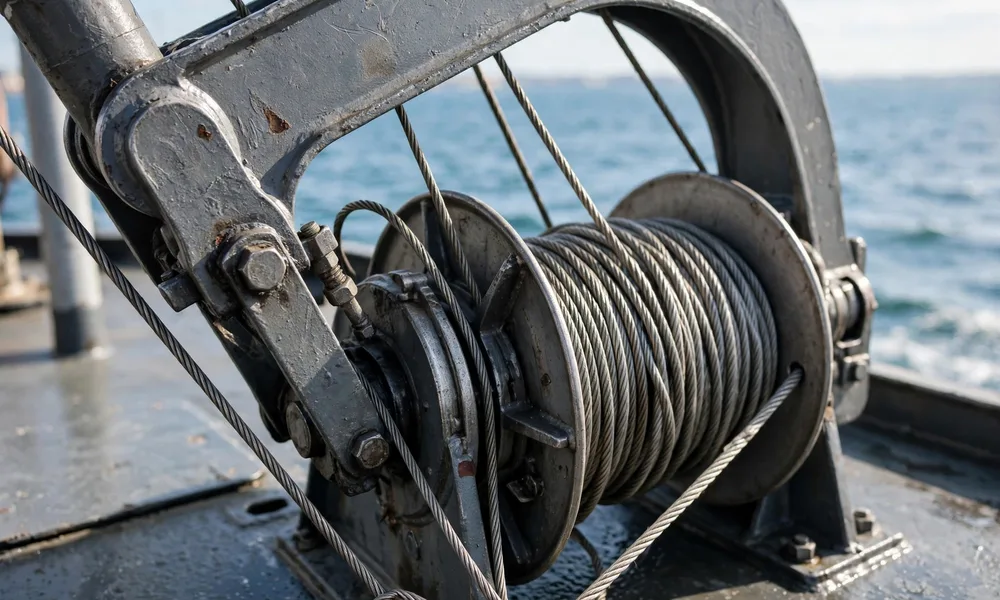
Once the boat is clear of the ship, the winch lowers it on two wire ropes, one at each end, so the boat stays level as it goes down. The specification will give a lowering speed, but the more important number is the one that describes the brake. A luxury davit uses a centrifugal brake, a clever mechanical device that lets the boat descend at a steady, safe speed no matter how heavy it is, and stops it if the rope runs too fast.
The crew does not have to judge the speed by feel, because the brake does it for them. That is deliberate. In an emergency, the person operating the davit may be frightened, tired or inexperienced, and the machine must be forgiving of that. The brake, the winch drum and the wire ropes are inspected constantly for wear, rust and broken wires, because they are the only thing holding the boat. A similar demand for simple, reliable controls appears on other deck machinery, and the way a luxury lifeboat davit works shows how a heavy machine is kept under the control of one person.
4. The falls, and why two ropes matter
The wire ropes that lower the boat are called the falls, and their specification is one of the most important lines on the whole sheet. It will give their diameter, their material, usually galvanised or stainless steel wire, and their breaking load, which is many times higher than the weight they will ever carry. Two falls are used, one at each end of the boat, so the boat stays level, and so that a failure of one rope does not mean the loss of the boat.
5. The release gear, and letting go at the right moment
When the boat touches the water, it floats free of the ship, but it is still attached by the falls. The crew inside the boat pulls a release handle, and both ends of the boat let go at the same moment, so the boat does not tip or hang by one rope. The specification will describe the release as simultaneous, or on-load and off-load, meaning whether it can be operated while the boat is still hanging on the ropes or only once the weight is off them.
The release is designed so it cannot be pulled by accident while the boat is still in the air, and so it works even if the boat is full of water or the crew are wearing gloves. It is tested again and again, because a release that works too easily is as dangerous as one that will not work at all. The cost of that reliability is part of what makes a lifeboat system expensive, and the way a luxury ship lifeboat is so expensive explains where that money goes.
6. Working when the power fails, and the materials that survive the sea
A luxury lifeboat davit must work even if the ship loses power. The lowering is driven by gravity, not by electricity, so a blackout cannot stop a boat from reaching the water. The brake that controls the descent is mechanical, the release is mechanical, and the only thing the crew needs is the strength to pull a handle and the training to know when to pull it. Some davits also have a hand winch, so the boat can be raised again by muscle power if it needs to be recovered after a drill.
The materials are chosen for a life in salt water. The davit is made from marine-grade steel, painted and protected against corrosion, with stainless steel fittings where the ropes and moving parts meet the sea air. The specification will list the paint system, the protection standard and the inspection interval, because a davit that looks fine on the outside can be corroding quietly on the inside. Between drills, the davit is inspected, greased and tested, and every fault is written down and fixed, until the whole routine takes minutes and nobody hesitates.
| Specification | Typical luxury lifeboat davit |
|---|---|
| Type | Gravity davit, with hydraulic or electric swing |
| Safe working load | About 5 to 10 tonnes, boat plus passengers |
| Outreach | Enough to clear the hull, even with the ship listing |
| Lowering speed | Steady, controlled by a centrifugal brake |
| Falls | Two wire ropes, one at each end of the boat |
| Release | Simultaneous release at both ends, from inside the boat |
| Power failure | Lowering by gravity, no electricity needed |
| Material | Marine-grade steel, painted against salt water |
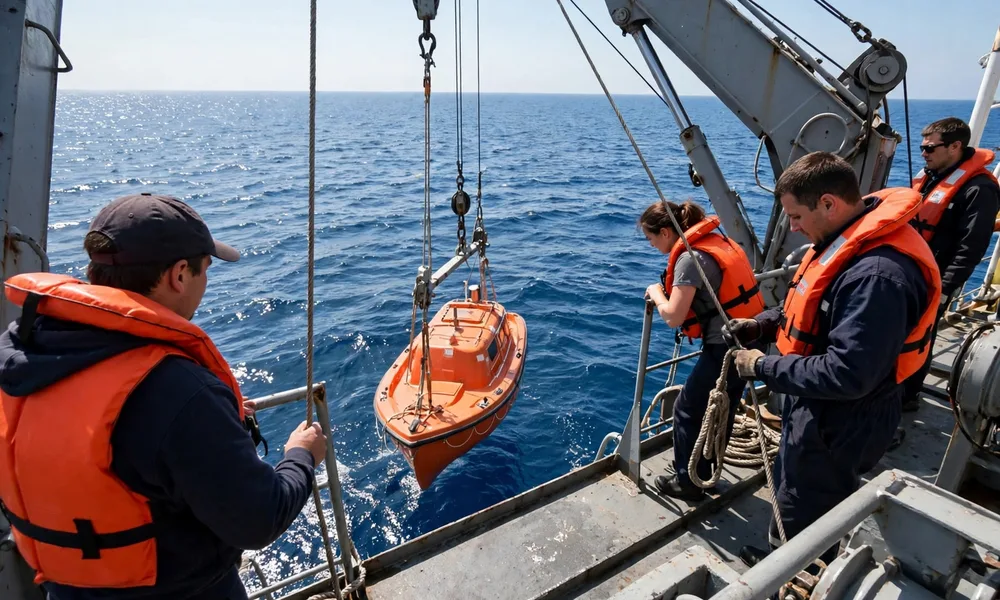
A luxury lifeboat davit is an estimated $100,000 to $400,000 per davit and lifeboat set, depending on the size of the boat, the number of passengers it carries and the type of davit. A large ship needs many sets, so the total cost runs into millions, yet it is the one part of a ship where nobody argues about the price, because it is the part that saves lives.
Here is a rare fact worth knowing. The gravity davit, which lowers a lifeboat using its own weight, was invented after the sinking of the Titanic, when it became clear that lifeboats needed to be launched quickly and reliably, even by a frightened crew in the dark. More than a century later, the same idea is still at the heart of every modern davit, because gravity never runs out of power, never needs fuel, and never fails to show up.