The road out of the valley was empty at dawn, just a ribbon of cold asphalt climbing between pine trees and granite walls. The driver pressed the throttle coming out of a hairpin, and the car answered at once, the engine note rising hard as the rear tyres found grip and the whole machine seemed to shrink around him. By the third corner he was no longer thinking about the car at all, which is exactly what a good sports car is supposed to do.
A luxury sports car is built for moments like that, when the road turns and the machine has to answer without hesitation. Its spec sheet looks like a wall of numbers, though, and the numbers only make sense when you know what each one does on a real road. This is what a luxury sports car spec sheet means, number by number.

The spec sheet at a glance
| Figure | Typical range | What it tells you |
|---|---|---|
| Engine | 3.0 to 6.5 litre, turbocharged or naturally aspirated | How the power is made |
| Power | Roughly 400 to 700 horsepower | How hard the car can push |
| Torque | Roughly 500 to 800 Nm | How strongly it pulls from low revs |
| 0 to 100 km/h | Roughly 3.0 to 4.5 seconds | How quickly it launches |
| Top speed | Roughly 290 to 340 km/h | How fast it can go flat out |
| Weight | Roughly 1,400 to 1,700 kg | How much mass the power must move |
| Power-to-weight | Roughly 300 to 450 hp per tonne | The real measure of quickness |
| Braking, 100 to 0 km/h | Roughly 30 to 34 metres | How fast it can stop |
| Price | Roughly $150,000 to $400,000 | What the engineering costs |
Power and torque: the two numbers that are not the same thing
Power is the headline number, and a luxury sports car usually makes roughly 400 to 700 horsepower, but torque is the number the driver feels most. Torque is the twisting force that shoves the car forward out of a corner, and a turbocharged engine can make roughly 500 to 800 Nm of it from low in the rev range, which is why a modern sports car feels so urgent even at ordinary road speeds. Horsepower is what keeps the car pulling at the top of the rev range; torque is what gets it moving in the first place.
The engines themselves are usually 3.0 to 6.5 litre units, either turbocharged or naturally aspirated, and the choice changes the character of the car completely. A naturally aspirated engine builds its power smoothly all the way to a high redline and sounds sharper doing it, while a turbocharged engine delivers a bigger punch lower down and is easier to live with in traffic. Neither is better in every way, and the spec sheet will not tell you which one you will enjoy more, but it will tell you where in the rev range the power lives. The way the engine, chassis and bodywork come together is described in the guide to how a luxury sports car is made, from the first welded frame to the finished machine.
Acceleration and top speed: what the stopwatch really measures
The 0 to 100 km/h time, roughly 3.0 to 4.5 seconds on a luxury sports car, is the number buyers quote most, and it is also the most misunderstood. It depends on the tyres, the road surface, the launch control and the weather, so two cars with the same headline time can feel very different on the road. What the number does tell you is how well the car puts its power down, because a car with huge power and poor traction will spin its wheels and waste the launch, while a car with less power and clever traction will be gone before the other one hooks up.

Weight and balance: the invisible spec
Weight is the spec that shapes everything else, and a luxury sports car usually weighs roughly 1,400 to 1,700 kg. Engineers fight for every kilogram because weight dulls acceleration, lengthens braking distances and makes the car feel heavy in corners.
Balance matters as much as total weight. A car with its engine mounted in the middle, ahead of the rear axle, puts roughly equal weight on the front and rear tyres, which makes it turn in cleanly and stay predictable when the driver lifts off the throttle mid-corner. A front-engined car can feel just as good, but only if the engineers have worked hard to push the engine back and the heavy parts low, and the spec sheet will sometimes list the weight distribution, often close to 50:50 on a well-sorted car. The same balance of power and grip is explained in the guide to how a luxury off-roader works, which shows what changes when the same engineering is aimed at rough ground instead of smooth asphalt.
Braking: the spec that saves the fun
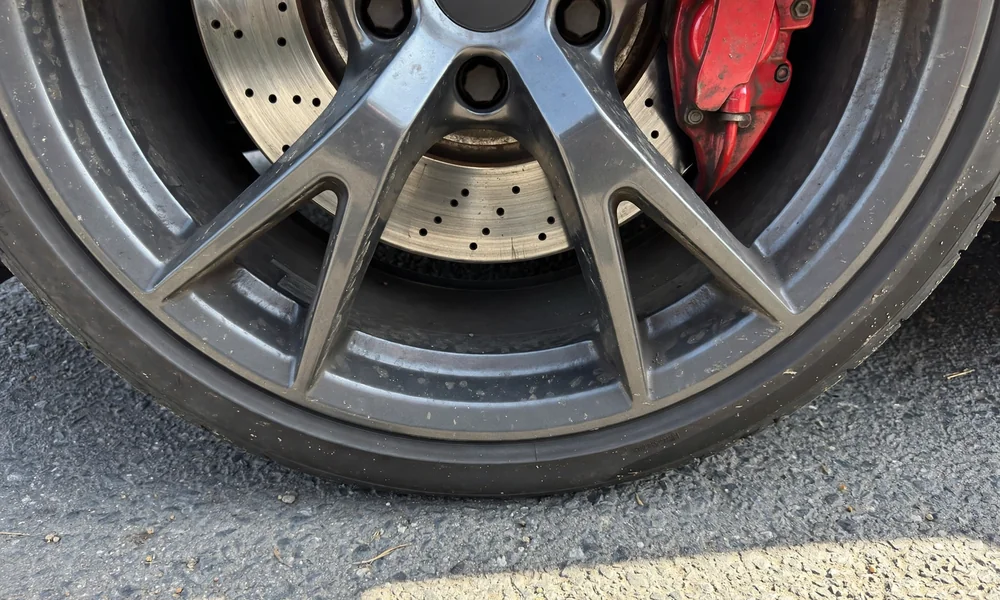
Braking distance from 100 km/h to a standstill, roughly 30 to 34 metres on a luxury sports car, is the spec that decides how late a driver can brake into a corner, and it depends on the brakes, the tyres and the weight of the car working together. Luxury sports cars usually wear large ventilated discs, often carbon ceramic on the most expensive models, because carbon ceramic discs resist fade when they get hot, which means the tenth hard stop of the day feels like the first. For a sense of how the sports car compares with its open-topped cousins, the guide to how a luxury convertible works shows what changes when the roof comes off and the body has to stay stiff without it.
Price: what the money buys
A luxury sports car costs roughly $150,000 to $400,000 as an estimate, with limited editions going far higher, and the money goes into the engine, the chassis, the brakes and the finish. A mass-market car can match one number on the sheet, such as power, but it will not match the whole sheet at once, because the engineering that makes a car quick, balanced and reliable at speed is expensive to design and to build.
The gap between a fast ordinary car and a true luxury sports car is mostly felt rather than seen: steering that talks back to the driver, a chassis that stays composed over a bumpy road, and controls that work perfectly lap after lap. Buyers who drive for pleasure tend to pay it, because a car that disappears around the driver is worth more than a faster one that fights him.
A rare fact worth knowing
Some luxury sports cars are fitted with a rear wing that changes its angle automatically, tilting up under hard braking to act as an air brake. It is not there for show. At high speed the wing can add hundreds of kilograms of downforce, pressing the rear tyres into the road, and when the driver brakes hard it flips up to catch the air and help slow the car. Owners who have felt it work once tend to call it the cleverest part of the whole car, and it is the kind of detail that never makes the headline numbers.


