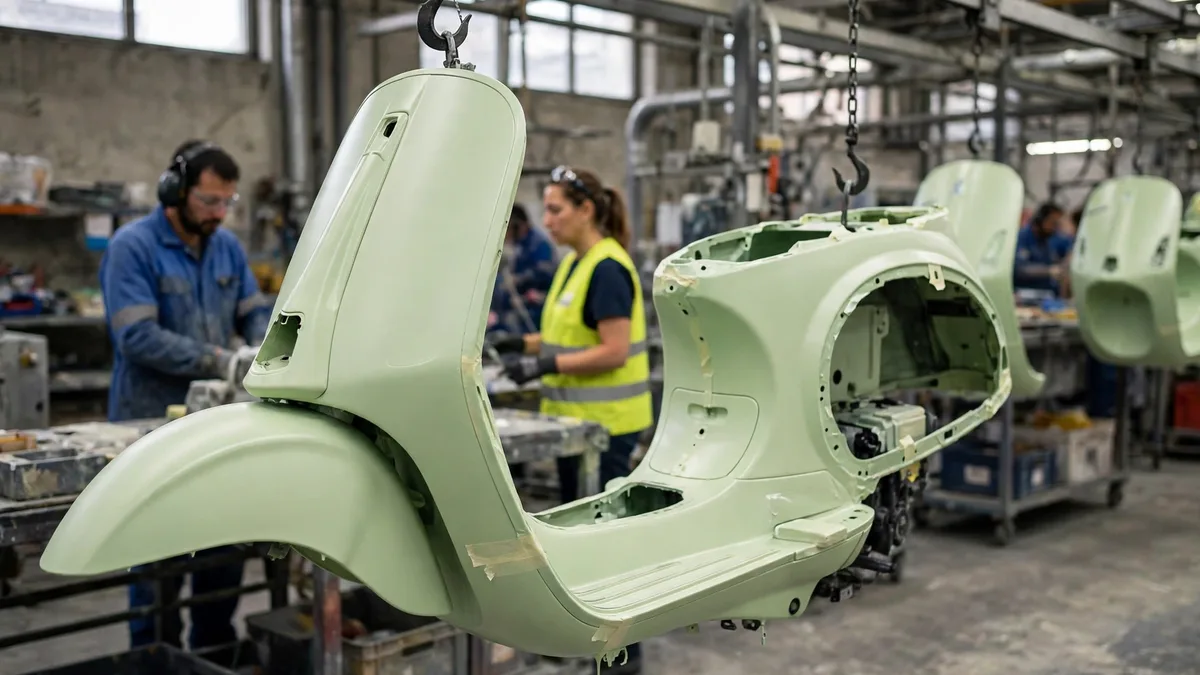
In a factory in Italy, a steel body hangs from a hook and moves slowly down a line, dipped and sprayed until it shines like a mirror. It has the shape every rider recognises at a glance: the rounded leg shield, the narrow waist, the wide rear that hides the wheel. There is no engine under it, no exhaust, no fuel tank. This one is electric, and the silence of the line suits it, because the machine it is becoming makes almost no sound at all.
This is how a luxury electric Vespa is made, from the pressed-steel body that links it to its petrol ancestors to the battery and hub motor that replace the engine.
Step 1: The steel monocoque is pressed and welded
Every electric Vespa starts as flat sheets of steel, pressed into curves by machines that have made the same shapes for decades. The leg shield, the floor and the rear body are pressed separately, then welded together into a single monocoque, a body that is also the frame. The monocoque is dipped in a rust-proofing bath before it is painted, and it is dried slowly so no moisture is trapped inside the hollow sections. The petrol Vespa works on exactly this steel body, and the guide to how a luxury Vespa works shows how the same monocoque has carried riders for nearly eighty years.
Step 2: The paint is laid on in layers
A luxury electric Vespa is painted like a small car, not like a scooter. The body is primed, baked, sprayed with a base colour and then given two coats of clear lacquer, each one baked in an oven before the next goes on. The pastel greens, creams and blues of the luxury models are mixed in small batches and matched to a sample panel, and the finished paint is polished until it reflects the factory lights without a ripple. The paint is the most visible sign of the luxury badge, and it is also the most expensive single stage of the build.
Step 3: The battery pack is built and sealed
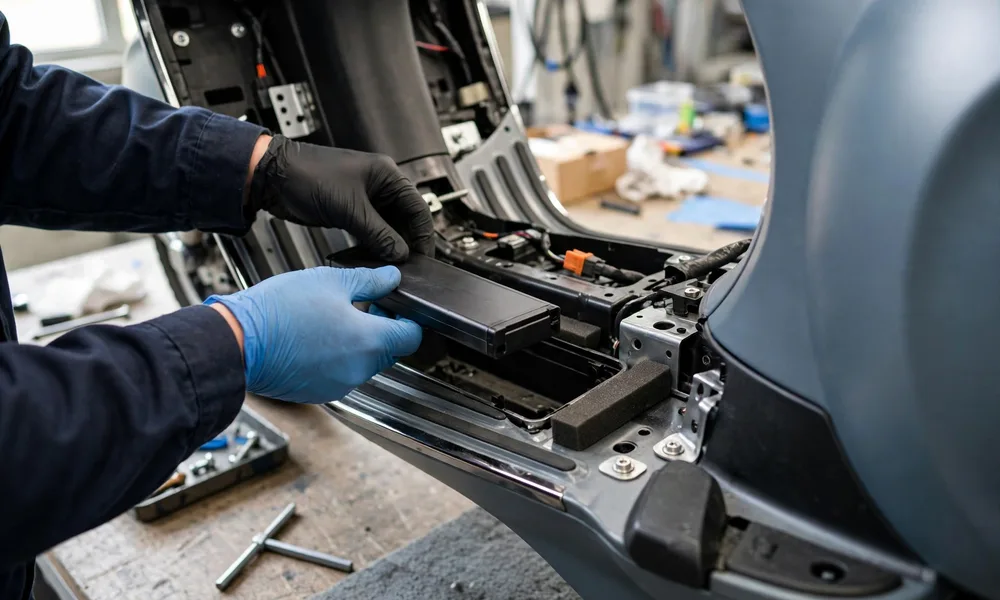
While the body is being painted, the battery is built on a separate line. Hundreds of small lithium cells are tested one by one, and only cells with matching voltage are grouped together, so the pack charges and discharges evenly and no single cell wears out early. The cells are packed into a slim, sealed metal case that slides into the floor of the scooter, where the fuel tank used to sit, and the case is fitted with cooling channels and a sensor that watches the temperature of every group of cells. A battery built this way is the most expensive part of the scooter, and it is treated with the care of a jewel, not a component.
Step 4: The hub motor goes into the rear wheel
The electric Vespa has no engine, no gearbox and no belt. Instead, a hub motor is built directly into the rear wheel, a ring of copper windings and magnets sealed inside a drum that looks, from the outside, like an ordinary wheel hub. The motor is assembled in a clean room, because dust inside the windings would shorten its life, and it is tested on a rig that spins it up to full speed before it is ever fitted to a scooter. The same electric simplicity runs through other small city machines, and the story of how a luxury electric scooter is made shows how a battery and a hub motor replace an engine in an even smaller frame.
Step 5: The electrics, brakes and details are fitted
With the body, battery and motor in place, the scooter is dressed. The handlebar carries a digital dashboard, a twist-grip throttle and two brake levers, and behind it sit the controller, the small box that turns the rider’s twist into power for the motor. The brakes are discs, front and rear, with regenerative braking that feeds a little energy back into the battery every time the rider slows down. Every switch is tested before the scooter moves, because an electric scooter with a faulty throttle is a machine that cannot be trusted.
Step 6: The road test, in silence
The last stage is a road test, and it is a strange one for a factory that used to listen for engine notes. The finished electric Vespa is ridden around a test course while a technician checks the throttle response, the brakes, the dashboard and the range estimate, listening not for an engine but for rattles, squeaks and loose trim. The bigger electric two-wheelers are tested the same way, and the guide to how a luxury electric motorcycle works shows how a larger battery and motor change the same simple job.
The spec sheet at a glance
| Specification | Typical luxury figure | What it tells you |
|---|---|---|
| Body | Pressed-steel monocoque | How solid and long-lived it is |
| Motor | 4–6 kW hub motor, rear wheel | How strongly it pulls away |
| Battery | 4–5 kWh lithium pack | How far it goes on a charge |
| Range | 80–130 km per charge | How far a charge takes you |
| Top speed | 70–95 km/h | How fast it can go |
| Charging | 3–4 hours, home socket | How long a full charge takes |
| Weight | 130–150 kg | How heavy it is to move |
| Brakes | Discs front and rear, regenerative | How it stops and recovers energy |
| Seat height | 770–790 mm | How easily riders reach the ground |
Keeping it in good shape
A luxury electric Vespa lasts longest when its battery is treated gently. Charge it regularly rather than letting it sit empty for weeks, and keep it out of freezing garages in winter, because cold shortens the range and ages the cells. Wash the steel body with fresh water after rides on salted roads and wax it twice a year, just as with a petrol Vespa, so the paint never gets a chance to bubble.
What it costs
A luxury electric Vespa typically costs an estimated $8,000 to $14,000, depending on the model, the battery size and the finish. The estimate covers the scooter alone, not the helmet, the charger or the insurance.
A rare fact
One detail few riders ever learn is that the first electric Vespas were built as an experiment in the 1970s, long before batteries were good enough to make them practical, and the factory shelved the idea for forty years. The shape survived, the battery did not, and when lithium cells finally became light and powerful enough, the old electric drawings were dusted off and the same steel body was given a second life. It is a rare thing in engineering, a machine that waited half a lifetime for its power source to catch up.
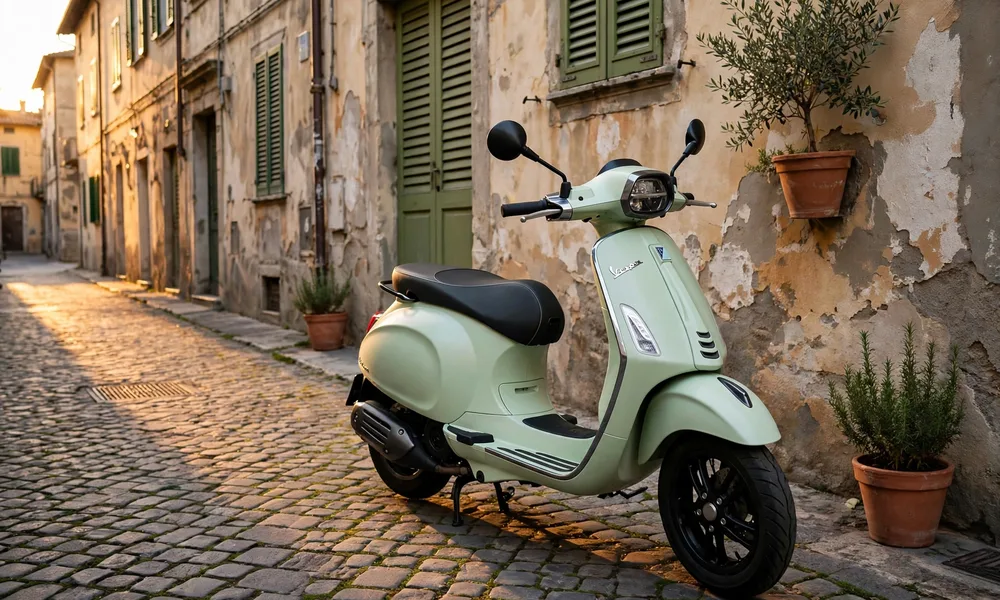
A luxury electric Vespa is made by keeping the best of the old machine, the steel body and the hand-finished paint, and replacing the noisiest part of it with silence. The result looks like the Vespa everyone recognises, but it starts with a twist and a hum rather than a putter, and the factory that builds it has learned to listen for a different kind of perfection.


