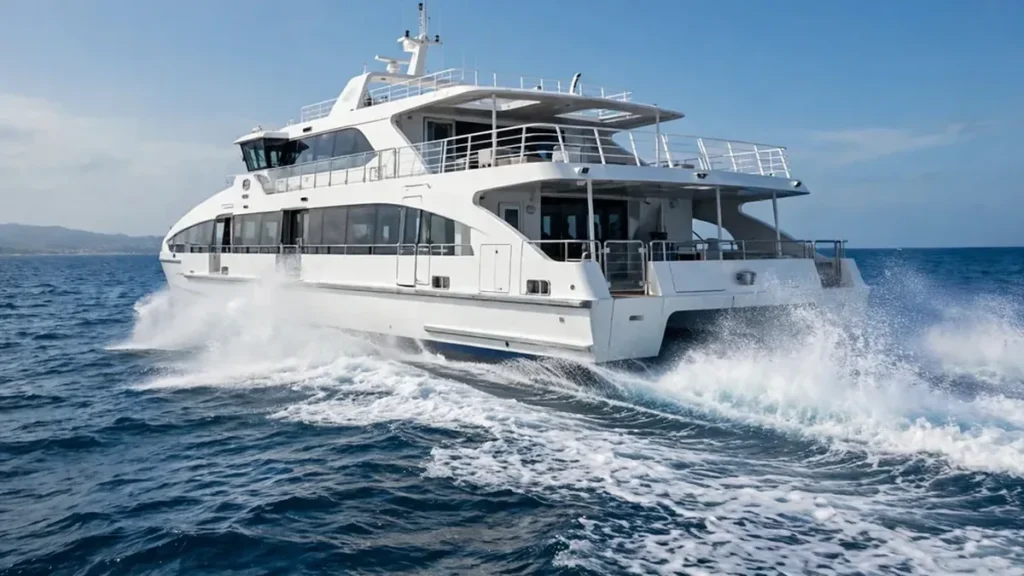
Most yachts stay where the water is warm and the harbours are full. A luxury explorer yacht does the opposite. It heads for icy bays, remote islands and empty stretches of ocean, carrying its owners far beyond the horizon and bringing them home safely. It is a yacht built like a small ship, with a steel hull, huge fuel tanks and room for tenders, diving gear and a helicopter.
An explorer yacht is not just a pretty boat with a long range. It is a self-sufficient floating base that can make its own water, treat its own waste, keep its crew warm in polar cold and stay at sea for months. Understanding how it works means understanding how a home, a workshop and a ship can all live in one hull. Here is how a luxury explorer yacht works, from its engines to its stabilisers and its tenders.

How It Works
Step 1: The steel hull and ice protection
The heart of an explorer yacht is its hull, made from thick steel rather than the fibreglass used on most pleasure yachts. Steel can take a knock from floating ice, a log or a rocky shore without cracking, and it can be repaired in almost any port in the world. The bow is strengthened with extra plating, and the propeller and rudder are protected by a skeg, a fin of steel that stops ice and debris from hitting them. The hull is divided into watertight compartments, so flooding in one space cannot sink the yacht.
Step 2: The engines and the long range
Explorer yachts usually have two diesel engines, each driving its own propeller, so the yacht can keep going if one engine fails. The engines are large but they run slowly and steadily, tuned for efficiency rather than speed. Huge fuel tanks sit low in the hull, giving the yacht a range of five thousand nautical miles or more, enough to cross an ocean without refuelling. The fuel is filtered and polished as it is used, removing water and dirt that could stop an engine far from help. The story of how a luxury explorer yacht is made shows how those tanks and engines are fitted into the hull, with space left around them for engineers to work. Generators run alongside the engines, making electricity for lights, cooking, navigation and air conditioning.
Step 3: Stabilisers, thrusters and steady handling
At anchor in a remote bay, an explorer yacht must stay steady while guests eat, sleep and launch tenders. Fins under the hull, called stabilisers, extend outwards and tilt to fight the roll of the waves, working even when the yacht is moving slowly. At the bow and stern, thrusters push water sideways, letting the captain turn the yacht in its own length or hold it against a jetty in a crosswind. A dynamic positioning system can even hold the yacht in one spot over a dive site, using satellite signals and thrusters to fight wind and current.
Step 4: Making water, power and comfort on board
Far from shore, an explorer yacht must make everything it needs. Watermakers push seawater through fine membranes, turning it into fresh drinking water at a rate of thousands of litres a day. The air conditioning and heating are designed for extremes, keeping the cabins warm in the Arctic and cool in the tropics, often with double glazing and thick insulation. Waste water is treated on board so that nothing harmful goes into the sea, and rubbish is compacted and stored until the yacht reaches port. The full specifications of an expedition yacht explain how range, tank size and generator power are measured, and why those numbers matter more than top speed on a long voyage.
Step 5: Tenders, toys and going ashore
An explorer yacht carries its own fleet. A large tender, often a rigid inflatable boat, is launched from the aft deck by crane, and it can carry guests to a beach, a dive site or a village with no jetty. There may also be kayaks, paddleboards, diving compressors, fishing gear and sometimes a small submarine or a helicopter on the top deck. The crew stores all of this in a garage and a workshop, with tools and spare parts to fix almost anything. The story of how a luxury catamaran yacht works shows a different way of carrying guests in comfort, but the explorer adds range and toughness to the same idea. Launching a tender in a swell takes practice, and the crew rehearses it until it feels routine.
Step 6: Navigation, safety and the crew at work
On the bridge, the captain has radar, satellite charts, weather forecasts and cameras that watch the decks and the engine room. The yacht carries life rafts, immersion suits and a medical kit, and the crew trains for fire, flooding and man-overboard drills every week. Communications run by satellite, so the yacht can call for help or receive weather updates anywhere on Earth. When the yacht drops anchor in a quiet bay at the end of a long passage, all of that work becomes invisible, and guests simply see a calm yacht in a beautiful place.

Explorer Yacht Specifications
| Specification | Typical Luxury Explorer Yacht |
|---|---|
| Length | 45 to 75 metres |
| Hull material | Steel, ice-strengthened bow |
| Range | 5,000 to 7,000 nautical miles |
| Cruising speed | 11 to 13 knots |
| Guests | 10 to 14 guests |
| Crew | 12 to 18 crew |
| Fresh water made | 8,000 to 15,000 litres a day |
The Price
A luxury explorer yacht costs an estimated $30 million to $80 million to buy, depending on its size, range and the standard of its interior. Running one costs an estimated $3 million to $6 million a year in crew wages, fuel, maintenance, insurance and berthing, with long expeditions adding more. Owners accept that cost because no hotel can take them to a glacier at dawn or a coral reef with no other boat in sight. The yacht is not just transport; it is the whole holiday, the hotel and the base camp in one hull.
A Rare Fact
Some explorer yachts carry a small submarine in a garage under the deck. The submarine is launched by crane, and it can dive with two or three people to depths of several hundred metres, where the water is dark and cold and full of creatures few people ever see. The pilot steers with a joystick, and the passengers watch through thick acrylic windows as the seabed drifts past. It is the ultimate tender, and it turns a yacht holiday into a real expedition.

Life on an explorer yacht follows the rhythm of the sea. Mornings start with a weather check and a plan for the day, whether that means diving, hiking ashore or simply sailing to the next bay. Evenings are quiet, with dinner on deck, the anchor chain holding steady and the stars bright overhead because there is no city light for hundreds of miles. The crew works hard, but the work has a purpose everyone on board can feel.
A luxury explorer yacht works because every system has a backup and every space has a purpose. Its steel hull takes the knocks, its engines run for weeks, its watermakers and generators keep life comfortable, and its tenders open up places no road can reach. That is what makes it different from an ordinary yacht. It does not just float in beautiful water. It takes its owners far beyond the horizon, and brings them home with stories no one else has.