The harbour is busy at dawn, and the biggest ship in it cannot move on its own. A container ship three hundred metres long needs to turn in a basin barely wider than it is long, slide sideways toward a quay, and stop within a metre of the concrete, all while the wind pushes at its steel side like a sail. The machine that makes that possible is small, square, and almost comically powerful for its size, and the newest versions make no noise at all. This is the electric tugboat, and watching one work is watching a harbour ballet performed by a machine the size of a house.
For a century, tugboats burned diesel and belched smoke while they shoved ships around. The electric tug keeps the same job and the same brute strength, but replaces the diesel engines with batteries and electric motors. Building one is a different kind of shipbuilding, where the battery room matters as much as the hull.

How an Electric Tugboat Is Made
1. Designed around one number: bollard pull
Every tugboat design starts with bollard pull, the force the boat can exert while tied to a fixed post, and for a modern harbour tug that number is usually between fifty and seventy tonnes. Naval architects work backwards from that figure, choosing the hull shape, the propeller size, and the power needed to deliver it. The hull is short and wide, with a rounded bow for pushing and a flat stern for stability, and the whole boat is designed to work at low speed with enormous thrust rather than to go fast. Stability calculations matter more than on almost any other vessel, because a tug can be pulled sideways by the ship it is towing, and the design must keep it upright even when the towline pulls hard from the side.
2. A steel hull built to take punishment
The hull is built from heavy steel plate, welded into blocks and assembled in a dry dock much like a larger ship, but with extra reinforcement where it counts. The bow and sides carry thick rubber fenders, great black tyres and moulded rubber blocks that absorb the shock of pressing against a steel ship. The deck is fitted with a towing winch, a staple-like towing arch, and a hook that can release the towline instantly if something goes wrong.
3. The battery room, the heart of the boat
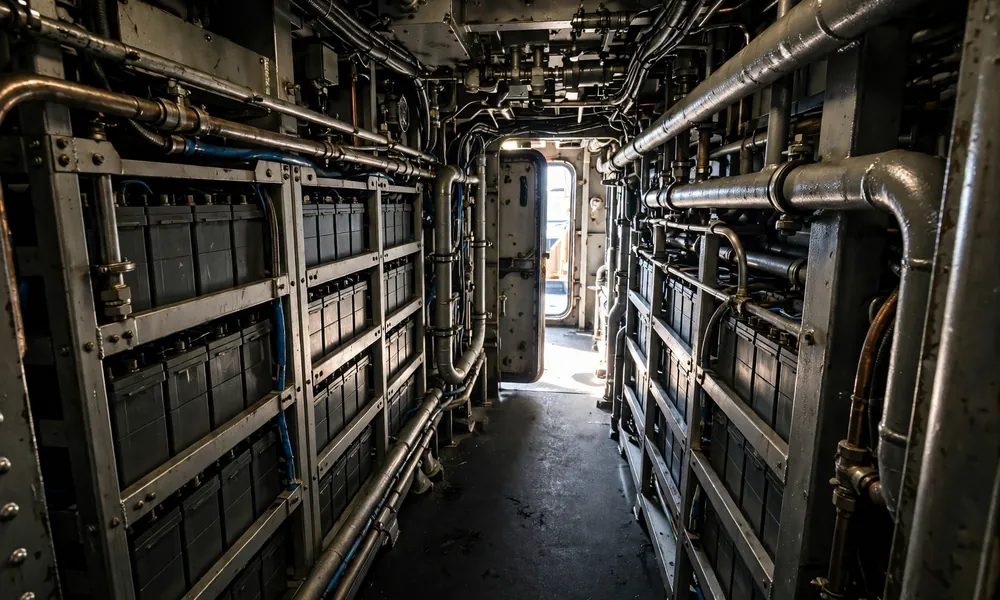
The battery room is where an electric tug differs most from its diesel ancestors. Racks of lithium-ion battery modules are installed in a climate-controlled compartment, wired together into a system that typically stores around five to six megawatt-hours of energy, roughly the same as a hundred electric cars. Cooling pipes run between the racks, fire suppression systems watch for any sign of overheating, and the room is sealed against water and gas. Engineers test every connection twice, because a battery fault at sea is far harder to deal with than one in a workshop.
4. Electric motors and azimuth thrusters
Power flows from the batteries to electric motors, which drive azimuth thrusters, propeller units mounted in pods that can rotate a full 360 degrees beneath the hull. That rotation is what gives the tug its extraordinary manoeuvrability: it can push forwards, sideways, or backwards without turning, and it can spin on the spot. The thrusters are fitted through the bottom of the hull while the boat is still in the dry dock, aligned to a fraction of a degree, and tested by spinning them in air before the dock is flooded. The same electric propulsion idea powers larger vessels, as explained in our guide to how an electric ferry is made, but on a tug the system is tuned for short, violent bursts of thrust rather than steady cruising.
5. Charging, controls, and the wheelhouse
An electric tug is only useful if it can recharge quickly between jobs, so the yard fits high-power shore charging connections, often rated at several megawatts, along with the control systems that manage the charge safely. In the wheelhouse, the captain works with joysticks rather than a traditional wheel and throttle, one for each thruster, plus screens showing battery charge, motor temperature, and the load on the towline. The accommodation is small but comfortable, with cabins for a crew of about six, a galley, and a mess room, because many tugs work around the clock in shifts. Our guide to how a luxury tugboat is made shows how the same hull can be finished to a far higher standard for private owners, while the working tug keeps things simple and tough.
6. Trials: pulling, pushing, and stopping
Sea trials for a tug are a spectacle. The boat is tied to a bollard on the quay and ordered to pull at full power while load cells measure the force, confirming the bollard pull the designers promised. Then it goes out into the harbour to push against a real ship, to spin in its own length, and to stop dead from full speed. Engineers watch the battery drain, the motor temperatures, and the thruster response, and they test the emergency release on the towing hook. Only when the boat can pull its rated force, hold station in a crosswind, and return to the quay with charge to spare is it handed over to its owner, ready for a working life of short, hard days and quiet nights on charge.
Specifications
| Specification | Typical figure |
|---|---|
| Length overall | 22 to 30 metres |
| Beam | 11 to 13 metres |
| Bollard pull | 50 to 70 tonnes |
| Battery capacity | About 5 to 6 megawatt-hours |
| Top speed | About 12 to 13 knots |
| Propulsion | Two azimuth thrusters, fully rotating |
| Crew | About 4 to 6 |
| Endurance | A full harbour shift on one charge |
Price
An electric tugboat costs considerably more to build than a diesel tug of the same size, and the batteries are a large part of the reason. A new electric harbour tug is estimated to cost about 15 to 25 million dollars, depending on its bollard pull, battery size, and charging equipment, while a comparable diesel tug is estimated to cost roughly half as much. Those figures are estimates only. Operators accept the higher purchase price because the running costs are lower: electricity is cheaper than diesel, electric motors need less maintenance, and many ports now offer grants or lower fees for zero-emission harbour craft. The steering and manoeuvring gear is similar to that on larger ships, as described in our guide to how a ship bow thruster works.

A Rare Fact
An electric tug can recover energy while it works. When a tug is being pulled along by the ship it is assisting, or when its thrusters are dragged through the water, the propellers can spin the motors as generators and push a small amount of charge back into the batteries, a marine version of regenerative braking in an electric car. It is only a small gain, but on a boat that spends its life being pushed and pulled, every bit helps.
The electric tugboat does not try to be glamorous. It is a short, strong, silent workboat, built to spend its life in the shadow of ships a hundred times its size, and to make their movements look easy. In a harbour full of diesel smoke and engine noise, the quiet boat doing the hardest work is often the one that has changed the most.


