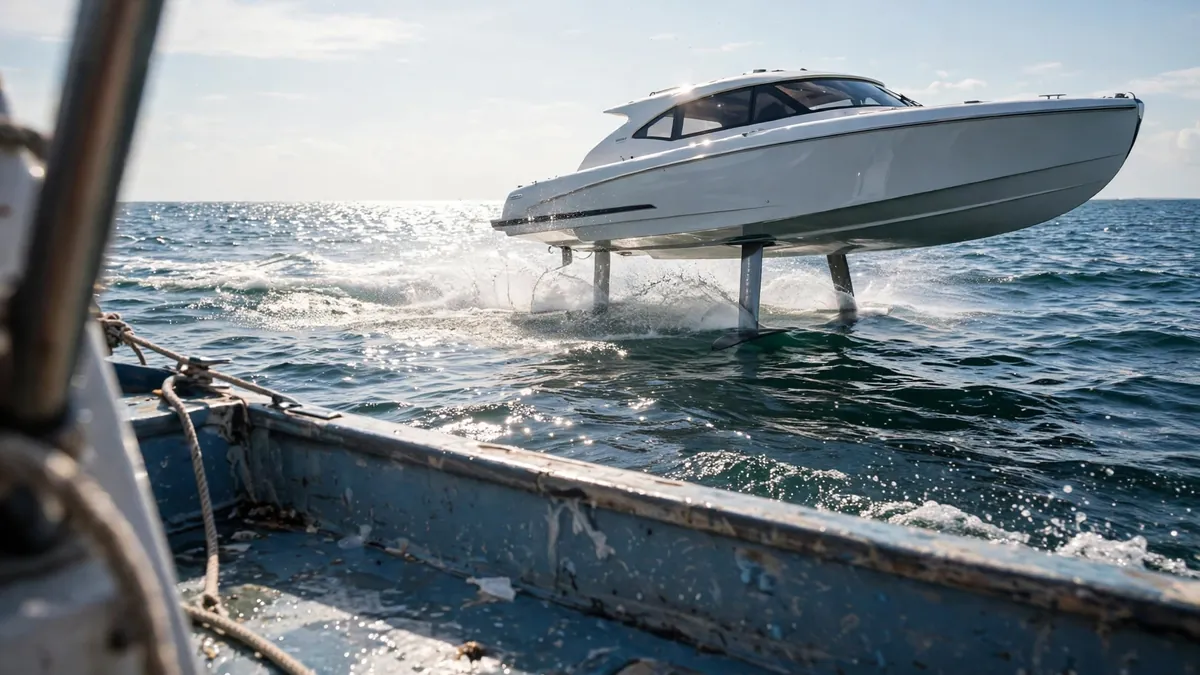
The boat leaves the marina like any other, low in the water, its hull cutting a small white wake behind it. Then, at about twenty knots, something strange happens. The hull rises, the wake flattens to almost nothing, and the boat begins to glide a metre above the surface on two thin legs, silent and level, as if the water had turned to glass. People on the shore point. The passengers stop talking and start smiling. This is not a ferry, with rows of seats and a timetable to keep. This is a luxury hydrofoil, a private boat built for a handful of guests, and it flies on water for the sheer pleasure of it.
A hydrofoil works by lifting its hull clear of the water on underwater wings, called foils, so that only the thin foil struts touch the sea. With the hull out of the water, drag falls away and the boat can go faster, smoother, and further on less power. Ferries use the same idea to carry commuters, but a luxury hydrofoil is a different animal: smaller, faster, quieter, and finished like a yacht, with leather seats, a drinks fridge, and a sound system, all riding on a machine that behaves more like an aircraft than a boat.
How a Luxury Hydrofoil Works
1. The hull: light, stiff, and built to leave the water
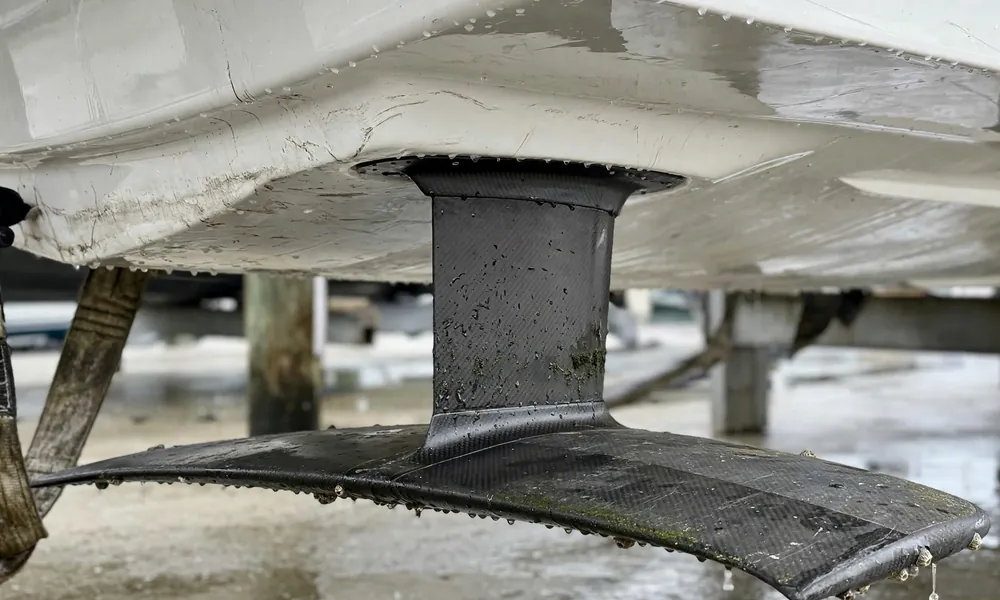
A luxury hydrofoil starts with a hull built from carbon fibre, which is both lighter and stiffer than fibreglass or aluminium. The hull is shaped for two jobs: to plane efficiently at low speed while the foils are still submerged, and to fly cleanly once it lifts, with nothing dragging in the water. Because the hull spends most of its time in the air, the builders pay special attention to the structure where the foil struts meet the hull, reinforcing it with extra carbon layers to carry the full weight of the boat on two narrow points.
2. The foils: underwater wings
The foils themselves are the heart of the machine. A typical luxury hydrofoil has a forward foil and an aft foil, each one a carefully shaped wing, usually made from stainless steel or carbon fibre, mounted on a slim vertical strut. As the boat accelerates, water flows over the foils and generates lift, just as air generates lift over an aircraft wing. At a certain speed, called takeoff speed, the lift exceeds the weight of the boat and the hull rises out of the water. The foils stay submerged, and the struts slice through the surface with barely a ripple. The whole system is related to the larger foils on passenger craft, described in our guide to how an electric hydrofoil ferry works, but the private boat uses smaller, lighter foils tuned for speed and ride comfort rather than carrying a hundred passengers.
3. Electric propulsion, quiet by design
Most modern luxury hydrofoils are electric, with a battery pack under the deck feeding one or two electric motors mounted in a pod behind the aft foil. Electric power suits a hydrofoil perfectly, because the motors are quiet, they deliver full torque from a standstill for a clean takeoff, and there is no exhaust to spoil the clean air on deck. Charging is done at the marina, and the boat is designed for day trips rather than long ocean passages, which keeps the battery size manageable.
4. The flight controller: a computer that flies the boat
Left alone, a hydrofoil would be unstable, pitching and rolling as waves pass under it. The luxury hydrofoil solves this with a flight controller, a computer that reads sensors hundreds of times a second and adjusts the foils to keep the boat level. Small flaps on the foils move up and down, the ride height is held steady, and the boat banks gently into turns like an aircraft. The driver steers with a wheel and a throttle, much like a normal boat, while the computer does the flying. The build of the larger passenger version is covered in our guide to how an electric hydrofoil ferry is made, which shares the same flight-control principles at a much bigger scale.
5. Takeoff, cruise, and landing
A typical trip has three phases. First the boat accelerates on its hull, pushing through the water like any speedboat until it reaches about eighteen to twenty knots. Then the foils take over, the hull lifts, and the ride goes suddenly smooth and quiet, even in a light chop. In cruise, the boat flies at thirty-five to forty-five knots, using far less energy than a conventional boat at the same speed, and the passengers feel almost no vibration. To stop, the driver eases off the throttle, the boat settles back onto its hull, and it manoeuvres into the marina like any other boat.
6. The cabin: a yacht above the water
What makes this a luxury hydrofoil rather than a racing machine is the cabin and the deck. The cockpit has hand-stitched seats, a touchscreen chart plotter, and a joystick for docking. Below deck there is a small lounge with a fridge, a sound system, and space for bags and towels. The finish is yacht standard: teak decking, polished stainless steel, and upholstery chosen to survive salt and sun. The point is that the boat is not only fast and clever, it is a place to spend a day, to cross a bay for lunch, to watch the sunset from a boat that is flying, and to arrive feeling relaxed rather than rattled. Foiling at this small scale has its roots in toys as well as transport, and the lightest version of the idea is explained in our guide to the electric hydrofoil surfboard.
Specifications
| Specification | Typical figure |
|---|---|
| Length overall | 10 to 15 metres |
| Beam | About 3 to 4 metres |
| Passengers | 8 to 12 guests plus crew |
| Takeoff speed | About 18 to 20 knots |
| Foiling cruise speed | 35 to 45 knots |
| Propulsion | Electric motor, single or twin pod |
| Range | About 60 to 100 nautical miles |
| Hull material | Carbon fibre composite |
Price
A luxury hydrofoil is a specialist boat, and its price reflects the carbon fibre hull, the flight-control system, and the low production numbers. A new luxury hydrofoil is estimated to cost about 800,000 to 2.5 million dollars, depending on its size, battery capacity, and the standard of the cabin finish, with larger or fully custom boats estimated to cost more. Those figures are estimates only. Running costs are lower than for a conventional boat of similar speed, because the electric motors need little maintenance and the foiling hull uses less energy, but the foils themselves need regular inspection, and any damage to a foil or its control system is a specialist repair.

A Rare Fact
A hydrofoil can be smoother in rough water than a conventional boat, because its foils fly below the surface chop. While a normal hull slams into every wave, the foils ride in calmer water a metre down, and the flight controller smooths out what remains. Passengers on a foiling boat often feel less motion at forty knots than they would at twenty knots in an ordinary speedboat.
The luxury hydrofoil is not a ferry, and it is not trying to be one. It carries no timetable, no crowds, and no compromises for capacity. It is a private boat that happens to fly, built for people who want the fastest, smoothest, quietest way across the water, and who enjoy the small daily miracle of a hull leaving the sea behind.