On a test track in the late afternoon, an engineer stands beside a barrier with a clipboard and a stopwatch, watching the same car come round for the twentieth time. Each lap looks identical from where he stands, but the numbers tell a different story: the braking point moves a metre later, the corner speed creeps up, and the lap time falls by a tenth. That slow, patient tuning is what a luxury sports car really is, long before anyone drives it for fun.
This is how a luxury sports car works, system by system: the engine that makes the power, the gearbox that delivers it, the chassis that keeps it on the road, and the electronics that watch over all of it, lap after lap.

The engine: where the power is made
At the heart of a luxury sports car sits the engine, usually a large petrol unit of 3.0 to 6.5 litres, either turbocharged or naturally aspirated. Inside it, pistons move up and down in cylinders, squeezing a mix of fuel and air and then igniting it, and the explosion pushes the piston down and turns the crankshaft. A turbocharged engine forces extra air into the cylinders with a turbine spun by the exhaust, so it makes more power from the same size, while a naturally aspirated engine breathes on its own and builds its power smoothly all the way to a high redline. The guide to the luxury sports car specs, explained sets out what the finished numbers mean, and the engine in this section is where every one of those numbers begins.
The gearbox: how the power reaches the wheels
Power from the engine means nothing until it reaches the road, and the gearbox is what delivers it. Most luxury sports cars use a dual-clutch gearbox, which is really two gearboxes in one: one clutch handles the odd gears and the other the even gears, so the next gear is already selected before the shift happens. The result is a gear change in a fraction of a second, with no interruption in power. A launch control system holds the revs and manages the clutch so the car leaves the line as quickly as the tyres allow, rather than spinning its wheels and wasting the start.
The chassis and suspension: keeping the tyres on the road
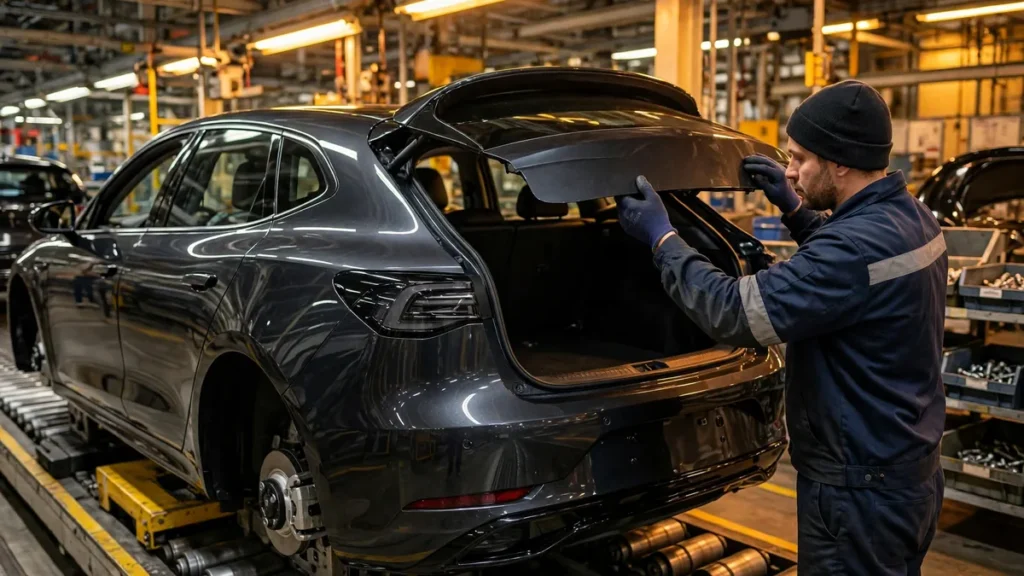
The chassis is the skeleton of the car, usually a mix of aluminium and carbon fibre, built to be stiff and light at the same time. A stiff chassis lets the suspension do its work properly, because the body does not flex and confuse the wheels. The suspension itself is often adaptive, with dampers that change their firmness many times a second, softening over a bumpy road and firming up in a corner. The guide to how a luxury sports car is made follows the chassis from the first welded frame to the finished machine, and the suspension in this section is what turns that stiff skeleton into a car that can be driven to the shops as well as to a racetrack.
The brakes and the tyres: stopping and gripping
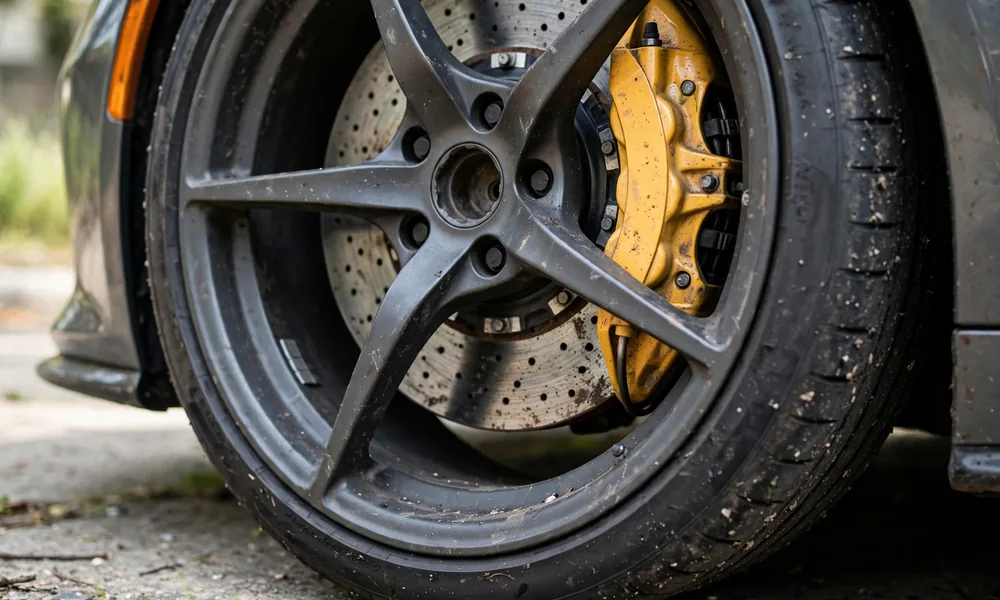
A car that goes fast must also stop fast, and the brakes on a luxury sports car are built for repeated hard use. Large ventilated discs, often carbon ceramic on the most expensive models, resist fading when they get hot, so the tenth hard stop of the day feels like the first. The callipers squeeze the discs with many pistons, spreading the force evenly, and the brake pedal is tuned so the driver can feel exactly how much grip is left. The tyres matter just as much: wide, low-profile rubber, often with a different compound on the front and the rear, gives the grip that turns power into speed.
The aerodynamics: using the air, not fighting it
At speed, the air itself becomes a force the car must manage. The bodywork is shaped so that air flows smoothly over it, and the underside is often flat, with a diffuser at the rear that speeds the air underneath and pulls the car down onto the road. A rear wing or an active spoiler tilts up under hard braking to act as an air brake, and flattens out again on a straight to reduce drag. None of this is decoration. At high speed, the downforce from the aerodynamics can add hundreds of kilograms of grip, pressing the tyres into the road exactly when the driver needs it most.
The electronics: the invisible co-driver
Modern sports cars are watched over by electronics that work faster than any driver. Traction control watches each wheel many times a second and cuts power the moment one starts to spin, while stability control brakes individual wheels to keep the car pointing where the driver steered it. The systems can be loosened or switched off by an experienced driver, but they are always there in the background, ready to catch a mistake. The same balance of power and grip is explained in the guide to how a luxury off-roader works, which shows what changes when the same engineering is aimed at rough ground instead of smooth asphalt. Inside the cabin, the driver gets a clear set of dials, a small display and paddle shifters, arranged so that nothing needs to be hunted for at speed.
The spec sheet at a glance
| Specification | Typical luxury figure | What it tells you |
|---|---|---|
| Engine | 3.0 to 6.5 litre, turbocharged or naturally aspirated | How the power is made |
| Power | Roughly 400 to 700 horsepower | How hard the car can push |
| Torque | Roughly 500 to 800 Nm | How strongly it pulls from low revs |
| Gearbox | Dual-clutch, paddle shift | How quickly it changes gear |
| 0 to 100 km/h | Roughly 3.0 to 4.5 seconds | How quickly it launches |
| Braking, 100 to 0 km/h | Roughly 30 to 34 metres | How fast it can stop |
| Weight | Roughly 1,400 to 1,700 kg | How much mass the power must move |

What it costs
A luxury sports car typically costs an estimated $150,000 to $400,000, depending on its engine, its materials and how much of it was made by hand, with limited editions going far higher. Most of the price is in the engine, the chassis, the brakes and the finish, and in the fact that the parts are made in the hundreds, not the millions, so every hour of engineering is paid for by one buyer, not spread across a production line.
A rare fact
One detail few drivers ever learn is that many luxury sports car engines use a dry sump, with the oil kept in a separate tank instead of a pan under the engine. In a hard corner, the forces can push the oil to one side of an ordinary pan and leave the pump sucking air, which starves the engine at the worst possible moment. A dry sump pumps the oil away as fast as it returns, so the engine stays lubricated through corners that would leave a normal car gasping, and the engine can also sit lower in the car, which helps the balance.