On a cold morning at a small airfield outside Wichita, a business jet spools up on the apron and the sound is less a roar than a clean, rising whistle. Passengers settle into leather seats, a pilot runs a checklist, and within minutes the aircraft is climbing through thin cloud at forty thousand feet. Nobody on board thinks much about the two metal tubes hanging under the wings, yet those engines are the reason the whole trip is possible. A private jet engine is one of the most demanding machines ever built for civilian use: it must be light enough to fly, tough enough to swallow a bird at five hundred miles an hour, quiet enough for a conversation in the cabin, and reliable enough that a failure is measured in events per million flight hours. Building one takes months, thousands of parts, and a level of precision that makes watchmaking look relaxed.
The engines on most modern private jets are turbofans, a design in which a large fan at the front pulls in air, most of it flowing around the core to produce quiet thrust while a smaller share is squeezed, burned, and blasted out the back. That split is what makes a business jet engine different from the screaming turbojets of the past: the bypass air softens the noise and improves fuel economy, which matters when an owner is paying for every gallon. Inside, temperatures in the combustion chamber run hotter than the melting point of the metal around them, and the only reason the engine survives is a constant film of cooling air and coatings measured in microns.
How a Private Jet Engine Is Made
Step 1: Forging the fan and compressor discs. The build starts with raw titanium and nickel alloy billets, heated until they glow and pressed in giant forging presses into discs and rings. Each forging is X-rayed and ultrasound-tested for hidden flaws, because a crack no wider than a hair can grow under the spinning loads of flight. A single fan disc may carry blades that each pull with the force of a small car when the engine runs at full power.
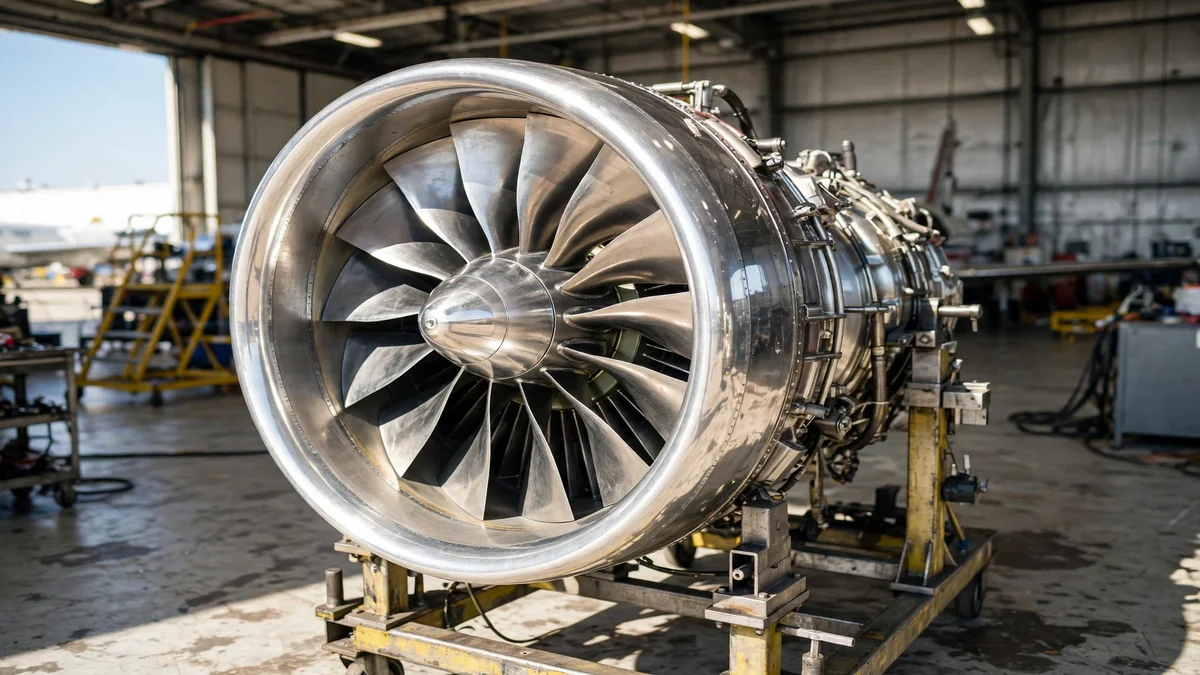
Step 2: Machining the blades. Fan blades are carved from solid titanium on five-axis milling machines that work to tolerances thinner than a human hair. Compressor blades, smaller and more numerous, are shaped from nickel alloys and given a slight twist along their length so they meet the air at the right angle at every point. Each blade is weighed, balanced, and matched into sets, because a set that is even slightly out of balance will shake the engine apart over thousands of hours. The finished blades feel almost impossibly light for the work they do.
Step 3: Building the combustor and turbine. The combustor is a ring of flame tubes where fuel and compressed air mix and burn at roughly two thousand degrees Celsius. Around it sit the turbine blades, the hottest and most stressed parts in the engine, cast as single crystals of nickel superalloy so there are no grain boundaries for cracks to follow. Tiny cooling holes, some narrower than a pin, are laser-drilled through each blade, and a ceramic thermal barrier coating is sprayed on top.
Step 4: Assembling the core. Technicians stack the compressor stages, combustor, and turbine onto a central shaft in a clean assembly hall, checking clearances with feeler gauges and laser trackers. Bearings are fitted, seals are set, and the rotating assembly is balanced on a spin rig at speeds far above anything it will see in flight. If it binds or wobbles now, the whole stack comes apart again.
Step 5: Fitting the fan, casing, and accessories. The big front fan goes on next, followed by the outer casing, the nacelle, and the gearbox that drives fuel pumps, oil pumps, and the generator. Wiring looms and fuel lines are routed by hand, clipped and checked twice, because a chafed wire at altitude is a problem nobody wants. The accessory gearbox alone can look like a small city of pipes and brackets, yet every line has a single correct path.
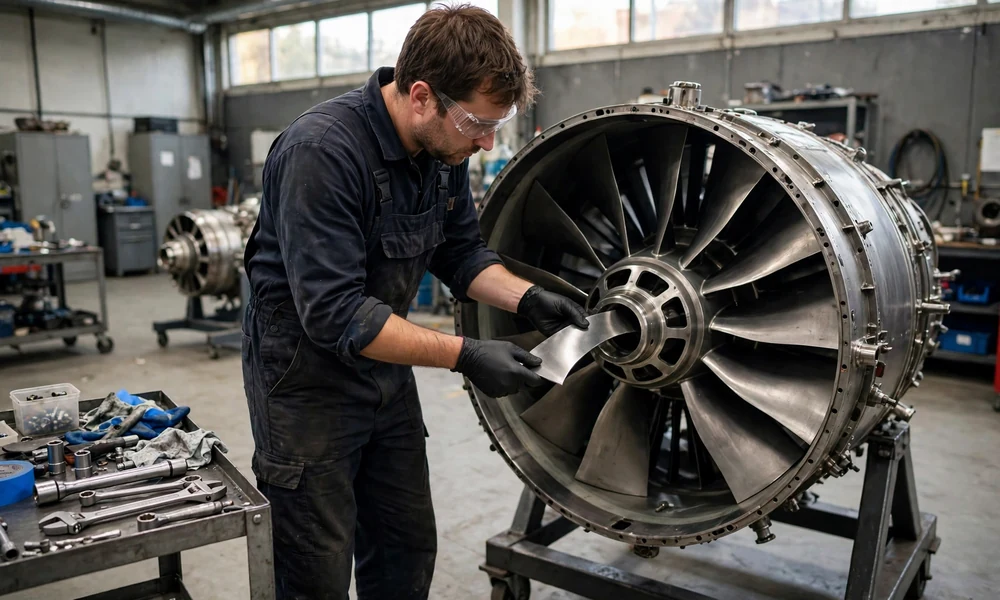
Step 6: Testing on the stand. The finished engine is bolted to a test stand, plumbed with fuel, and run through its full range: idle, climb power, maximum takeoff thrust, and simulated failures. Engineers watch vibration, temperature, oil pressure, and exhaust gas readings on screens, listening for anything unusual. A new engine typically spends many hours on the stand before it is cleared, and its performance data becomes part of its permanent record. Only then is it crated, shipped, and hung under a wing, where it will be expected to run for thousands of hours between major overhauls.
Private Jet Engine Specs
| Specification | Typical figure |
|---|---|
| Engine type | High-bypass turbofan |
| Thrust range | 3,000 to 18,000 pounds |
| Bypass ratio | 4:1 to 6:1 |
| Fan diameter | 28 to 45 inches |
| Combustor temperature | Around 2,000°C |
| Time between overhauls | 4,000 to 7,000 flight hours |
| Engine weight | 600 to 2,500 pounds |
Those numbers move a lot between a light jet and a long-range flagship, but the pattern is the same: modest thrust by airliner standards, packaged into a small, quiet, efficient unit. The high bypass ratio is the key to the hush in the cabin, and the overhaul interval is the key to the economics, since taking an engine off a jet grounds an aircraft worth tens of millions.
How Much Does a Private Jet Engine Cost?
A new business jet turbofan typically costs an estimated $2 million to $8 million, depending on size and model, with the largest long-range engines at the top of that range. That is only the purchase price. A full overhaul is an estimated $1 million to $3 million, and operators usually budget for it through hourly maintenance programmes that charge an estimated $300 to $900 per flight hour, per engine. Fuel burn is another major cost: a light jet burns an estimated 100 to 150 gallons per hour in total, while a large-cabin jet can burn an estimated 400 gallons or more. All of these figures are estimates and vary with the engine model, the maintenance programme, and how the aircraft is flown.
A Rare Fact About Jet Engines
Here is a detail that surprises most people: the turbine blades in a modern business jet engine are grown as a single crystal of metal. There is no grain structure at all, because the boundaries between metal grains are where cracks start under heat and stress. The blades are cast in a mould, pulled slowly out of a furnace so the crystal grows in one direction, and the result is a part that can run for thousands of hours in gas hotter than its own melting point. It is one of the most extreme applications of materials science in everyday civilian life, and it sits quietly inside an engine most passengers never see.

The next time a jet whistles past overhead, it is worth remembering what is spinning inside those nacelles: thousands of parts, each made to a tolerance a watchmaker would respect, working together in heat that would melt them without constant cooling. The private jet cabin gets all the attention, with its leather and wood, but the engine is the part that earns its keep every single flight. It is also a reminder of how far aviation has come, from noisy early jets to machines so refined that owners now ask why electric aircraft are so expensive as the next step. For now, the turbofan remains the heart of private flight, and the rotary range extender ideas explored in what a rotary EV range extender is show how engineers keep borrowing ideas across machines that burn fuel and machines that do not.