On a private runway at dawn, a jet the size of a bus waits with its door open and its cabin lights already on. A pilot walks around it with a torch, checking tyres and wingtips, while inside a crew member lays out breakfast on a table the size of a desk. The aircraft looks simple from the outside, a white tube with two engines and a swept tail, but the sheet that describes it runs to pages of numbers. Those numbers are the difference between a jet that crosses an ocean and one that stops for fuel halfway.
A private jet specification sheet lists the performance, size and comfort figures that define what the aircraft can do. It is written for buyers and pilots, not for passengers, so it is dense with abbreviations and ranges that look like code. This guide translates the key figures into plain language, so you can read a jet spec sheet the way a pilot does, and know what each number really promises.

The Spec Sheet at a Glance
| Specification | Typical Luxury Private Jet | What It Means |
|---|---|---|
| Maximum range | 6,500–7,500 nautical miles | How far it flies without refuelling |
| Cruise speed | Mach 0.85–0.90 | About 850–900 kilometres per hour |
| Passenger capacity | 10–16 people | Seats, including crew rest areas |
| Cabin height | 1.88–1.91 metres | Most adults can stand upright |
| Cabin width | 2.34–2.44 metres | Room for wide seats and an aisle |
| Maximum take-off weight | 38,000–45,000 kilograms | Aircraft, fuel, people and luggage |
| Take-off distance | 1,500–1,800 metres | Runway length needed at full weight |
| Service ceiling | 51,000 feet | How high it can cruise, above weather |
These are typical figures for a large-cabin long-range private jet, not a single model. A light jet will show far smaller numbers, and an ultra-long-range jet will beat most of them. Read the figures against the size of the aircraft and the kind of trips its owner flies.
Range and Speed: The Headline Numbers
Range is the first number any buyer looks at, because it decides which cities the jet can connect without stopping. Six thousand five hundred to seven thousand five hundred nautical miles is enough to fly from London to Los Angeles, or from Dubai to New York, with fuel to spare. The figure on the sheet is measured with a small number of passengers and still air, so a full cabin and a strong headwind will shrink it. Speed is quoted as a Mach number, a fraction of the speed of sound, because at altitude that is how pilots think. Mach 0.85 to 0.90 works out at roughly 850 to 900 kilometres per hour over the ground, which is fast but not the fastest a jet can go. Flying faster burns far more fuel, so the cruise speed on the sheet is a compromise, chosen to balance time against fuel burn.
Cabin: The Room That Flies
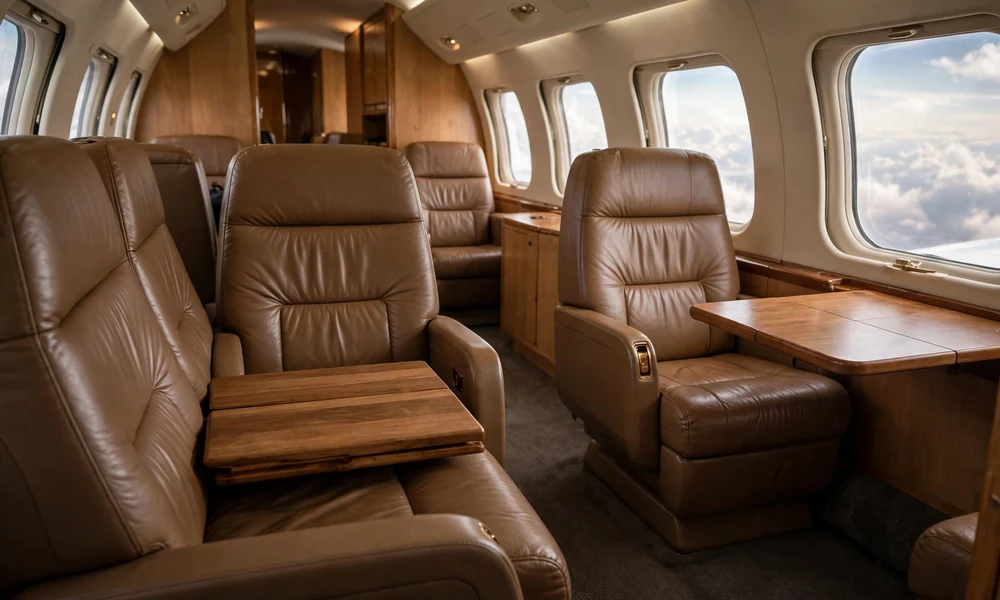
The cabin numbers are the ones passengers feel. A height of 1.88 to 1.91 metres means most adults can stand and walk the aisle without ducking, which sounds small but changes the whole feeling of the cabin. Width runs 2.34 to 2.44 metres, wide enough for seats the size of armchairs with a proper aisle between them, and a cabin length that typically stretches twelve metres or more, divided into zones for working, dining and sleeping. Ten to sixteen seats is the usual layout, and the number is not just about seats: it covers the weight of the people, their luggage and the crew rest area on longer flights. The cabin of a jet is built to the same standard of quiet and comfort as the rest of the aircraft, and our guide to how a luxury private jet works explains the systems that keep it warm, quiet and pressurised.
Engines and Fuel: What Lifts Forty Tonnes
Two turbofan engines do all the lifting, each producing roughly 7,000 to 8,000 kilograms of thrust. They are mounted at the rear of the fuselage, which keeps the cabin quiet and leaves the wing clean for lift. The engines burn kerosene-based jet fuel, and a long-range jet carries 20,000 to 25,000 litres of it in tanks inside the wings and the centre fuselage. Fuel is the heaviest single thing the jet carries, and its weight shapes every other number on the sheet: fill the tanks and the range is long, but the passenger and luggage allowance shrinks. Pilots talk about fuel as a trade, and the spec sheet shows the terms of it. Building those engines is a precision job in its own right, as our guide to how a luxury private jet is made shows step by step.
Runway and Weight: Where the Jet Can Land
Take-off distance is the number that decides which airports the jet can use. One thousand five hundred to one thousand eight hundred metres at full weight is short for an aircraft of this size, and it is what lets a private jet use smaller airfields close to a city instead of a big international hub. The figure depends on weight, temperature and altitude: a hot day at a high airport stretches it, sometimes by hundreds of metres, which is why the sheet also lists the distance at different weights. Maximum take-off weight, 38,000 to 45,000 kilograms, is the ceiling for everything the jet carries, and every kilogram of fuel, food and luggage counts against it. Below that ceiling the jet is certified to fly; above it, it simply does not take off. The landing distance is shorter, around 800 to 1,000 metres, because the jet arrives lighter, having burned most of its fuel on the way.
Price: What a Large Private Jet Costs
A new large-cabin long-range private jet typically costs between 45 and 75 million dollars, depending on the model and the cabin fit. The airframe and engines account for most of that, with the cabin interior, avionics and custom finishes taking the rest. Against those numbers the spec sheet starts to make sense. Range, speed and cabin size are not luxuries on the sheet; they are the reasons the aircraft costs what it does, and the reasons an owner chooses one jet over another.
A Rare Fact Worth Knowing
Here is a detail few spec sheets mention. A private jet cabin is often quieter than a luxury car at motorway speed, because the engines sit behind the cabin and the fuselage is lined with layers of insulation. At cruise, the noise inside can fall to around 50 decibels, quiet enough for normal conversation across the cabin. It is a small reminder that the most expensive numbers on the sheet are not the ones about speed. They are the ones about silence, height and air, the things passengers feel for ten hours at a time.
Read the sheet slowly, and the private jet stops looking like a rich person’s taxi. Range is measured in thousands of nautical miles, speed in fractions of the speed of sound, cabin space in metres of standing room, and weight in tonnes of fuel and people. Those numbers are the aircraft, and a pilot reads them the way a driver reads a road. The helicopter world plays by similar rules at lower altitude, as our guide to how a luxury helicopter is made explains.