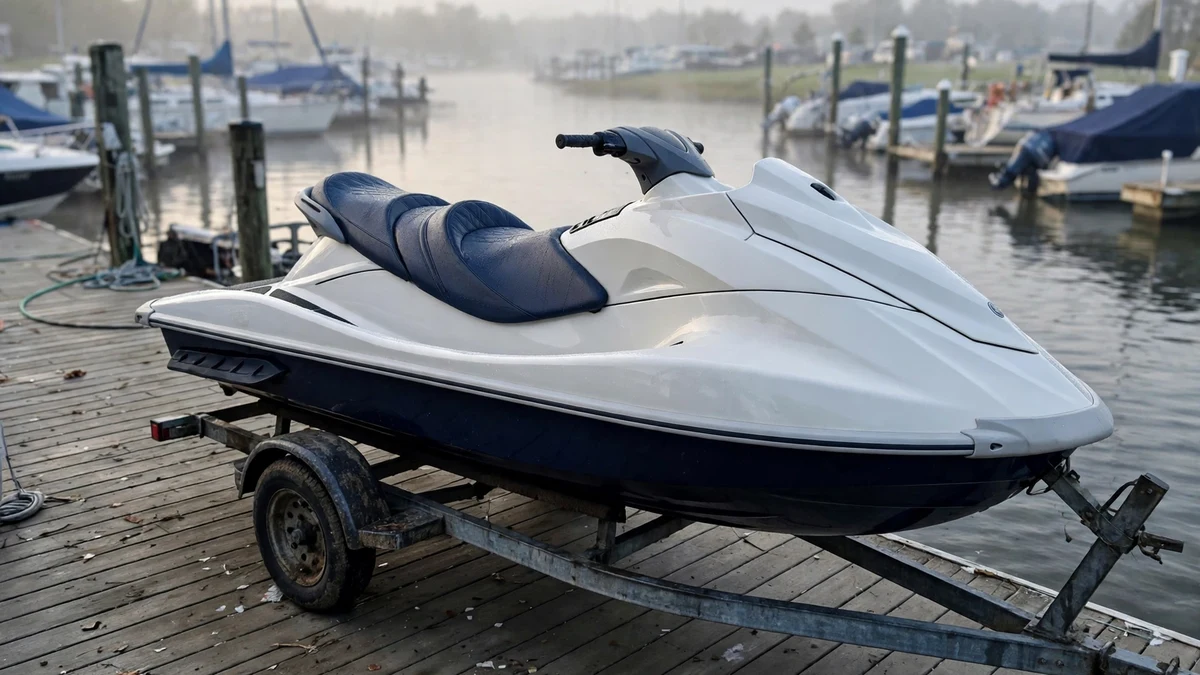
At first light the marina is still asleep, and a jet ski sits on its trailer like a piece of polished sculpture. Its hull curves like a surfboard, its seat is stitched like a car interior, and its engine is hidden away where no rider will ever see it. It looks simple, almost toy-like, until you try to build one.
A luxury jet ski is a small boat, a motorcycle and a jet engine squeezed into a machine you can lift onto a trailer with two people. It must survive salt water, hard landings and full-throttle turns. This is how a luxury jet ski is made, from a bare mould to the first run across open water.
Step 1: The hull is laid up in a mould
Every jet ski starts as a mould, a huge polished shell shaped exactly like the finished hull. Workers brush in layers of fibreglass cloth and resin by hand, building up thickness where the hull will take the hardest knocks, around the keel and the bow, and keeping it thin where weight matters most.
Between the fibreglass skins goes a foam core, which gives the hull its stiffness and its buoyancy. The deck is laid up in a second mould in the same way, and both parts are left to cure until the resin has hardened into a single rigid shell.
Step 2: Hull and deck are joined and finished
Once cured, the hull and deck are lifted from their moulds and trimmed. A worker runs a blade around the edge, cutting away the extra fibreglass, and then sands the seam until it is smooth to the touch. The two halves are bonded together with adhesive and bolts, and the join is sealed so not a drop of water can find its way inside.
Then comes the finish. The hull is sprayed in deep colours, often with several coats and a clear lacquer, and the graphics are laid on under the lacquer so they can never peel.
Step 3: The jet pump is fitted at the stern
The jet pump is what makes a jet ski move, and it is fitted before the engine. A stainless steel impeller sits inside a housing at the stern, and when it spins it draws water in from underneath the hull and fires it out of a nozzle at the back. There is no propeller to catch on a rope or a swimmer, which is part of the point.
The pump is bolted to the hull with a watertight seal, and the steering nozzle is connected to the handlebars, so turning the bars swings the jet of water and pushes the stern the other way. The same direct steering that makes a jet ski so nimble is described in the guide to how a luxury speedboat is made, where a bigger hull uses the same idea on a grander scale.
Step 4: The engine is lowered into the hull
The engine is the heaviest single part of the machine, and it is lowered into the hull on a small crane. Most luxury jet skis use a supercharged four-cylinder engine, sealed against salt water and mounted low in the hull, where its weight keeps the machine stable in a turn. It is bolted to mounts that soak up vibration, and every hose and wire is routed away from heat.
The engine drives the jet pump through a short shaft, with no gearbox in between, so the throttle is the only control. The cooling system draws in lake or sea water, runs it around the engine, and spits it out through the exhaust, which is why a jet ski must never be run dry on land. The full range of power and trim is set out in the guide to luxury jet ski specifications explained, and the numbers there show how much power is packed into so small a hull.

Step 5: The cockpit, seat and controls go on
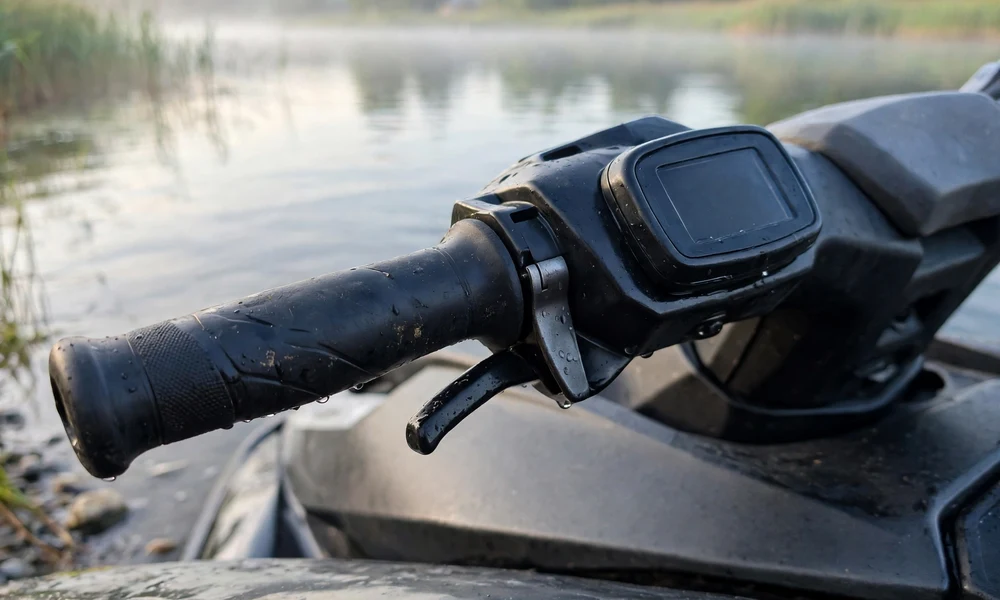
With the machinery in place, the top of the machine gets its attention. The handlebars are fitted with a throttle lever, a start button and a small display that shows speed, fuel and warnings. The seat is upholstered in marine vinyl, stitched to drain water and to grip a wet rider, and it lifts off to reveal the engine bay underneath. The electric side of the family, with its quiet motors and battery packs, is covered in the guide to luxury electric jet ski specifications explained, and many of the same cockpit ideas appear there.
Footwells are lined with a grippy mat, and the storage compartments are sealed with rubber gaskets.
Step 6: Testing on the water and final inspection
Before handover, every luxury jet ski is ridden, not just switched on. A tester launches it, opens the throttle and checks that it accelerates cleanly, turns without cavitation, and stops when the brake lever is pulled.
Back on land, the hull is checked for leaks, every bolt is checked against its torque figure, and the engine bay is dried and inspected. The final polish is done under bright lights, and the machine is crated or trailered for delivery. Only then is it a luxury jet ski, rather than a collection of very expensive parts.
Specifications at a glance
| Feature | Typical luxury figure |
|---|---|
| Length | About 3.5 metres |
| Engine | Supercharged four-cylinder, about 300 horsepower |
| Top speed | About 65 to 70 miles per hour |
| Dry weight | About 350 to 400 kilograms |
| Fuel capacity | About 70 litres |
| Seating | Three riders |
| Hull material | Fibreglass with carbon fibre reinforcement |
What it costs
A luxury jet ski typically costs between about $18,000 and $30,000, and these are estimates, not fixed prices. The price rises with engine power, with a supercharged model costing far more than a naturally aspirated one, and with extras such as a sound system, a larger display and a fitted cover. Running costs are real too: fuel, servicing, insurance and winter storage can add a large sum over a season, and a trailer is usually bought separately. Buyers pay for the finish, the power and the warranty, and for a machine that can be ridden hard all summer without complaint.
A rare fact
The first jet ski was not built as a toy at all. It was designed in the 1970s as a stand-up machine for one rider, and it took years before a sit-down model with a seat appeared. The jet pump itself is older still, borrowed from fire-fighting boats that needed to run in shallow water without a propeller. That is why a modern luxury jet ski can skim across water barely deep enough to cover your ankles, and why it can be beached on sand without damage to anything underneath.
From mould to marina, a luxury jet ski is a study in doing more with less. A hull you can lift, an engine you cannot see, and a pump with no propeller add up to a machine that feels like a motorcycle on water, and that is exactly the feeling its builders are chasing.