The marina is quiet just after sunrise, and the water is flat enough to hold a reflection. A single jet ski sits on its lift, dark hull gleaming, seat still dry, and a small crowd of early walkers keeps slowing down to look at it. The owner, coffee in hand, is asked the same question every weekend: how fast does it go?
Top speed is the least useful number on a luxury jet ski spec sheet, and also the one that tells you least about what the machine is like to ride. A premium personal watercraft is judged by a different set of figures: how much thrust its pump makes, how heavy it is, how the hull behaves in chop, how far it will go on a tank, and how quickly it can stop. This guide reads the whole sheet the way an experienced rider does, starting with the numbers that decide how it feels and ending with the ones that decide how far it will take you.
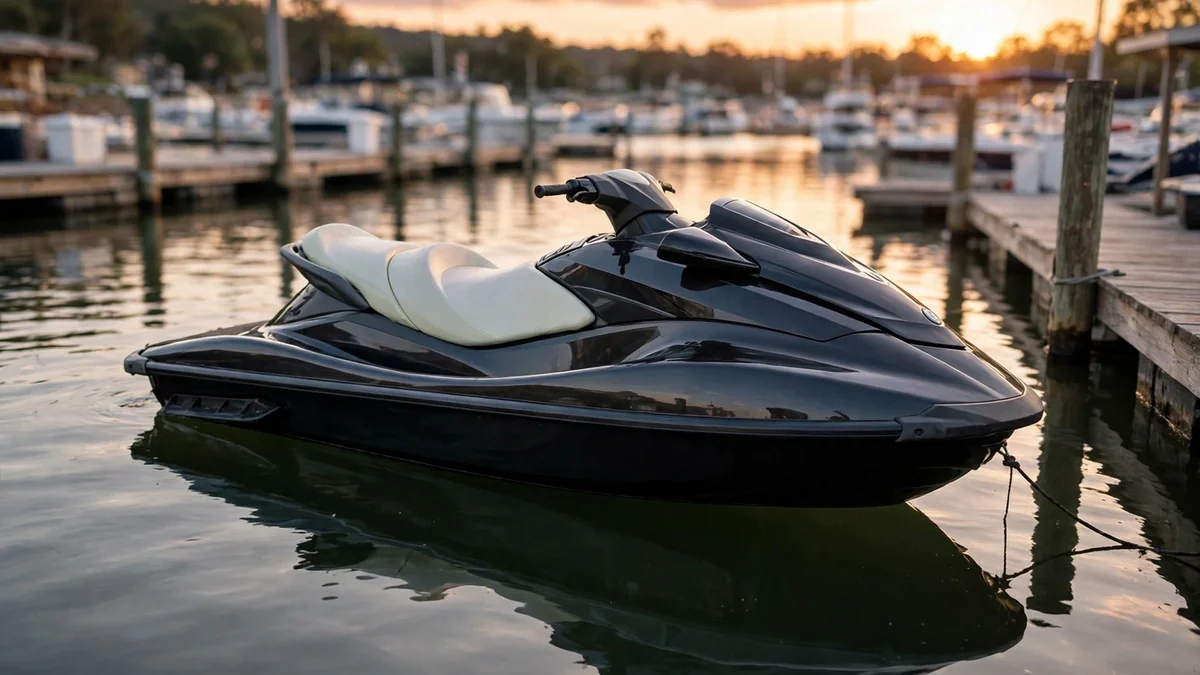
The spec sheet at a glance
| Specification | Typical luxury figure |
|---|---|
| Engine | 1,600 to 1,900 cubic centimetres, supercharged |
| Power | 230 to 325 horsepower |
| Thrust | Jet pump, 155 millimetre impeller |
| Weight | 370 to 460 kilograms, dry |
| Length | 3.4 to 3.7 metres |
| Fuel tank | 60 to 70 litres |
| Range | 120 to 180 kilometres per tank |
| 0 to 80 km/h | 3 to 4 seconds |
| Top speed | 105 to 115 kilometres per hour |
| Rider capacity | Three people |
| Storage | 90 to 170 litres |
| Hull | Deep V, fibreglass composite |
| Braking | Reverse bucket, intelligent brake system |
| Display | Seven inch touchscreen, GPS and audio |
| Seating | Stepped three person saddle, heated grips |
Engine and thrust: why the pump matters more than horsepower
A luxury jet ski engine is usually a supercharged three cylinder unit of 1,600 to 1,900 cubic centimetres, and its job is to feed a jet pump rather than turn a propeller. The pump draws water in through an intake grate and forces it out through a narrow nozzle, and the reaction pushes the craft forward. Horsepower is the number brochures print in large type, but the pump is the number a rider feels: the size of the impeller, the shape of the nozzle and the way the thrust builds from a standstill decide whether the ski leaps out of the water or hesitates and cavitates when the throttle opens hard.
Supercharging matters here because a jet ski has no gears. The engine must pull hard from idle to full revs, and the supercharger fills that gap, giving strong acceleration even with three people aboard and a full tank. The trade is fuel: a supercharged ski at full throttle drinks far more than a naturally aspirated one, which is why the range figure deserves as much attention as the power figure. The closest relatives on the water are covered in the luxury speedboat spec sheet explained, where the same supercharged thinking meets a much bigger hull and a propeller.
Hull and weight: the numbers that decide the ride in chop
The hull is the most honest figure on the sheet. A luxury jet ski weighs 370 to 460 kilograms dry, and that mass shapes every other number: the pump must be bigger, the brakes must be stronger, and the engine must make more power just to move it. What matters is not only the total but the shape. A deep V hull cuts through chop and stays planted in a turn, while a flatter hull skips across the surface and bounces the rider around when the water turns rough. Length matters too: at 3.4 to 3.7 metres, a premium ski is long enough to bridge small waves instead of falling into every trough.

Top speed and range: reading both figures together
Top speed on a luxury jet ski is typically 105 to 115 kilometres per hour, and most premium models are limited to about that by agreement rather than by engineering. The more useful figure is acceleration: nought to 80 kilometres per hour in three to four seconds tells you how the ski will feel pulling away from the dock, towing a wakeboarder, or climbing out of a turn. A ski that reaches its top speed slowly feels lazy even if the final number is impressive, while one that accelerates hard feels fast at half its maximum.
Range is the practical figure, and it is the one new buyers most often misread. A 60 to 70 litre tank gives roughly 120 to 180 kilometres of mixed riding, but that figure collapses at full throttle, where a supercharged engine can halve it. The smart way to read the sheet is to pair the tank size with the fuel consumption at cruising speed, not at full throttle, and to remember that the last quarter of the tank is reserve in practice: nobody wants to idle home from open water with the fuel warning flashing. Electric watercraft take a different path to the same problem, and the electric side is covered in the luxury electric surfboard spec sheet explained, where battery capacity replaces the fuel tank entirely.

Price: what the money buys
A luxury jet ski typically costs an estimated 20,000 to 30,000 dollars, with fully loaded flagship models going beyond that. The base machine underneath may be a fine ski on its own, and the difference is the finish: the supercharged engine, the premium sound system, the touchscreen navigation, the stitched saddle and the paint that is polished rather than sprayed. Options add up fast: a trailer, a cover, a cooler, a fishing package and a spare key can add thousands more to the price, and the trailer alone is often an afterthought that costs more than buyers expect.
Running costs deserve a line on the sheet too. A supercharged ski needs premium fuel, an annual service, a winter layup in cold climates and a new battery every few seasons, and the pump impeller wears with sand and debris. The electric boats that share the marina tell a different cost story, and that story is covered in how a luxury electric boat is made, where the battery pack and the motor replace the supercharged engine entirely.
A rare fact worth knowing
Some luxury jet skis carry a small freshwater wash system built into the hull, a feature almost no other small watercraft has. After riding in salt water, the rider connects a garden hose to a port on the rear deck and flushes the engine cooling passages and the pump with fresh water, all without starting the engine. It is a tiny line on the spec sheet, listed as a single feature, but for an owner who rides in the sea every weekend, it is the difference between an engine that lasts a decade and one that corrodes from the inside out. It takes only a minute at the end of the day, and it is the kind of small, thoughtful detail that separates a premium machine from a rental.


