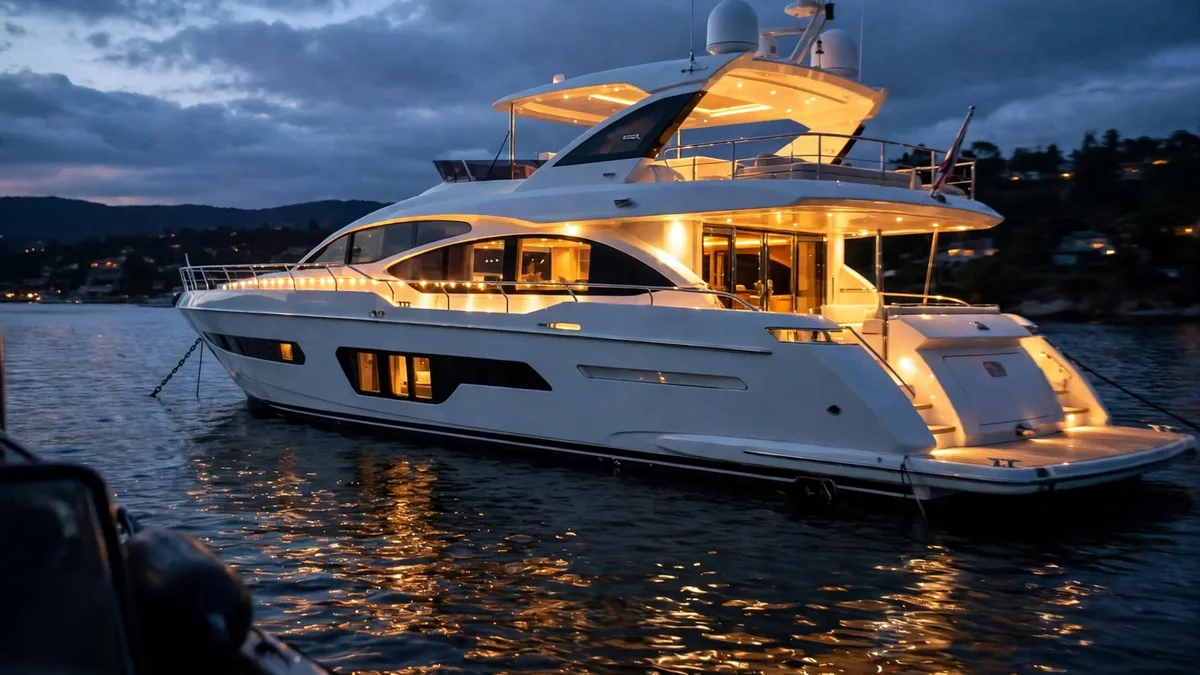
A superyacht at anchor after dark does not disappear into the night. It glows: warm light in the saloon windows, a soft wash along the hull, and underwater lamps turning the water around the stern pale green-blue, with fish circling in the glow.
That glow is engineered, not accidental. This is how a luxury yacht lighting system works, from the power that feeds it to the dimmers, colours and underwater lamps that turn a yacht into a landmark after sunset.
How It Works
Step 1: Power is generated and stored
Every light on a yacht starts with power, and on a large yacht that means generators. Diesel generators in the engine room make alternating current for the heavy loads, while battery banks store direct current for the quiet hours. The lighting system draws from both, switching between them without a flicker when the generators shut down for the night.
The power runs through a main switchboard, a panel of breakers and meters that divides it into circuits for each deck and each room. A lighting circuit that trips can be reset from the bridge, and a fault in one room never takes out the lights in another. The switchboard is the least glamorous part of the system and the one everything depends on.
Step 2: LED fixtures light the interior
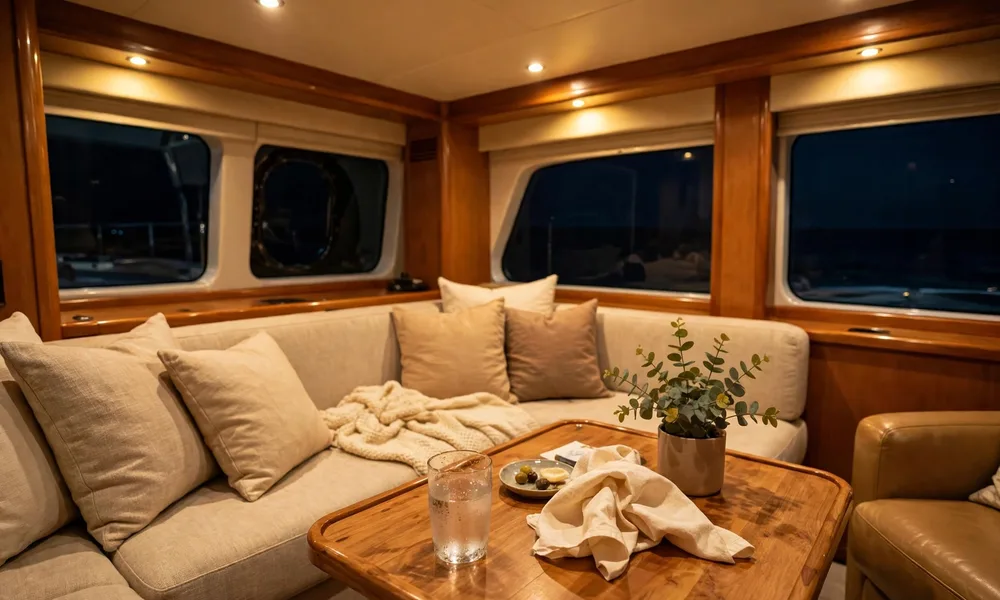
Inside, the work is done by LEDs, tiny light sources that use little power and last for years. They hide in ceiling coves, under shelves and behind mirrors, washing walls with warm light instead of shining into guests’ eyes. The colour is chosen carefully: warm white in cabins and the saloon, cooler white in the galley and engine room where the crew need to see detail.
Each fixture is dimmable, and many can change colour temperature through the day, brighter and cooler in the morning, warmer and lower in the evening. The fixtures are sealed against humidity, because a yacht is damp by nature, and they are fixed with screws that will not rust. A failed LED is swapped in minutes, with no tools beyond a small screwdriver.
Step 3: Scenes are programmed for every mood
The real magic is the scene system. One button by the door sets a whole room: bright for cleaning, low and warm for dinner, dark for a film. The scenes are programmed into a central controller, which talks to every dimmer in the room and fades them together over a few seconds, so the change feels gentle instead of sudden.
Guests can change the scene from a tablet or wall panel, and the crew can set the whole yacht from the bridge: anchor lights on, deck lights low, underwater lights glowing. The controller remembers the yacht’s usual rhythm, and it can run a schedule, dimming the corridors at midnight and bringing the galley up at dawn. Good lighting is never noticed; it simply feels right.
Step 4: Deck and navigation lights keep the yacht safe
Outside, the rules change. Navigation lights are required by law: red to port, green to starboard, white at the masthead and stern, each visible for miles and shielded so it can only be seen from its own side. Other vessels read those lights to know which way the yacht is heading, so they are wired to their own circuit and tested every evening before dark.
Deck lights are separate: bright floods that let the crew work safely on deck at night, and soft courtesy lights along steps and handrails that stop guests tripping. The deck lights are switched in zones, so the crew can light the working foredeck while leaving the guest sun deck dark and quiet. Every outdoor fitting is sealed against salt spray and hosed down with fresh water after a rough passage.
Step 5: Underwater lights glow beneath the hull
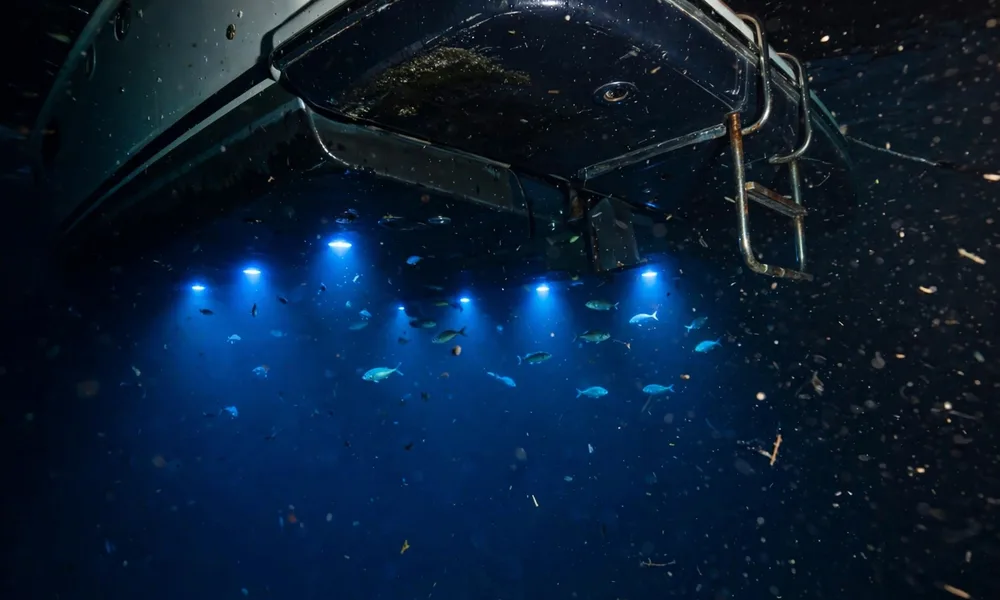
The most famous part of a yacht lighting system sits below the waterline. Underwater lights are sealed lamps set into the hull, shining down and out into the sea. They turn the water around the stern glowing green or blue, and at night they draw fish, squid and sometimes turtles to the light, giving guests a private aquarium off the swim platform.
Each lamp is a sealed unit of LEDs behind toughened glass, rated to keep seawater out at depth and to survive the pressure of the yacht moving at speed. They are wired through the hull with watertight glands, and run cool enough that a diver can touch one. The crew switch them on at dusk and off at bedtime, and they rinse the lenses when the yacht is hauled out, because growth on the glass dims the glow.
Step 6: Controls tie the whole yacht together
The last layer is control. Wall panels, tablets and the bridge talk to one controller, which talks to every dimmer, switch and lamp on the yacht. The system is wired in a ring, so a break in one cable does not kill the lights beyond it, and the controller logs every fault, flagging a dying lamp before a guest notices it.
When the yacht is left alone, the system runs a security routine, switching lights on and off in different rooms through the evening so the yacht looks occupied. And when the owner steps aboard, one button wakes the whole yacht: saloon warm, deck soft, underwater lights glowing, anchor light already burning at the masthead.
| Spec | Detail |
|---|---|
| Power | Diesel generators and battery banks feeding a main switchboard |
| Interior | Dimmable LEDs hidden in coves, warm in cabins and cool in the galley |
| Scenes | Programmed moods fading whole rooms together from one button |
| Deck | Legal navigation lights plus zoned floods and courtesy step lights |
| Underwater | Sealed LED lamps in the hull glowing green or blue beneath the stern |
| Control | One controller linking panels, tablets and bridge, wired in a ring |
The hardest part of a yacht lighting system is the salt. Every fitting lives in damp, salty air, and salt eats contacts, clouds lenses and corrodes screws, so the system is built from marine grade metals and sealed units, and the crew wipe the fittings after every passage. A light that works in a house will die in a season at sea.
What One Costs
A luxury yacht lighting system typically costs an estimated $30,000 to $250,000 installed, set mostly by the size of the yacht and the number of fixtures and scenes. A simple package for a modest yacht sits near the bottom, while a full superyacht system with underwater lights and whole yacht control costs far more. For the library it lights after dark, how a luxury yacht library is made follows the quietest room on board, and how a luxury yacht gym is made shows the brightest workout space at sea.
A Rare Fact
A yacht’s underwater lights can be seen by fish from hundreds of metres away, and the fish gather in the glow to feed on the plankton the light attracts. On a calm night at anchor, the crew can watch the food chain play out under the stern, from tiny shrimp to the larger fish hunting them, all lit like a stage.
A luxury yacht lighting system is power, LEDs, scenes and underwater lamps working together so the yacht feels warm inside and looks like a landmark outside. It lights the way on deck, sets the mood in the saloon, and turns the water around the stern into a glowing aquarium. For the sun deck it lights at dusk, the yacht sun deck specifications show the space where guests watch the sunset.


