The donor car arrives on a flatbed, ordinary and unremarkable, a long sedan fresh from the factory with the smell of new leather still in it. Within a week it will be unrecognisable. It will be cut in half, stretched by more than a metre, given a new roof, a new floor, a bar, a starlit ceiling, and a cabin quieter than a library. A luxury limousine is built to hide the work that went into it.
Stretching a car is one of the most demanding jobs in the automotive world. Cut a steel body in the wrong place and the car will flex, rattle, and eventually crack. Do it properly, and the result feels like it rolled off the production line that way, only longer, quieter, and far more comfortable. The builders who do this work are coachbuilders, a craft that predates the motor car itself, and the best of them treat a sedan the way a tailor treats a suit: measure twice, cut once, and finish everything by hand.

How a luxury limousine is made
Step 1: Choosing the donor car
Every stretch limousine begins life as a production car, usually a large luxury sedan chosen for its strong body structure, its quiet engine, and its long wheelbase. Builders look for a car with a stiff chassis, because the longer the car becomes, the more it wants to twist over bumps. The donor is stripped down before any cutting starts: the interior is removed, the fuel tank is drained, the wiring is labelled, and the glass is taken out and stored.
Step 2: Cutting and stretching the body
The cut is made through the middle of the car, usually behind the front seats and ahead of the rear axle, at a point chosen by the engineers. The two halves are pulled apart on the jig, and a new steel mid-section is fitted between them, built from box-section steel and sheet metal shaped to match the original body. The new section is welded in place, the welds are ground smooth, and the whole body is checked for straightness with lasers. This is the step that separates a proper coachbuilder from a shortcut job, and it is why the finished car drives like one car instead of two cars glued together.
Step 3: Reinforcing the chassis
A longer car needs a stronger spine. Builders weld in additional steel rails under the floor, reinforce the door pillars, and add cross-bracing that ties the front and rear of the car together. The suspension is upgraded with heavier springs and stronger dampers to carry the extra weight of the cabin, the passengers, and the equipment, and the brakes are often upgraded too, because a limousine can weigh a tonne more than the car it started as. Every reinforcement is hidden under the floor and behind the trim, so the passenger never sees a single weld. To understand what all that extra length does to the driving experience, see how a luxury limousine works on the road.
Step 4: Building the cabin
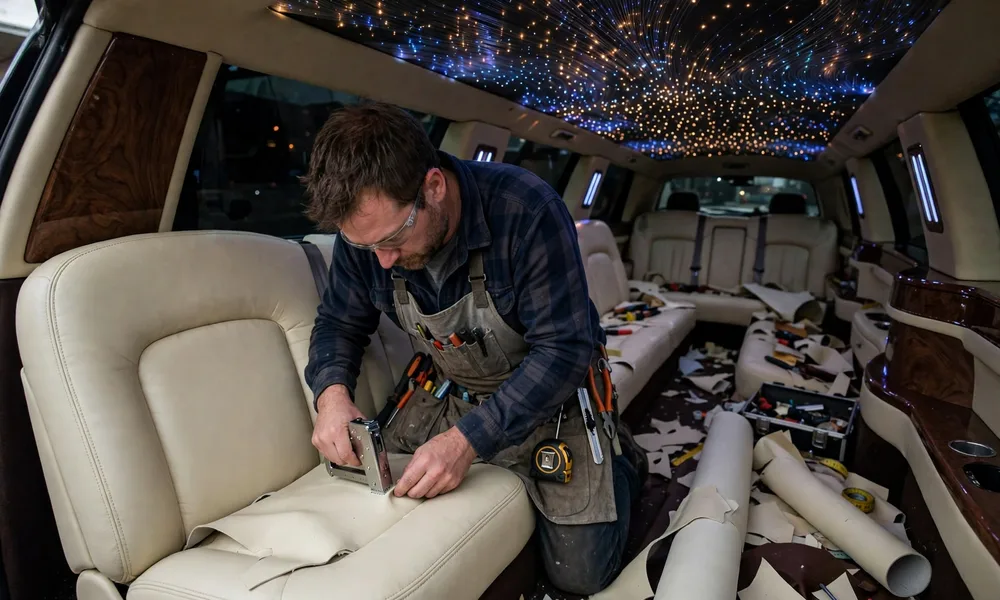
With the shell stretched and strengthened, the cabin is built like a small room. A partition goes in behind the driver, usually with a powered glass divider that slides down at the touch of a button. The rear cabin gets new seats, often two facing benches in soft leather, with heating, cooling, and massage functions wired into the car’s electrical system. The ceiling is lined in suede or Alcantara, and on many luxury builds it carries hundreds of tiny fibre-optic lights that mimic a night sky. A bar is fitted with crystal glassware in spring-loaded holders, a small refrigerator is plumbed into the floor, and the sound system is rebuilt with speakers hidden in the doors and the roof.
Step 5: Electrics, lighting, and entertainment
A luxury limousine carries a second electrical system almost as complex as the car’s own. A second battery and an upgraded alternator power the cabin lights, the screens, the refrigerator, and the sound system, and a control panel lets the passenger dim the lights, close the divider, and change the music without asking the driver. The wiring is routed through the new floor section in protective conduits, and every circuit is fused separately so a fault in the bar light cannot take out the door locks. Technicians test every switch, every screen, and every speaker before the trim goes on, because fixing a wire behind a finished leather panel is a job nobody wants.
Step 6: Paint, glass, and finishing
The stretched body is painted as one piece, usually in deep black or a dark metallic colour, with multiple coats and a final polish that takes a full day. The chrome trim is refitted, the badges are reapplied, and the car is detailed inside and out until the paint reflects like a mirror. A final road test follows, with the builder driving the car over rough roads and listening for the rattles and creaks that would betray a bad stretch. Only when the car is silent does it pass. The cost of all this hand work is part of what our guide to why a luxury limousine is so expensive breaks down.
Step 7: Inspection, certification, and delivery
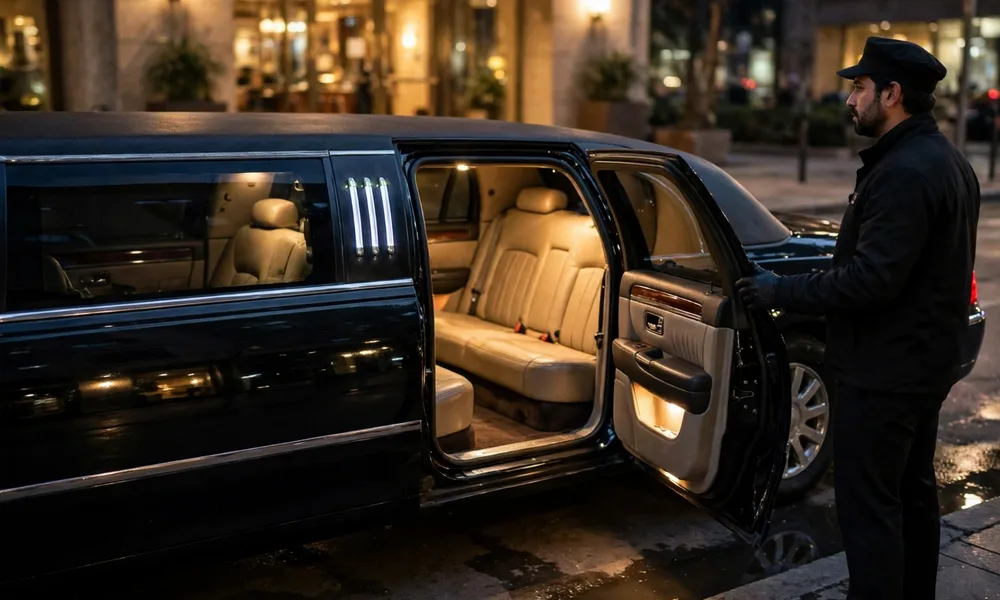
Before a limousine can carry passengers for hire, it must pass inspection and certification in its home market, which covers the structural work, the brakes, the seatbelts, and the emergency exits. The builder hands over a file of documents, photographs of the build, and the warranty, and the car is delivered to its owner, often a hotel, a hire company, or a private buyer. The first time the owner opens the rear door and the cabin lights come up, the cut, the welds, and the long days in the workshop are invisible, which is the whole achievement. The same obsession with hand finishing shows up in other corners of the luxury world, including the factory work described in our guide to how a luxury electric car is made.
Specifications
| Specification | Typical luxury stretch limousine |
|---|---|
| Donor car | Large luxury sedan |
| Stretch length | 120–150 cm |
| Overall length | 6.2–7.0 metres |
| Passenger capacity | 6–10 passengers |
| Engine | 3.0–5.0 litre V6 or V8, petrol or hybrid |
| Power | 300–450 horsepower |
| Cabin features | Bar, refrigerator, starlight ceiling, screens |
| Glass | Privacy glass, powered divider |
| Sound system | Multi-speaker, hidden installation |
| Build time | 6–12 weeks |
Price
A professionally built luxury stretch limousine typically costs an estimated $90,000 to $250,000, including the donor car and the coachbuilding work, with the most elaborate builds reaching beyond $300,000. That estimate covers the stretch, the cabin, and the electronics; chauffeur hire, insurance, and licensing are separate costs for the owner.
A rare fact
Some of the finest limousine builders keep a library of wooden bucks, full-size wooden forms shaped like the car’s body, that have been used for decades to shape replacement panels by hand. A single buck can outlive the model it was made for, and a craftsman can still beat a sheet of aluminium over it to make a perfect roof panel for a car that has not been in production for years.


