The car pulled up outside the hotel at midnight, and it kept coming: grille, bonnet, front door, another door, a second set of windows, more windows, until it finally ended near the next streetlight. The doorman opened a rear door and a passenger stepped out of what looked like a small lounge: soft light, a bar, facing seats, a screen on the wall. The car was longer than a city bus is wide, and it had turned a simple arrival into a ceremony. That is what a limousine is for.
A luxury limousine is a car taken apart and rebuilt by hand. It starts as a top-of-the-range sedan — a large saloon with a powerful engine and a quiet cabin — and a coachbuilder cuts it in half, stretches it, rebuilds the body, and fits an interior closer to a private jet than a car. Some are stretched for show, some for heads of state, and the armoured ones are built to survive things no car should ever survive. The price is in the hours: hundreds of them, by hand, on a car never built twice the same way.

What a limousine actually is
A limousine is a sedan stretched to carry more passengers in more comfort, usually by lengthening the wheelbase — the distance between the axles — by one to four metres. The extra length becomes a rear cabin with facing seats, a bar, screens, and space to sit and talk like a room rather than a car. The chauffeur sits in a separate front compartment, often behind glass, and the rear passengers travel in a silence no normal car can offer.
The stretch is only the beginning. Armoured limousines add ballistic steel, bulletproof glass, run-flat tyres and a reinforced floor, with engineering to carry the weight without ruining the ride. Presidential and royal cars go further: sealed cabins, independent air supplies, and communications that turn the car into a moving office. How a luxury limousine works is a story of a car rebuilt from the middle outwards, every centimetre by hand.
How a luxury limousine is made
Step 1 — A donor car is chosen. The coachbuilder starts with a new, top-specification sedan: a large car with a strong chassis, a powerful engine and a quiet cabin. The car is stripped of its interior and checked for straightness, because everything that follows depends on the starting point being perfect.
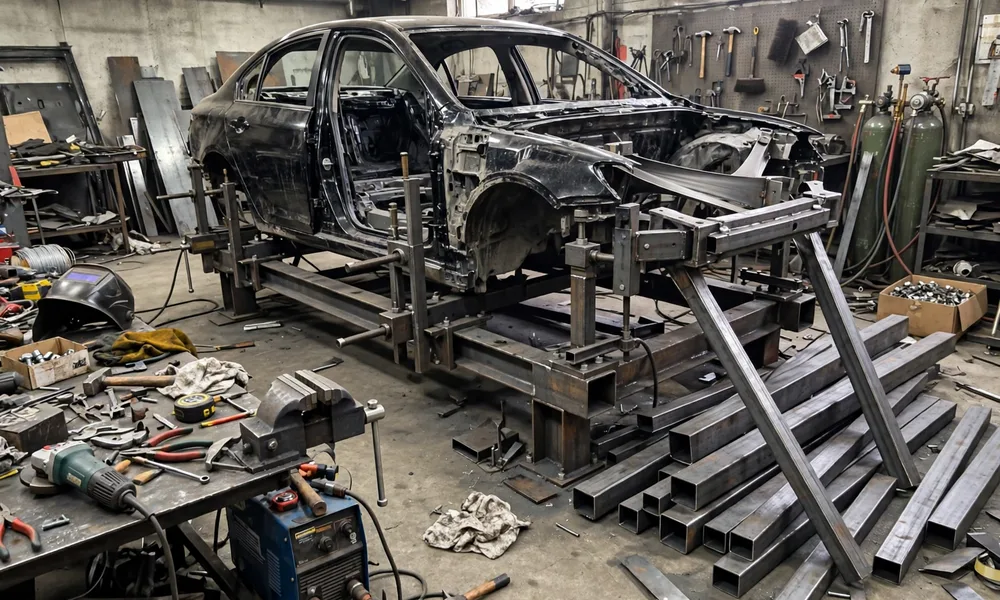
Step 2 — The car is cut in half. This is the moment that makes owners nervous. Body and chassis are cut across the middle, and the two halves are pulled apart on a jig to the length ordered. New steel sections are welded in to bridge the gap, and the frame is reinforced so the longer car is as stiff — or stiffer — than the original.
Step 3 — The body is rebuilt. New roof panels, doors, side panels and a lengthened driveshaft are fitted, and the car is checked for alignment down to the millimetre. A stretched car a fraction out of true will wear its tyres unevenly and pull to one side for life, so the jig work is the most skilled part of the build.
Step 4 — Armour goes in, if ordered. Armoured cars are built from the inside out: ballistic steel in the doors and floor, glass several centimetres thick, and suspension and brake upgrades to carry the extra tonne of protection. The weight changes everything — engine, cooling and tyres are all uprated to match.
Step 5 — The interior is fitted like a lounge. Leather, wood, carpet and metal are trimmed by hand. The rear cabin gets facing seats, a bar with crystal, screens, a sound system, reading lights and climate controls of its own. Wiring runs the length of the car for intercoms, lighting and entertainment, and every panel is fitted and refitted until the gaps are even.
Step 6 — Testing and certification. The finished car is tested on the road for ride, handling, noise and braking, and the stretch is inspected and certified by an engineer. Armoured cars are tested again for weight and braking, because a tonne of steel changes how a car stops. Only then is the car handed over — usually with a ceremony of its own.

The specification that drives the price
| Specification | Typical figure | What it means |
|---|---|---|
| Length overall | 6–10 metres | Stretched by one to four metres |
| Wheelbase | 4–6 metres | The extra length lives here |
| Engine | V8 or V12, 400–600 hp | Power to move the extra weight |
| Passengers | 6–10 in the rear cabin | A lounge, not a back seat |
| Armour level | Up to B7 standard | Stops rifle fire; adds a tonne |
| 0–60 mph | 5–7 seconds | Quick, despite the weight |
| Build time | 3–6 months | Mostly hand work, by a small team |
| Weight | 3–5 tonnes | Twice a normal large sedan |
The figure that surprises people most is the weight. A stretched, armoured limousine can weigh twice as much as the sedan it started as, and every part — engine, brakes, suspension, tyres — must be rebuilt to cope. The second surprise is the build time: three to six months for a car a factory builds in a day. That is the difference between a car made by a production line and one made by a dozen people with hand tools.
What it costs
A stretched luxury limousine typically costs an estimated $150,000 to $500,000, depending on the donor car, the stretch length and the interior standard. A modest stretch of a large sedan with a good interior sits near the lower end; a long, fully fitted car with a bar, screens and a partition reaches the middle. Armoured versions cost far more — an estimated $500,000 to $1.5 million — because the protection alone can cost more than the car. Running costs are high too: heavy cars eat tyres and brakes, and the hand-built interior needs a specialist. The price of a luxury supercar buys speed; a limousine’s price buys space, silence and ceremony — and the knowledge that no other car on the road is quite like it.
A rare fact
The longest limousine ever built is more than thirty metres long — longer than a blue whale — with twenty-six wheels, a swimming pool with a diving board, a helipad and a waterbed. Built in California in the 1980s, it is so long that it bends in the middle to get around corners. It is not a car anyone would buy for a wedding, but it proves the point: once you stretch a car, the only limits are imagination and money. The luxury limousine spec sheet reads modestly beside it, but every number — wheelbase, weight, build time — records a car cut in half and rebuilt by hand, and that is rare enough on its own.
A luxury limousine is not the fastest, most practical or most sensible car. It is a car taken apart and put back together longer, quieter and more private than it was born, by people who measure their work in millimetres and months. The price is high because the work is slow, the car is unique, and the arrival matters. A limousine does not take you somewhere. It announces you.


