On a family driveway in the suburbs, a minivan waits with its sliding door open and a child seat already strapped into the second row. From the outside it looks sensible, even plain, and that is exactly the point. Nobody stares at a luxury minivan. Everybody who rides in one remembers it.
The luxury minivan is a quiet contradiction: a vehicle built for school runs and airport trips, finished to the standard of a first-class cabin. This is how a luxury minivan is made, from a stamped steel floor to the first family holiday.
Step 1: The body shell is stamped and welded
Everything begins in the press shop, where flat sheets of steel are stamped into a floor pan, side panels, a roof and doors. The floor of a minivan is almost flat from front to back, which is what makes the cabin so roomy, but that flat floor has to be strong enough to protect the passengers in a crash, so the steel is thicker under the seats and around the door openings.
Robots weld the panels together on a line, hundreds of spot welds in a few minutes, and then the shell is dipped in a rust-proofing bath before it is painted. The result is a shell that feels solid when the door closes, with a soft thud instead of a metallic clang.
Step 2: The engine and hybrid system are fitted
Under the bonnet, most luxury minivans now carry a petrol engine paired with an electric motor, a hybrid system that lets the big box of a vehicle pull away silently and sip fuel in town. The engine and the electric motor are lowered into the shell as one unit, bolted to the subframe, and connected to the cooling system, the fuel lines and the wiring loom in a single careful sequence.
The battery pack sits low, usually under the floor between the axles, which keeps the centre of gravity down and leaves the cabin floor flat. The hybrid system is tested before the interior goes in: the engine is started, the motor is spun up, and the computers that decide when to use petrol and when to use electricity are checked against their programming.
Step 3: The sliding doors and tailgate are hung
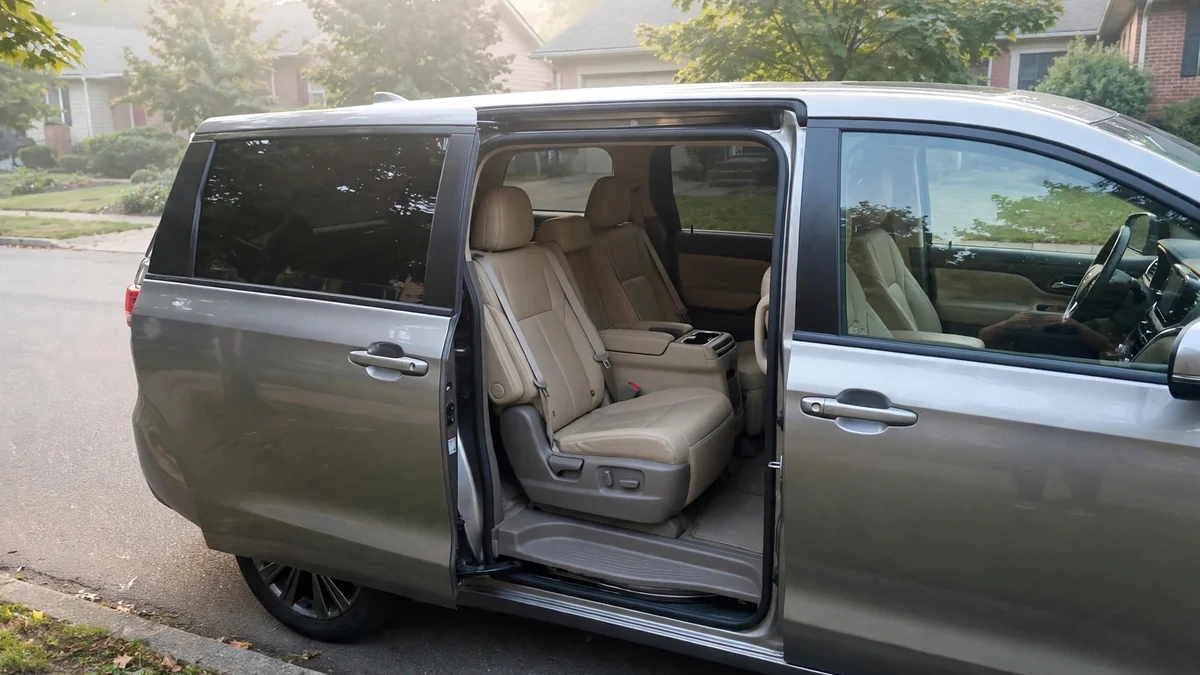
The sliding doors are the defining feature of a minivan, and hanging them is a job that demands patience. Each door runs on a track hidden in the bodywork, guided by rollers top and bottom, and powered by a small motor that must open the door smoothly whether the vehicle is parked on flat ground or on a slope.
The fitters adjust the door until the gaps around it are even to the millimetre, because an uneven gap whistles at speed and lets rain in. The power tailgate gets the same treatment, with a motor that lifts the heavy rear door and sensors that stop it if a hand or a head is in the way.
Step 4: The cabin is trimmed like a lounge
Once the doors are hung, the trimmers move in, and this is where the luxury minivan stops being a people carrier and starts being a lounge. The seats are the heart of it: thickly padded, covered in quilted leather, with heating, ventilation and, in the second row, ottoman-style leg rests that fold out like a business-class seat. Each seat is bolted to rails in the floor so it can slide, recline or fold flat into the floor when cargo takes priority.
The dashboard and the door panels are trimmed in soft-touch materials, with real wood or brushed metal inlays instead of hard plastic. The headliner is a soft suede-like cloth, the carpets are thick, and the glass roof is fitted with a blind that closes at the touch of a button. The screens and speakers are fitted at the same time, and the cabin is checked for squeaks by driving the half-finished vehicle over a rumble strip, because a rattle found now is cheap and a rattle found by the owner is not.

Step 5: Electronics, screens and safety systems are installed
A modern luxury minivan carries more computing power than the first spacecraft, and most of it is invisible. Cameras watch the road ahead, the blind spots and the cabin itself, while radar sensors track the traffic around the vehicle. The wiring that connects them runs in looms behind the trim, and each sensor is calibrated after fitting, because a camera that is a degree out of line will misjudge the distance to the car in front.
The infotainment hardware fitted here follows the same craft as the systems described in the guide to how luxury car infotainment is made, built as one integrated unit rather than a collection of gadgets.
Step 6: Testing, tuning and the first family drive
Before delivery, every minivan is driven. A test driver takes it through town traffic, onto the motorway and over rough roads, listening for wind noise, checking that the sliding doors stay silent, and feeling for any vibration through the steering wheel. The hybrid system is tested in stop-start traffic, where it does most of its work, and the brakes are checked for a smooth, even stop with a full load of test weights in the seats.
The final inspection happens under bright lights. Every panel gap is measured, every screen is switched on, every seat is folded and unfolded, and the paint is checked for flaws that only show at an angle. The hand-built bodywork and paint on the most exclusive cars follow the same patient routine described in the guide to how a luxury sports car is made, and the minivan gets the same standard, even though it will spend its life carrying children rather than turning heads.
The spec sheet at a glance
| Specification | Typical luxury figure |
|---|---|
| Length | 5.1 to 5.3 metres |
| Seats | Seven, in three rows |
| Engine | 2.5 litre hybrid petrol, four-cylinder |
| Power | 240 to 300 horsepower combined |
| Gearbox | Electronically controlled continuously variable |
| Fuel economy | 6 to 7 litres per 100 kilometres combined |
| Boot space | 500 to 900 litres behind the third row |
| Sliding doors | Power operated, both sides, foot sensor |
| Screens | Front touchscreen plus rear seatback screens |
| Seats | Quilted leather, heated and ventilated, ottoman second row |
| Safety | Cameras, radar, blind-spot and cabin monitoring |
| Build time | One to two days on the line, plus trim and testing |

What it costs, and a rare fact
A luxury minivan costs an estimated $60,000 to $110,000, depending on the trim, the hybrid system and the rear-seat equipment, with chauffeur-spec examples costing more. The full equipment list is laid out in the luxury minivan spec sheet, from the hybrid drivetrain to the rear entertainment system.
Here is the rare fact the brochure never mentions. The sliding doors on a luxury minivan are tested by opening and closing them more than one hundred thousand times on a rig before the design is approved, which is roughly thirty years of school runs, and the test rig counts every cycle. The door that survives that test is the one that still glides silently on the day the youngest child finally learns to open it alone.